
HKU Today
Dr Eric X Li at HKU: China’s Strategic Future Runs Through Eurasia and the Global South, Not Only the Pacific
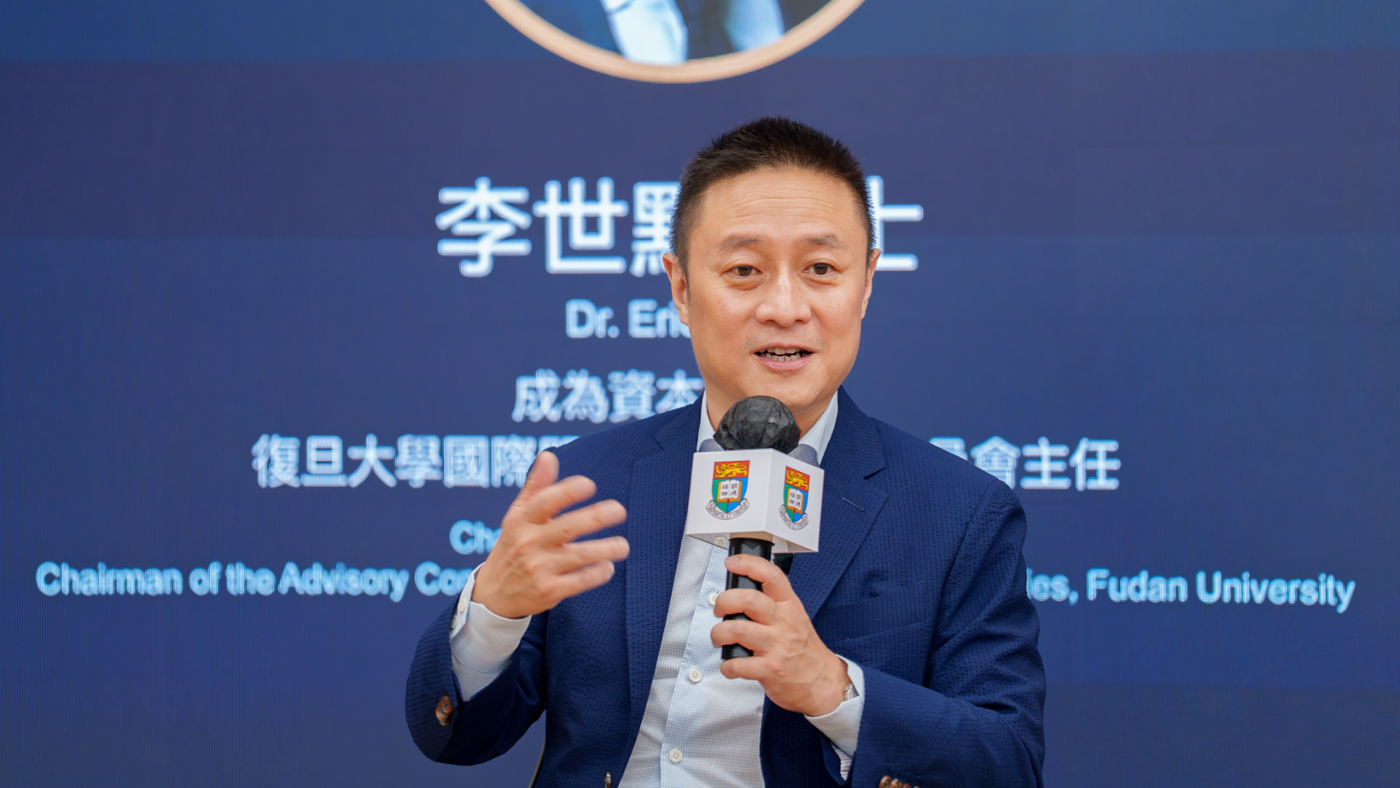
The Pacific is becoming China’s frontline, not its strategic centre, investor and political scientist Dr Eric X. Li argued at HKU – urging China to look more deliberately towards Eurasia and the Global South as technological rivalry reshapes the global order.
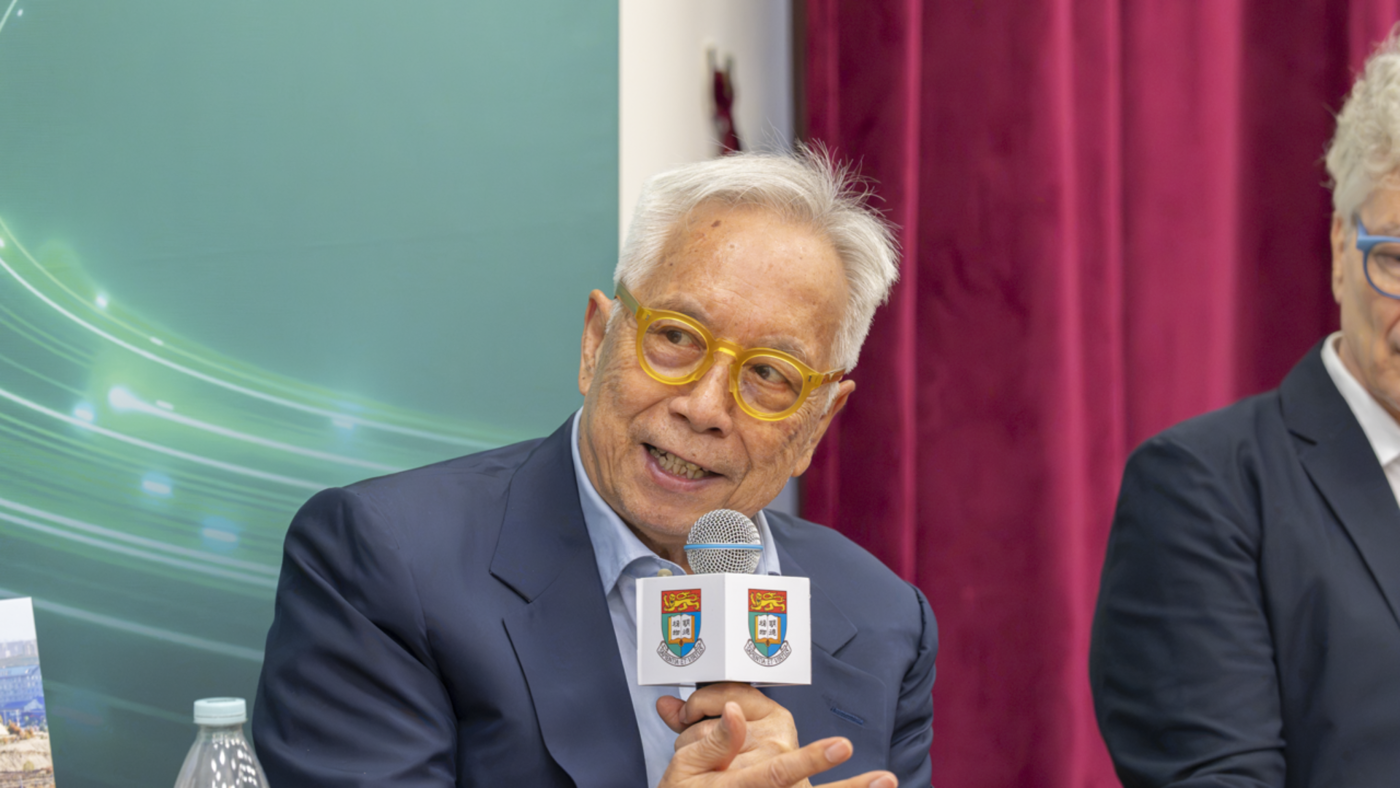
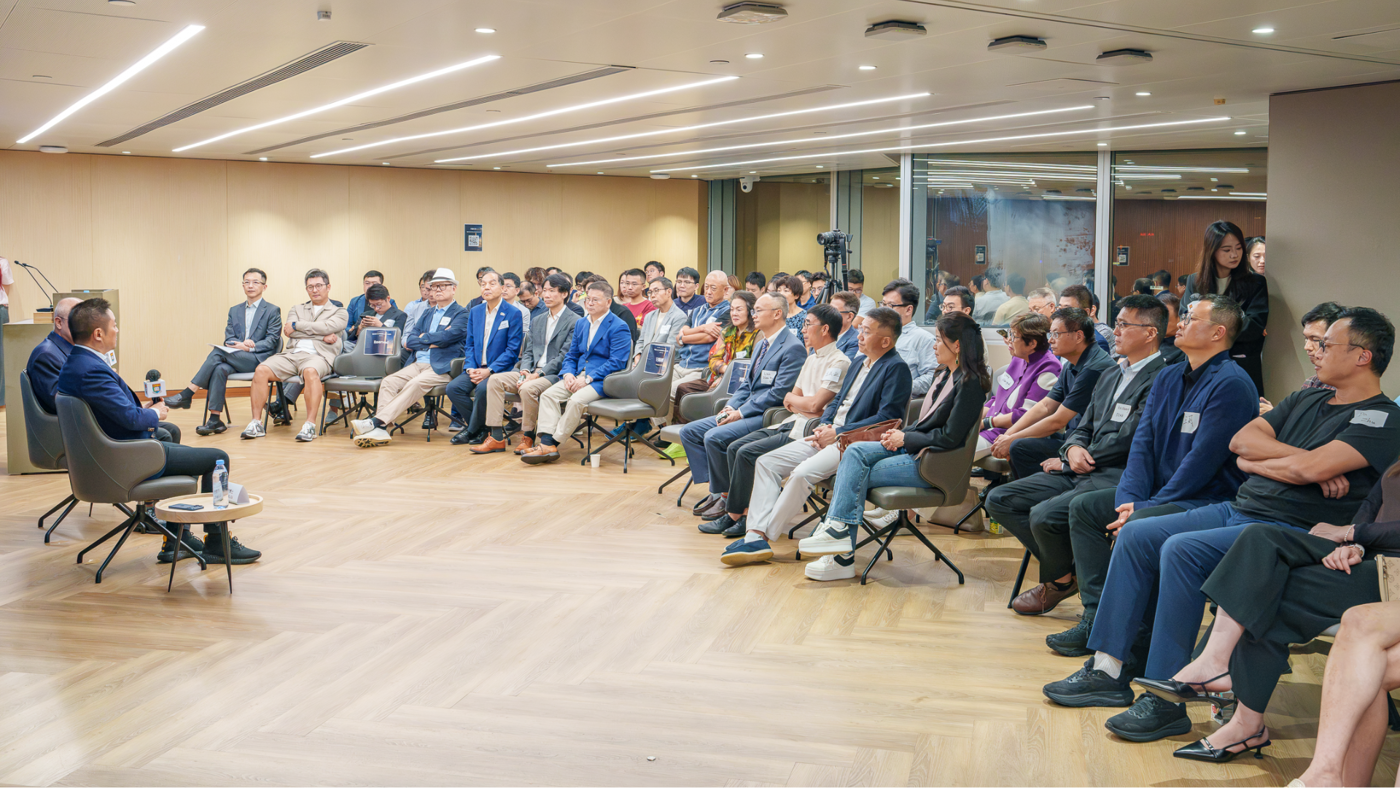
“When China has grown to its present scale, the Pacific is increasingly a frontline rather than a space capable of bearing China’s strategic centre,” Dr Li said. In a dialogue co-organised by HKU’s Communications and Public Affairs Office and Blue Ocean Salon, he used Washington’s “small yard, high fence” approach to technology policy as the starting point for a wider argument about power, technology and global links.
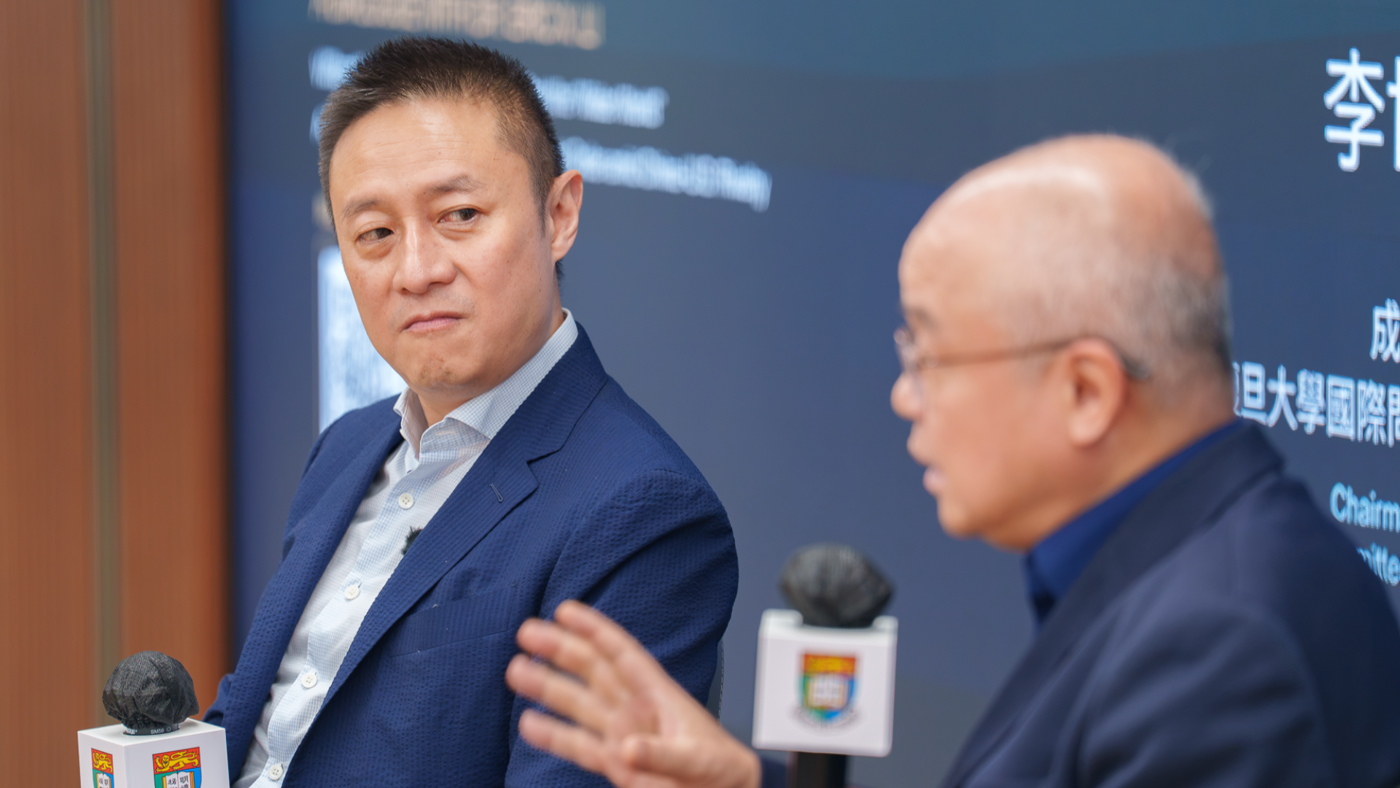
Speaking with Professor Yang Wang, HKU Vice-President (Institutional Advancement) and Chair Professor of Mathematics, Computing and Data Science, Dr Li argued that an Atlantic-centred world order is giving way to a multipolar reality in which continental resources, industrial production and connectivity will shape global power.
As chairman and managing partner of Chengwei Capital and chairman of the Advisory Committee of Fudan University’s China Institute, Dr Li suggested that China’s most consequential pathway now runs across the Eurasian landmass — through Russia and Central Asia — and outwards to the wider Global South.
Dr Li’s organising claim comes into sharper focus: US technology controls will not halt China’s industrial ascent, but will instead redirect its technological and manufacturing output towards markets in Southeast Asia, Latin America, and Africa. This shift, Dr Li argued, demands that China — including its international hubs like Hong Kong — evolve beyond traditional Anglophone alliances to build deep, structural ties across a much larger, more fragmented world.
From Atlanticism to a Continental Strategic Space
Dr Li contrasted the post-Cold War “Atlanticist” architecture — centred on US and Western European alliances — with the shifting realities of the Pacific, which he now views as a theatre of friction rather than a welcoming engine for growth. To secure its strategic future, Dr Li argued, China must pivot towards Eurasia, a vast continental space spanning China, Southeast Asia, Russia, and Central Asia. This region, he noted, holds the critical energy resources, agricultural capacity, and industrial mass needed to anchor China’s next phase of global engagement, while establishing crucial connections to three major oceans.
When Professor Wang asked whether this Eurasian strategic pivot could be likened to the classic strategy of “surrounding the cities from the countryside” (以农村包围城市), Dr Li cautioned against viewing it merely as a geographic circumvention tactic.
“It is not simply about bypassing or surrounding anyone,” Dr Li clarified. Instead, he framed it as a stark reality of hard-power competition. A nation’s strategic room to manoeuvre, he argued, will be determined strictly by technology, finance, industrial capacity, and food security, rather than rhetoric or ideological alliances.
Professor Wang then challenged the viability of placing Russia at the core of this strategic map, questioning the country’s resilience amid mounting economic pressure and political uncertainty. In response, Dr Li argued that the Sino-Russian alignment is driven by irreversible geopolitical realities. He emphasised that Russia’s relationship with the West has undergone a structural rupture since the war in Ukraine. Because returning to the previous status quo is highly unlikely in the coming decades, Russia effectively has no choice but to collaborate more substantially with China, making this continental partnership a lasting foundation of China’s Eurasian strategy.
Given this permanent geopolitical shift, Dr Li urged the next generation of Chinese youth to step outside their familiar Anglophone comfort zones. “Young people should go to Russia and Central Asia,” Dr Li advised, emphasising that mastering the languages, histories, and economies of these continental neighbours will be more vital to China’s future than relying solely on traditional Western ties.
Manufacturing Power and the Purpose of the Fence
Dr Li framed the current technological confrontation as a direct result of China’s economic evolution since joining the World Trade Organization. While Chinese firms once primarily assembled imported technologies, they have rapidly ascended the value chain to compete directly in advanced sectors like robotics and biotechnology. Professor Wang reinforced this shift, pointing out that China is no longer just catching up; it is now leading the world in electric vehicle exports and making massive strides in frontier fields like innovative drugs.
As China’s capabilities have expanded, Dr Li noted, the United States has constructed its “high fence” to protect its historical advantages in computing, semiconductors, and military-relevant innovation. In Dr Li’s view, the controls that keep these more capable technologies inside a protected “yard” are also deliberately designed to limit the global market reach of Chinese technologies.
Professor Wang offered a historical perspective to contextualise the friction over intellectual property. He observed that Washington’s current accusations against China — alleging technology theft, copying, and imitation — mirror the exact charges Great Britain levied against the United States during the 19th century. During the dawn of its own industrialisation, the US aggressively acquired British talent, learned its processes, and replicated its machine designs to accelerate domestic development. This historical parallel demonstrates that global technology diffusion rarely conforms to the moral narratives established by incumbent powers.
Dr Li agreed, emphasising that Washington’s restrictions serve as a delay tactic rather than a permanent barrier. “We will not accept it. We have to keep moving upwards,” he stated, treating the controls as a catalyst for domestic innovation.
Applying this logic to the semiconductor industry, Dr Li acknowledged the current US lead in advanced chips and computing capacity, but argued that stringent export controls and investment restrictions are inadvertently accelerating China’s drive for self-sufficiency. Rather than halting progress, the pressure is forcing Chinese firms to aggressively invest in their own fabrication, equipment, design tools, and talent, while inevitably redirecting their market focus towards the Global South.
AI, Open Models and the Global South
Dr Li acknowledged the current US advantage in computing resources and advanced chips, but argued that China is highly competitive in open-source models and real-world application scenarios.
Professor Wang, a renowned mathematician widely respected in Hong Kong for his insights into Web3, AI governance, and the societal impacts of emerging technologies, expanded on this by highlighting a critical physical constraint: energy. As AI’s power demands skyrocket, Wang noted that China’s rapid expansion of electricity generation and renewable energy infrastructure could provide a decisive advantage for massive AI deployment. While acknowledging that leading US models remain superior at certain highly specialised frontier tasks, Wang emphasised that the true measure of success will be translating these models into affordable, reliable tools for education, healthcare, manufacturing, and public services.
For Dr Li, the contest is not merely about who builds the best closed frontier model, but who can deliver useful technology at a scale and price the rest of the world can adopt.
“China does not want a bipolar world,” Dr Li stated. Instead, he envisions Chinese technology firms driving an “open-source” or “open-weight” AI ecosystem that dramatically lowers the barrier to entry, offering nations in Southeast Asia, Latin America, and Africa a viable alternative to expensive Western platforms.
When the discussion turned to the prospects of US–China cooperation on AI safety, Dr Li expressed profound pessimism, noting that mutual trust is too thin to support any meaningful near-term agreement.
Wang agreed that immediate collaboration is unlikely, but took a longer, more pragmatic view. Drawing a historical parallel to the Cold War pressure that forced Washington and Moscow to negotiate nuclear limits, Wang suggested that what ultimately brings both sides to the table will not be goodwill, but a shared existential threat.
“AI, too, poses a threat to survival,” Wang explained. “What may bring the sides to the table is a ‘near catastrophe — not one that causes a devastating catastrophe for humanity, but one that makes clear how close it came to one.” A grave AI near-miss, he argued, could make the cost of failing to manage this shared risk undeniable, creating a narrow but necessary opening for US–China cooperation on global AI governance.
From TED Talk to a Contest of Strength
Professor Wang noted that he first became familiar with Dr Li’s work through his breakthrough 2013 TED Talk, where Dr Li famously argued for the adaptability of China’s political system while challenging the universal claims of capitalist, multiparty democracy. That early critique laid the groundwork for a much deeper theoretical exchange during this dialogue regarding how the world evaluates political success.
Expanding on arguments he published in The Economist in 2021, Dr Li cautioned against conflating “liberalism” and “democracy”. While liberal systems prioritise individual rights, he noted that pure democratic mechanisms (like simple majority rule) can actually threaten those rights if a majority decides to disenfranchise a minority. Professor Wang expanded on this tension by pointing to the historical architecture of the US system itself. He noted that the framers of American democracy deliberately embedded liberal elements — such as the Bill of Rights and institutional checks and balances — precisely to curb the unchecked “power” of pure democracy and protect individual liberties from the tyranny of the majority. However, Wang observed that this proliferation of veto points has now made the path for public will to enter the policy system increasingly convoluted.
Professor Wang further reinforced this empirical approach by introducing a rigorous mathematical critique of modern political narratives. Invoking Arrow’s Impossibility Theorem, Wang pointed out that it is mathematically impossible to perfectly aggregate the diverse, multi-dimensional preferences of a society into a single, coherent “will of the people” without violating basic conditions of fairness. Wang sharply criticised the prevalent geopolitical tendency of “dimensionality collapsing” — the habit of compressing a nation’s immense complexity (its economy, history, education, and public welfare) into a simplistic, single-axis metric of “democratic versus authoritarian”. While this reduction makes for easy ideological rhetoric, Wang argued, it fundamentally shuts down nuanced analysis.
This shared scepticism of Western ideological frameworks highlights a stark shift in Dr Li’s strategic outlook since his 2013 TED Talk. In 2013, Dr Li made a direct, persuasive case to an international audience; today, he doubts that persuasion can bridge the divide.
When asked by an audience member if China’s growing technological weight could translate into greater influence in international communication, Dr Li was notably blunt.
“That TED Talk was 13 years ago. There is no point asking me to give it now; it would be a waste of time,” he confided. He now believes that no amount of forceful explanation can alter entrenched Western assumptions.
“Nothing works. I speak and they do not believe me; they speak and I do not believe them. It will only be a contest of strength now,” Dr Li concluded. Moving forward, he argued that it is raw hard power — productive capacity, technological supremacy, and strategic endurance — that will ultimately dictate which global narratives carry weight.
A Task for Hong Kong
The final part of the exchange brought this sweeping geopolitical argument home to Hong Kong. Dr Li challenged the city to rethink its traditional identity, suggesting that its historical brand of internationalism has been too narrowly “Anglophone” and deeply tied to traditional Western markets. As the world becomes definitively multipolar, Dr Li urged Hong Kong to radically expand its scope, cultivating deeper ties with Brazil, the Middle East, Russia, Central Asia, Africa, and Southeast Asia. He emphasised that this is not a rejection of Hong Kong’s world-class legal, monetary, and financial frameworks, but rather an urgent call to deploy those strengths across a much wider and more diverse global theatre.
Professor Wang embraced this vision, explicitly positioning the University of Hong Kong (HKU) as a vital catalyst for this broader, more grounded paradigm of internationalisation. In a fractured world, universities play an indispensable role in building the bridges that political rhetoric can no longer maintain. Wang emphasised that HKU is uniquely equipped to spearhead this transition — not only by educating a new generation of youth to deeply understand the histories and economies of these emerging regions, but by acting as a premier intellectual hub to foster cross-border research, technological cooperation, talent cultivation, and robust public dialogue.
For the HKU audience, the dialogue’s Eurasian proposition forces a concrete, lingering question: as technology controls harden and strategic competition intensifies, where will those commercial links, standard-setting, and global talent flow? As both speakers made abundantly clear, the answers for China’s future — and for Hong Kong’s continued prosperity — will no longer be found on just one side of the Pacific.
Related Topics
Related News