
People
From London to Kowloon, Art to Computer Science
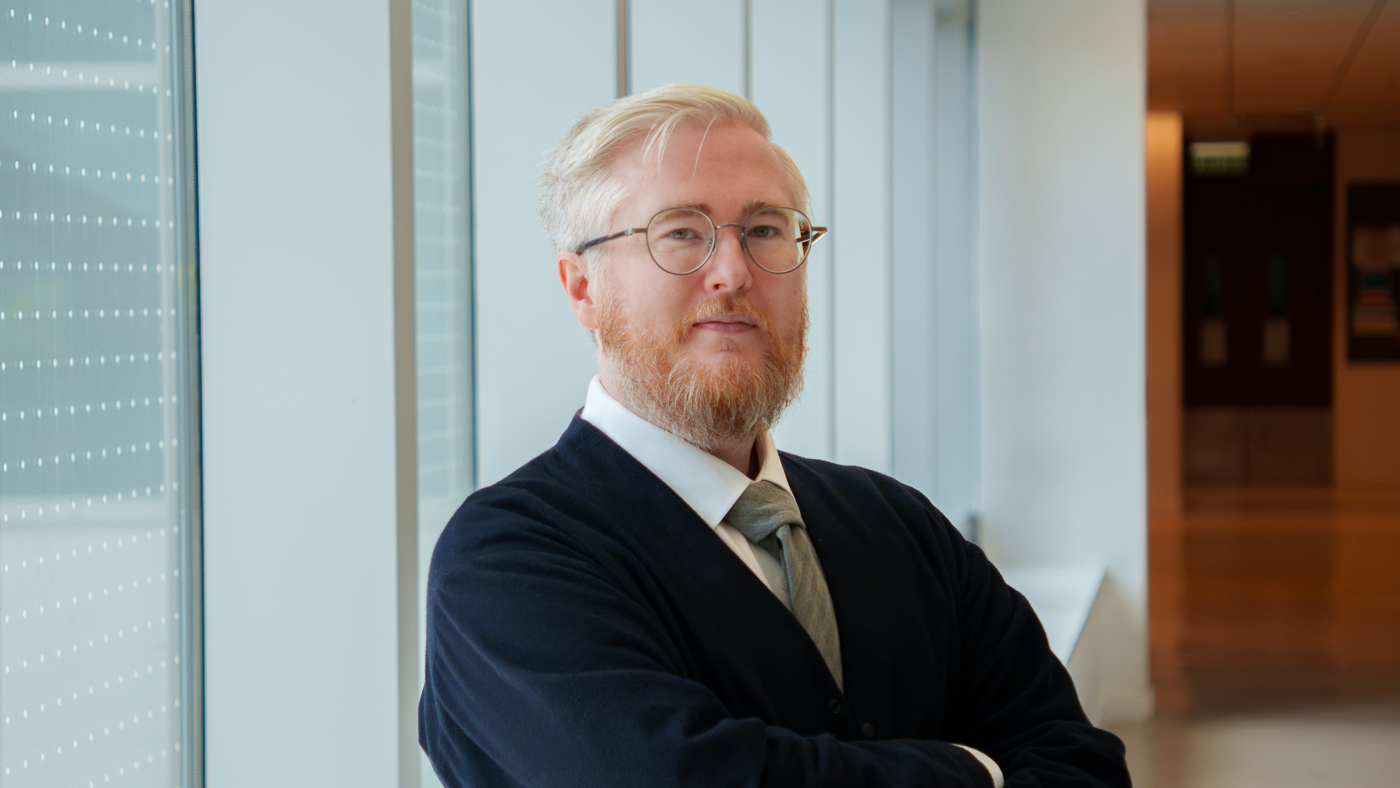
Dr Alan William Dougherty’s journey into computer science began far from the engineering laboratory.
Growing up in London, he was equally interested in mathematics, science fiction and the arts. He first pursued fine art, studying photography, video and mixed media, with a particular interest in abstract photography.
Years later, he moved to Hong Kong for his PhD and quickly developed an affection for the city. A fan of Wong Kar-wai’s films, he even chose Chungking Mansions as his first Hong Kong home. Today, the Assistant Director of HKU’s School of Computing and Data Science’s master’s programme describes himself fondly as both “a London boy and a Kowloon boy.”
Science through an artist’s eyes
Although Dr Dougherty eventually decided that a professional career in art was not right for him, the experience continues to shape his work. Abstract photography encouraged him to crawl under bridges, explore unusual spaces and photograph subjects from unexpected angles.
“I learned how to think differently,” he says. “I couldn’t apply my artistic skills directly to engineering, but I could approach problems from different perspectives.”
His aptitude for mathematics and science meant he was able to pivot into electronic engineering, robotics, machine learning and computer vision. At King’s College London, Dr Dougherty studied robotics and machine learning at a time when artificial intelligence was far less fashionable.
“AI was an ugly term then,” he recalls. “We called it pattern recognition or machine learning.”
Many classmates pursued telecommunications, and some warned him that machine learning was “going nowhere”. He followed his curiosity nonetheless. That decision eventually led to work spanning edge-AI compiler design, autonomous vehicles, human emotion classification, medical robotics and efficient human-pose estimation. Across these fields, one question has remained constant: “What is the outcome? What is the purpose of it?”
Conversational teaching
That focus on purpose also transformed his approach to education. Ten years ago, Dr Dougherty would have chosen research over teaching; today, he says he prefers teaching “100%”.
“I used to think teaching was just talking at people,” Dr Dougherty says. “Now, even if I am teaching hundreds of students, I feel I am having a conversation with them.” His favourite moment comes after class, when students remain behind to discuss the subject — not simply the homework.
His most formative teaching experience came while volunteering with secondary students with special educational needs. He describes his first three mathematics lessons as “a complete disaster”. Initially, he tried to deliver content quickly without understanding why the students were struggling. Only after sitting down with them did he discover that one student did not know how to use a calculator.
After some patient guidance, however, the student became more willing to engage. “The second I sat down and had a conversation with them, I understood,” he recalls. “Sometimes you can break through the shell by having a human interaction.”
Foundations for an uncertain future
These lessons informed the design of HKU Shanghai 2026 × Future Forum, an eight-day immersive programme for secondary students navigating the AI era held over the summer.
Rather than treating participants as passive listeners, the programme invited them to learn through conversation, experimentation, and purposeful creation.
Students engaged with HKU professors, scientists, entrepreneurs and industry mentors; explored laboratories and innovation enterprises; and visited the COMAC C919 project. Working in teams, they identified sustainability challenges, developed prototypes, considered business models and branding, and presented their ideas at a mini innovation expo.
For Dr Dougherty, the programme is not about asking teenagers to decide their careers immediately. It is about giving them the confidence and tools to explore.
His own journey — from art to engineering, London to Kowloon, and research to education — demonstrates that lives rarely follow straight lines.
“As long as you keep very good fundamentals, you can apply them to any field,” he says. He hopes students can combine those foundations with curiosity, creativity and human connection — preparing not only to understand emerging technology, but to shape its future.
Related Topics
Related News