
Newsroom
HKU and BNU Astrophysicists Use Wave Simulations to Open a New Window on Dark Matter
Astrophysicists from The University of Hong Kong (HKU), working with a research team led by Beijing Normal University (BNU), have developed a more physically realistic approach to testing how ultralight, or “fuzzy”, dark matter could influence gravitationally lensed images. The study is the first to make gravitational-lensing predictions directly from three-dimensional wave simulations of fuzzy dark matter. The simulations reproduce the observed image positions of a well-studied lensed quasar more closely than commonly used modelling approaches, highlighting the potential of high-resolution gravitational-lensing observations to probe the nature of dark matter. The findings of this research study have been published in The Astrophysical Journal Letters.
For nearly a century, physicists have grappled with the mystery of dark matter, a substance thought to comprise 85% of all matter in the Universe. Despite its prevalence, it does not emit, absorb or reflect light and is detected through its gravitational effects. Dark matter is also absent from the Standard Model of particle physics, our currently accepted framework for describing the fundamental particles and three of the four fundamental forces of the Universe, a framework that underpins much of modern technology.
Over the past decade, growing astronomical evidence has raised the possibility that dark matter may consist of ultralight particles. Owing to their extremely low masses, these particles can behave collectively like waves, producing complex interference patterns similar to those formed when waves meet on a beach. Such patterns could leave traces in multiple images of galaxies, which arise when the gravity of a massive object bends and distorts light from a more distant source, as predicted by Einstein's theory of gravity.
In the quest to unravel the mystery of dark matter, the research team, including Professor Jeremy Lim and Dr Amruth Alfred from HKU’s Department of Physics and The Hong Kong Institute of Astronomy and Astrophysics (HKIAA), made predictions for the properties of gravitationally lensed images if galaxies are indeed composed of ultralight dark matter. This is the first time such predictions have been made using direct computer simulations to accurately capture the wave-like mass patterns produced by interactions between ultralight particles. The simulations reproduced the observed positions of the lensed images more closely than the comparison models used in the study. The results suggest that gravitationally lensed systems could provide a way to test ultralight-dark-matter models. The researchers are now investigating other effects, including changes in the brightness of gravitationally lensed images.
The project grew out of research visits by the HKU researchers to BNU, where they collaborated closely with members of Professor Zong-Hong Zhu’s group, Dr Zhengxiang Li and PhD student Jiajun Zhou, the lead author of the study. "We were very excited to see what the simulations predicted as we did not know beforehand what observable signatures to expect. Jiajun worked very hard to rapidly get out these remarkable results and we believe this has opened entirely new avenues for future research on the nature of Dark Matter using lensing."
These visits were supported by multiple research grants and awards and helped lay the groundwork for the collaboration. The recent inauguration of HKIAA at HKU has set the stage for closer collaboration with colleagues in the Chinese Mainland and will open the doors to further cutting-edge astrophysics research.
For details of the research, please refer to the journal paper “Gravitational Lensing Predictions from Wave Simulations of Fuzzy Dark Matter”; DOI: 10.3847/2041-8213/ae9a9e
Media Enquiries:
Faculty of Science, The University of Hong Kong
Tel: +852 3917 5286
Email: cindycst@hku.hk
Image download and caption: https://www.scifac.hku.hk/press
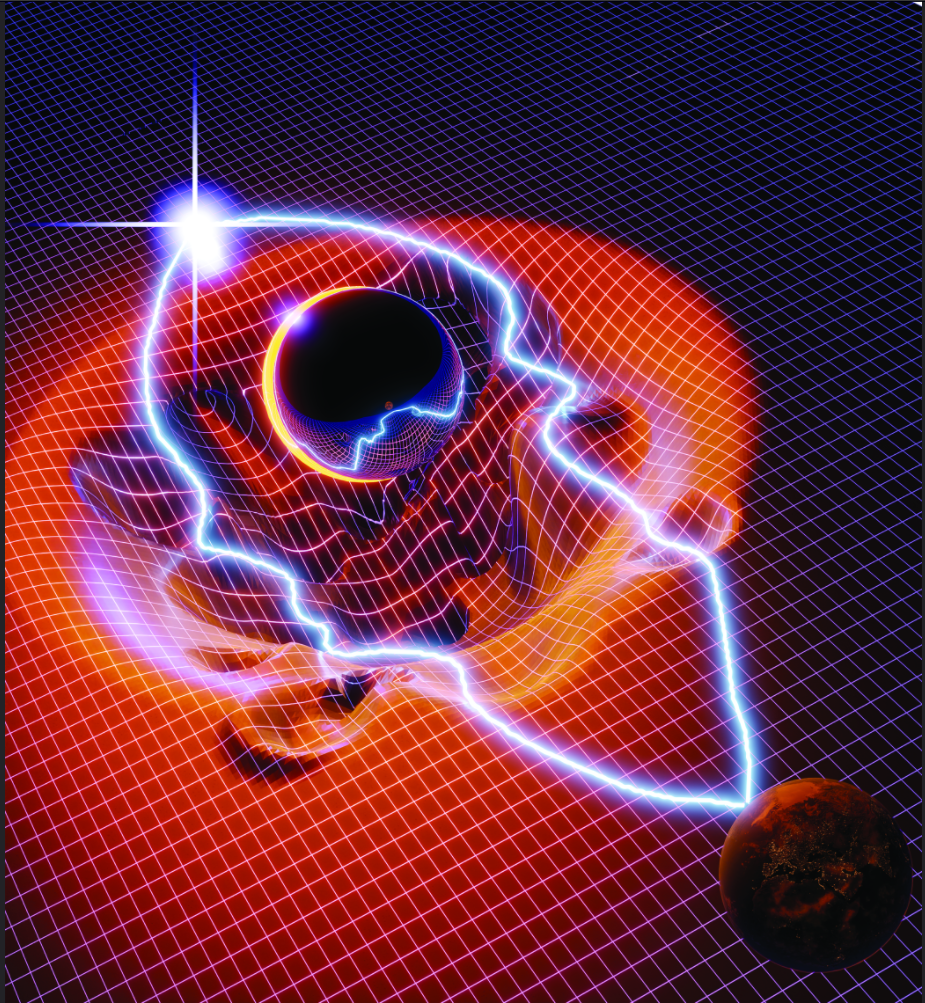
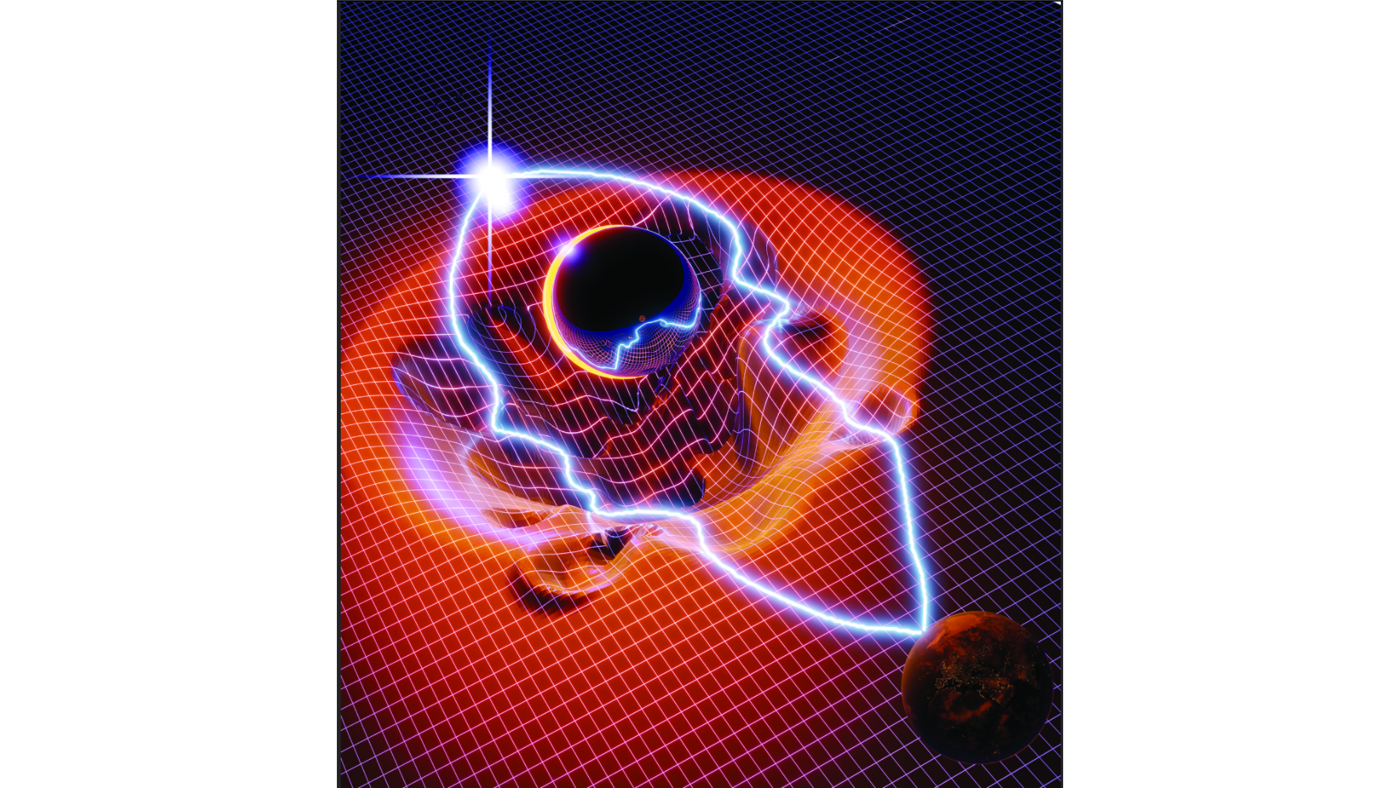
Figure 1. Artist’s impression illustrating how wave-like density patterns produced by ultralight dark matter could warp space and alter the path of light from a distant source. As the light travels past the lensing object on its way to Earth, it follows a distorted path shaped by the surrounding mass distribution. The reflective sphere symbolises the still-unknown nature of dark matter. The image was created using 3D computer graphics software. (Photo courtesy: Amruth Alfred)
Related Topics
Related News