
Newsroom
HKU researchers develop blockchain-inspired Gungnir codec for long-term DNA data storage
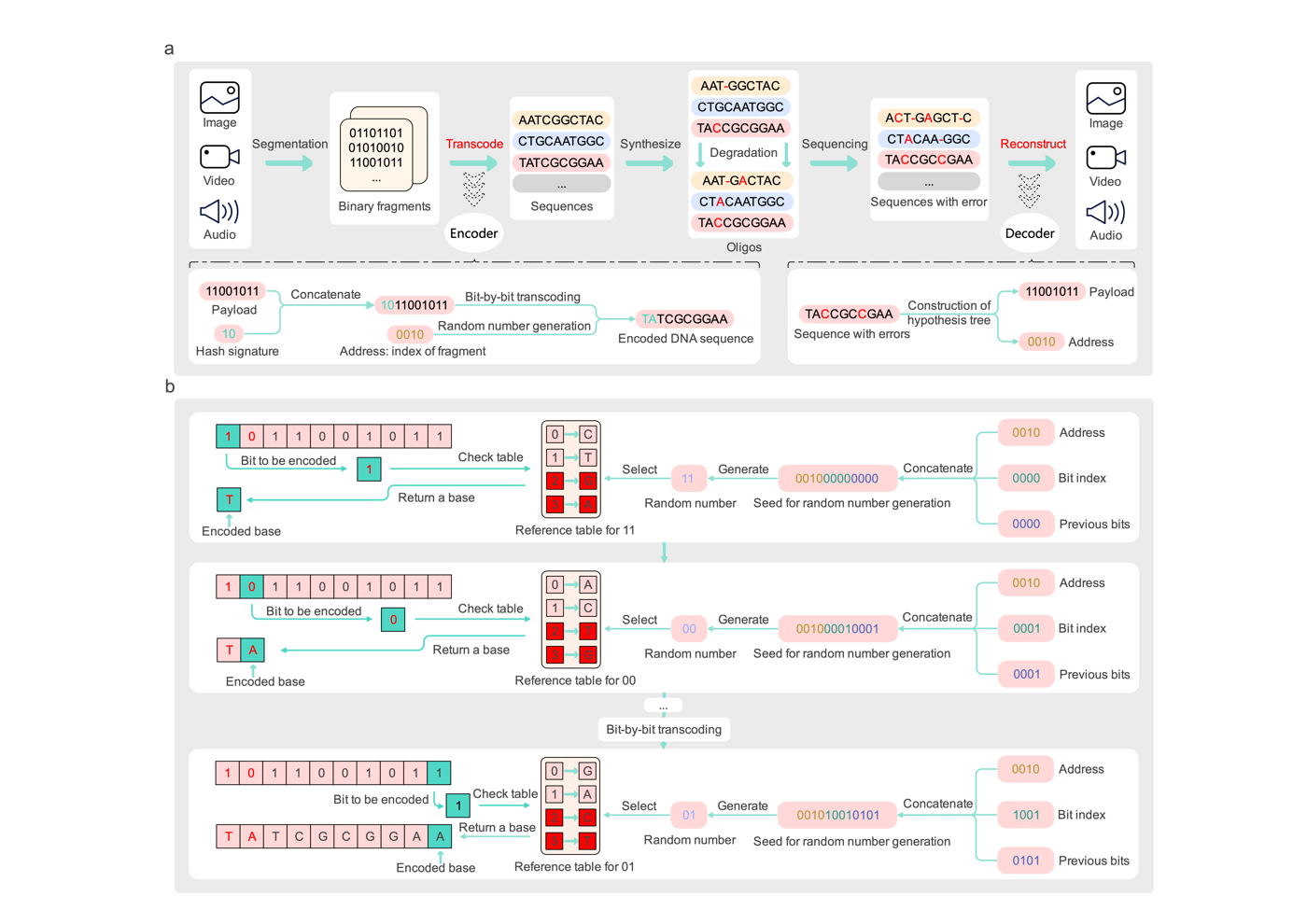
A research team at the Faculty of Engineering of The University of Hong Kong (HKU), led by Professor Ruibang Luo from the School of Computing and Data Science and Professor Can Li from the Department of Electrical and Computer Engineering, has developed Gungnir, a novel blockchain-inspired DNA data storage codec. The breakthrough framework significantly improves digital information recovery from severely damaged DNA sequences, extending the practical lifespan of DNA data archives from under a decade to centuries.
DNA is a promising medium for long-term archival storage. It can hold vast amounts of information in a very small physical volume, remain stable for millennia under suitable conditions, and require no energy during storage. However, as storage duration increases, DNA molecules can gradually degrade and accumulate damage, making the original files increasingly difficult to recover. Existing codecs work best with newly synthesised DNA. They are less effective at correcting the errors that build up as DNA is damaged during long-term storage.
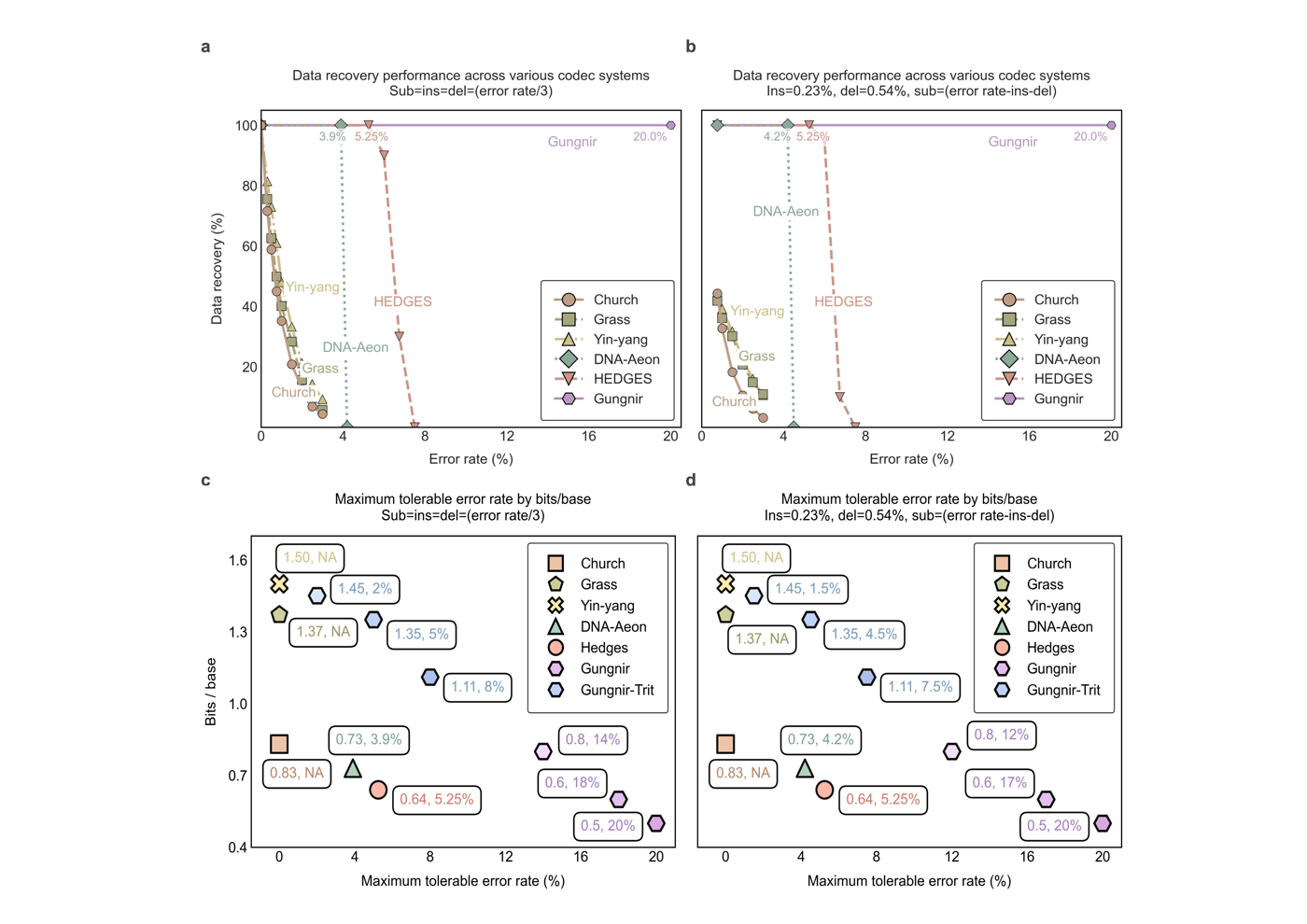
Gungnir introduces a new approach for error correction by applying blockchain-based computing techniques to DNA data storage. It uses substantial computing power to generate possible reconstructions of the original data and verify them until the correct information is identified. In other words, greater computing power gives Gungnir stronger error correction capabilities. The design enables a DNA drive to tolerate error rates of up to 20%, representing a fourfold improvement over existing methods.
This technique makes it possible to recover data even from heavily damaged DNA. In extreme testing, Gungnir achieved lossless data recovery from DNA with damage levels expected after around 400 years of archival storage. This could extend the practical lifespan of a DNA drive from less than a decade to several centuries. As computing power continues to grow, Gungnir’s performance could improve accordingly. This could make it possible to preserve digital information in DNA for millennia.
The research has been published in Nature Communications, titled “Gungnir codec enabling high error-tolerance and low-redundancy DNA storage through substantial computing power”.
Read the publication: https://www.nature.com/articles/s41467-026-71485-x
Gungnir is open source and available at https://github.com/HKU-BAL/Gungnir .
About Professor Ruibang Luo
Professor Ruibang Luo is an Associate Professor of the School of Computing and Data Science at the University of Hong Kong. He is also the Assistant Director (Learning Experience & Student Enrichment) and Associate Head of AI & Data Science Division. He completed his PhD training in Bioinformatics with Professor Tak-Wah Lam at the University of Hong Kong (2010-2015), and his postdoctoral training with Professor Steven Salzberg and Professor Michael Schatz at the Center of Computational Biology, Johns Hopkins University (2016-2017).
Professor Luo is a researcher working on bioinformatics algorithms and clinical informatics. He published more than 100 papers, with ten achieving over a thousand citations. He has been identified as Top 1% Scholars Worldwide by Clarivate Analytics since 2019, selected by Baidu Research as Worldwide Top 150 Chinese Young Scholars in AI, named Top 10 Innovators Under 35 Asia Pacific by MIT Technology Review in 2019, and recognised as 30 Under 30 Asia in Healthcare and Science by Forbes in 2017.
About Professor Can Li
Professor Can Li is an Associate Professor in the Department of Electrical and Computer Engineering at HKU. He is also the Associate Director of the Centre for Advanced Semiconductors and Integrated Circuits (CASIC) and the Programme Director of the BEng in Electronic Engineering. Before joining HKU, he worked at Hewlett Packard Labs in California. He received his bachelor’s and master's degree from Peking University and his PhD from the University of Massachusetts Amherst.
Professor Li is a researcher working on AI hardware, neuromorphic computing, non-volatile memory and emerging nanoelectronic devices, including memristors. His work has been cited more than 13,000 times. He was named a Clarivate Highly Cited Researcher in 2025 and has been identified as Top 1% Scholars Worldwide by Clarivate Analytics since 2022. His honors also include the NSFC Excellent Young Scientists Fund (Hong Kong and Macau), the Hong Kong Research Grants Council Early Career Award and the Croucher Tak Wah Mak Innovation Award.
Media Enquiries:
Faculty of Engineering, HKU
Ms Christina Chung (Tel: 3910 3324; Email: chungmc@hku.hk)
Ms Natalie Yuen (Tel: 3917 1924; Email: natyuen@hku.hk)
School of Computing and Data Science (email: cdsnews@hku.hk)
Related Topics
Related News