
HKU Around the World
‘AI & Humans’ Conference Brings Researchers to Bali to Examine the Social Impact of Tech

Researchers from Hong Kong, the Chinese mainland, Indonesia, and beyond gathered in mid-August at the Tsinghua University Southeast Asia Center in Bali, Indonesia, for “AI & Humans — Shaping the Future,” a two-day international academic conference co-organised by HKU and Tsinghua on the relationship between artificial intelligence and human development.
Led by the AI, Society & Social Dynamics strategic research theme (SRT) at HKU, as well as the University’s Departments of Psychology and Geography, the conference brought together scholars working across disciplines such as AI, cognitive and psychological science, education, computational social science, and geography.
Sessions examined human-centred AI for mental wellness, education, psychological interventions in the age of AI, AI’s role in neuroscience and mental health, the future of the educational and university systems and its impact on the environment and perceived social mobility.
Speakers from HKU included Professor Cecilia Cheng, Professor Xiaoqing Hu, Professor Charlene Lam, Professor Benjamin Becker, Professor Shelley Xiuli Tong, Professor Yuyu Zhou, Professor Hongsheng Zhang, and Professor Zhansheng Chen, head of the Department of Psychology.
Leading researchers and government officials from Indonesia also took part, including Professor Stella Christie, Deputy Minister of Higher Education, Science, and Technology of Indonesia, and Professor Dicky C Pelupessy, Dean of the Faculty of Psychology at Universitas Indonesia, leading discussions on how local institutions are tackling challenges related to AI in education, technology, and human flourishing.
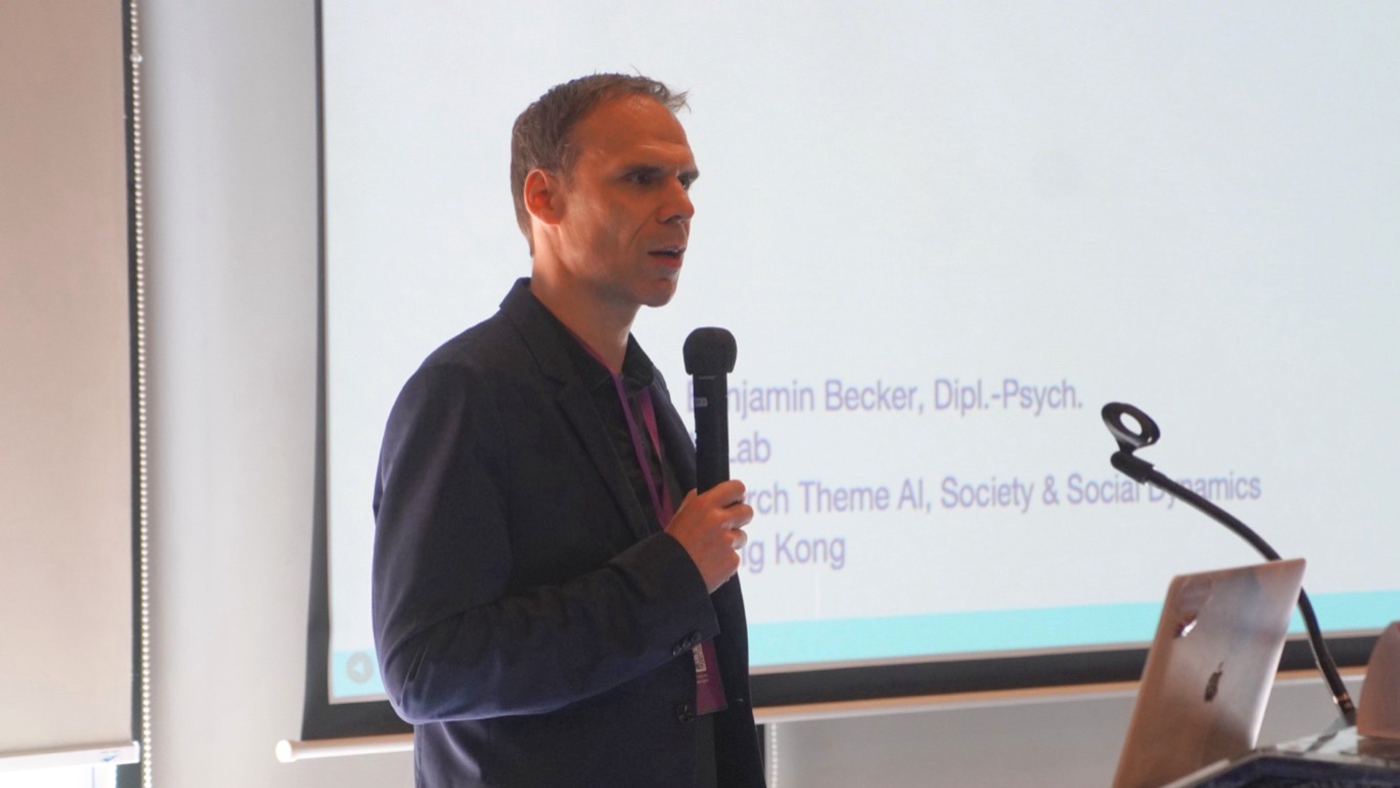
The programme was co-chaired by Professor Dan Zhang of Tsinghua University and Professor Becker of HKU.
The interdisciplinary nature of “AI & Humans” reflects the approach of HKU’s AI, Society, & Social Dynamics SRT, which is co-led by Professor Becker of the Department of Psychology, Professor Zhou of the Department of Geography, and Professor Duoduo Xu of the Department of Sociology.
It also grew out of a longstanding collaboration with researchers from Tsinghua, allowing the teams to capitalize on support from two leading universities.
“We’ve been working with Tsinghua on topics related to AI, the brain and mental health for years,” says Professor Becker. “But I think both sides realised that things are developing so fast that we need to get out of the lab and start setting the tracks for how the technology will impact humans and our society.”
Professor Zhang of Tsinghua University, co-chair of the conference, also highlighted the close relationship between psychology and AI: “AI is not only becoming a powerful tool for psychological research, but also an important subject of psychological inquiry. By bringing together the complementary strengths of Tsinghua and HKU, we hope to deepen the interaction between AI and psychological science and advance more human-centred innovation.”
In addition to keynote lectures, the conference also featured a student research forum that highlighted emerging work at the boundary of computational modelling, psychology, neuroscience, and applied AI.
“In the future, we hope to expand joint research and teaching initiatives between Tsinghua and HKU, perhaps as a weeklong summer programme for students and a forum to promote evidence-based AI policy-making,” says Professor Becker. “As for the conference, it has underscored the rapid impact that AI will have on individuals and society, and that this development requires evidence-based guidance that cuts across traditional disciplines and borders to promote human-centred AI”.

Related Topics
Related News