
Research & Discovery
Is AI Coming For Your Job? The Answer Is Messier Than You Might Think.
When every team can use artificial intelligence to produce a polished proposal, how do we decide whose ideas deserve backing?
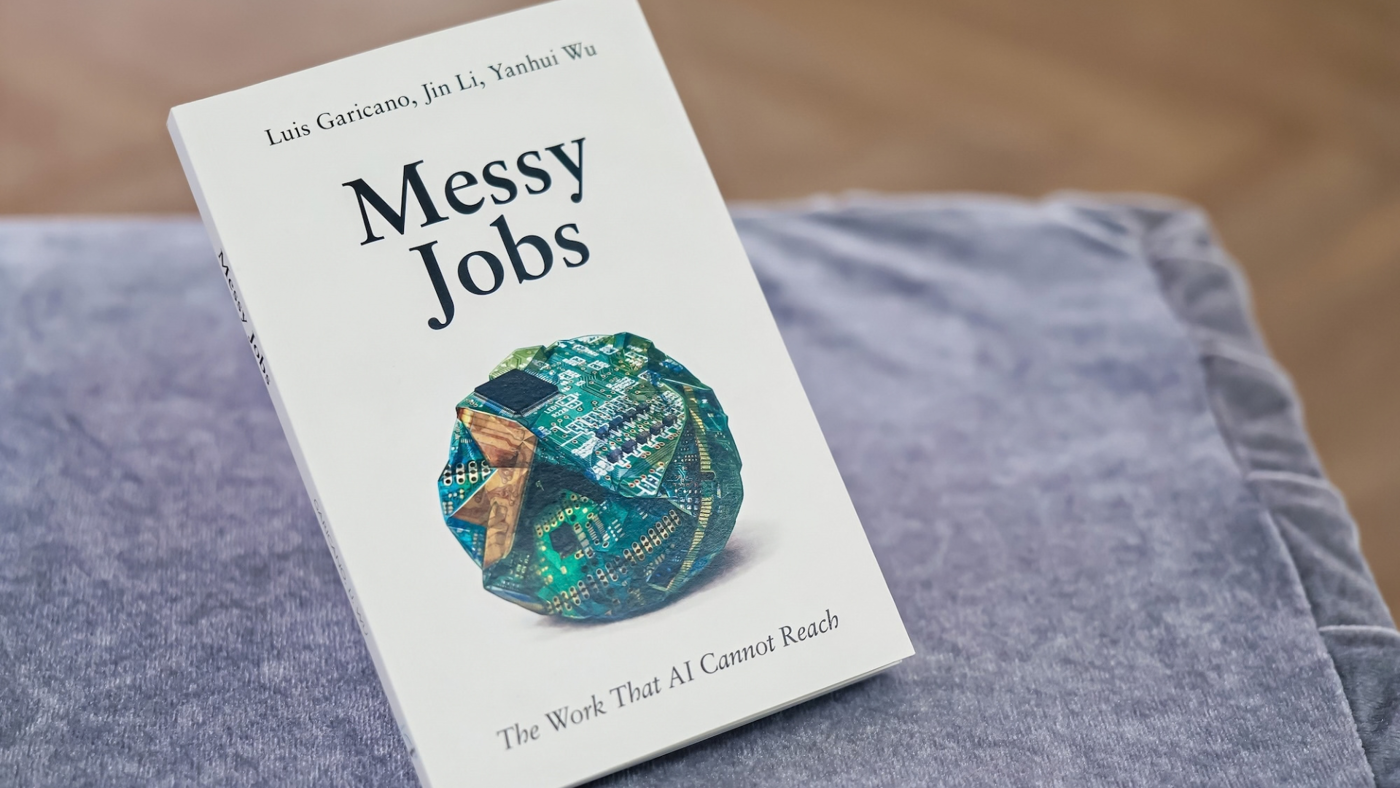
That question sits at the centre of “Will A.I. Still Take Our Jobs?”, a 2 October essay by Joshua Rothman in The New Yorker. The article draws heavily from “Messy Jobs: The Work That AI Cannot Reach”, a new book by London School of Economics Professor Luis Garicano and HKU Business School Professors Jin Li and Yanhui Wu, to argue that the technology may complicate rather than settle a familiar workplace test: how organisations recognise good judgement.
“If every team can generate better AI-based analysis to support their arguments,” the authors write in the book, “the demand for conflict resolution and authority-based decisions will increase dramatically.” As Rothman observes, many workplace choices involve more than evaluating the written case. They also involve deciding “who gets their way” — a question shaped by experience, tacit knowledge, relationships, and responsibility.
Published by Upriver Press, “Messy Jobs” challenges the simple view that all jobs will disappear as AI performs more individual tasks. Its central claim is that jobs are bundles. Some are “weak bundles”, where routine tasks can be removed with little cost to the rest of the role. Others are “strong bundles”, in which research, interpretation, coordination and accountability are so interdependent that separating one element damages the whole.
That distinction has implications for how workers are assessed. Rothman highlights the authors’ “90/10 production function”: AI can make getting a good-enough result much quicker, yet the final stretch towards excellence may remain hard to see from the output alone. “How do you distinguish workers who pushed to 98 percent from those who stopped at 91 percent?” the authors ask. “The surface looks identical.”
The New Yorker isn’t the only outlet talking about “Messy Jobs”. In a June article in The Atlantic, Rogé Karma used its weak- and strong-bundle framework to examine why automation may change jobs differently, depending on whether their technical and relational elements can be separated. An August City Journal review called the book’s contribution “less a forecast than a framework”, while raising a further question: even if an occupation survives, how will AI’s gains be distributed among people working within it?
For Professor Li — Zhang Yonghong Professor in Economics and Strategy, Director of HKU’s Centre for AI, Management and Organization (CAMO), and Area Head of Management and Strategy — the subject connects with his research on organisations, incentives and trust. Professor Wu, Professor of Economics and of Management and Strategy, researches organisational economics, digital platforms, media economics and AI.
CAMO examines how AI changes organisations, management practices and the nature of work.
The book’s companion website, messyjobs.ai, expands on its framework through an authors’ preface and a three-part guide to jobs at risk, sources of human value and the institutional redesign required when work becomes a human–AI bundle. Its opening example makes the point plainly: information may be abundant, but getting people to accept a decision and carry it through is another kind of work.
For managers and graduates alike, that may be the book’s most practical proposition. The question is not only what AI can do. It is whether organisations can recognise, develop and reward the human judgement needed when no prompt can settle the matter.
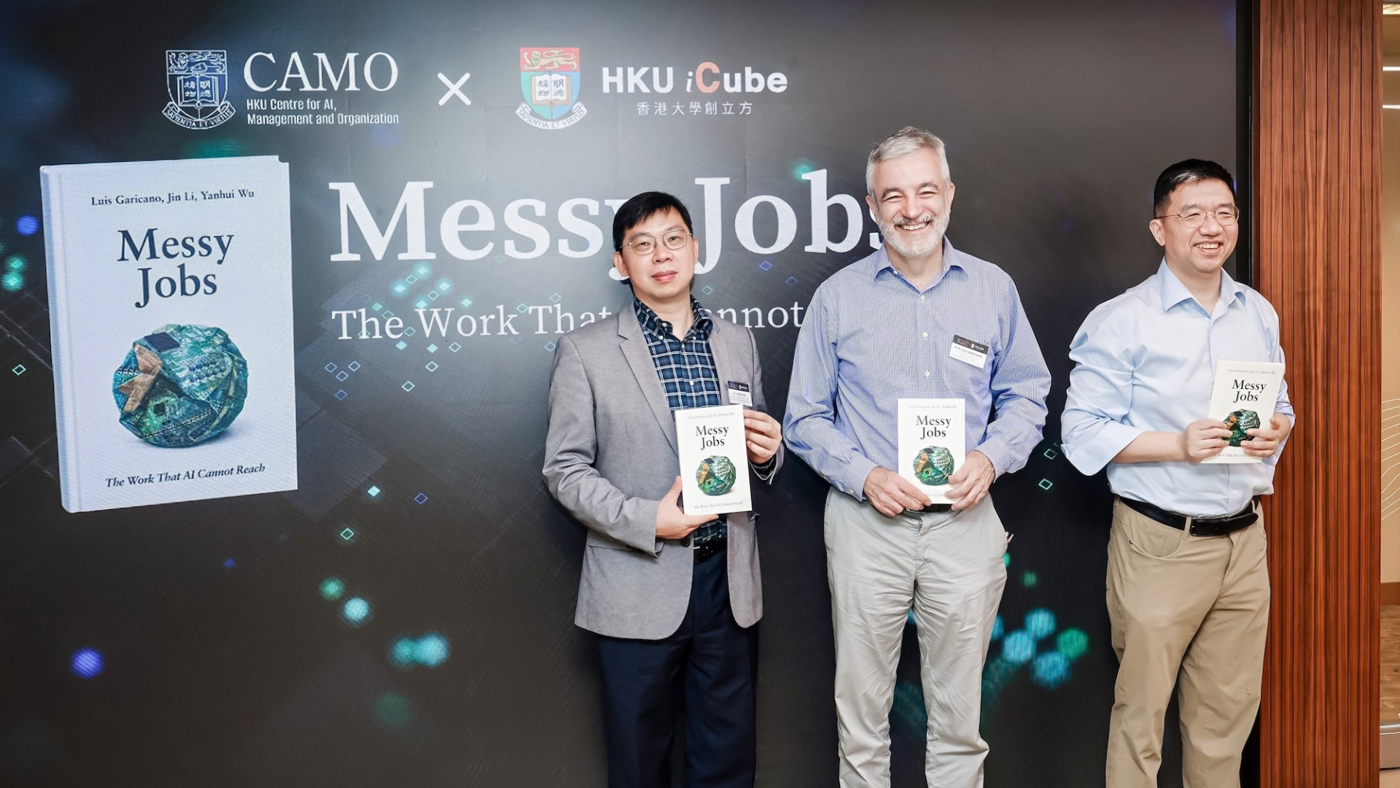
From left: Professor Wu, Professor Garicano, and Professor Li.
Related Topics
Related News