
Research & Discovery
When Stars Collide: New Study Reveals Previously Hidden Phase of Compact Star Mergers
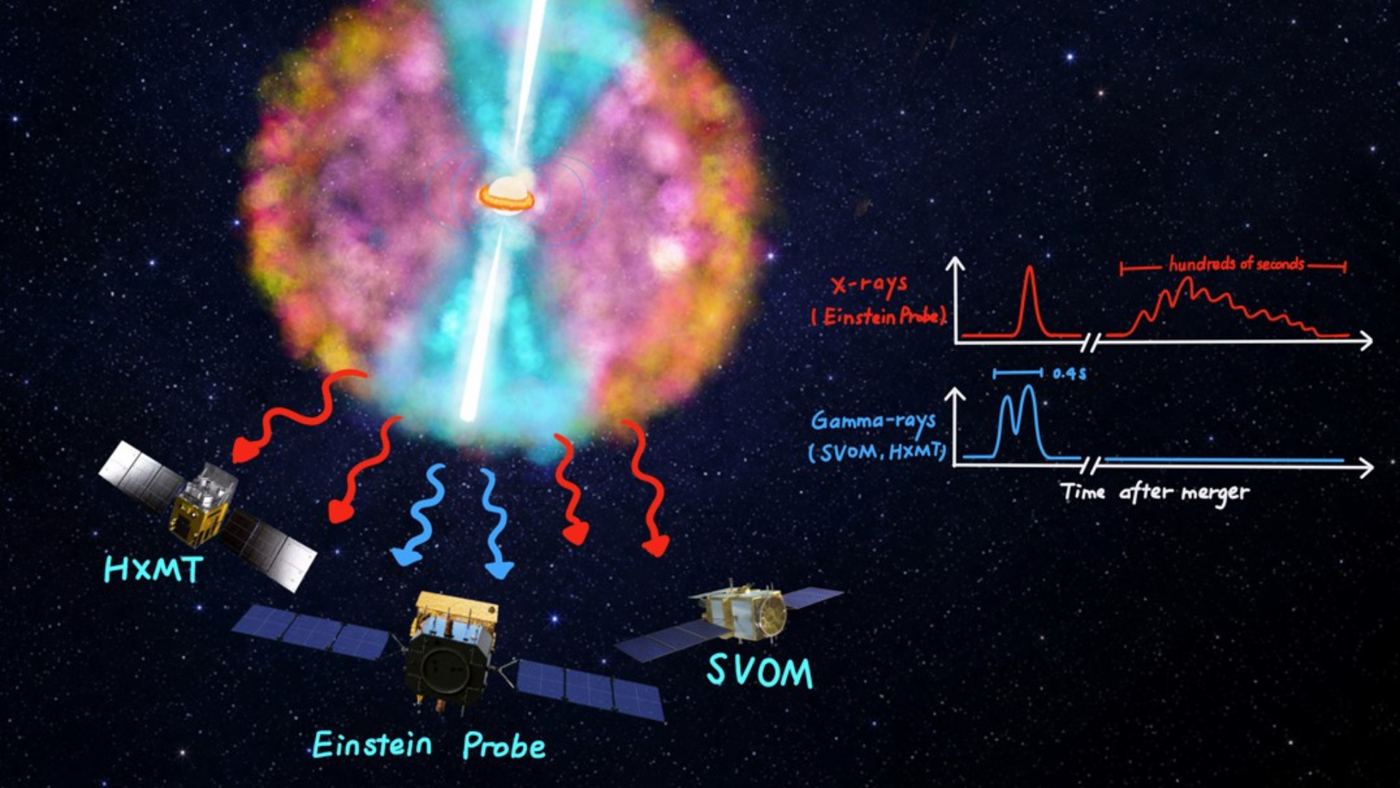
When two compact stars, such as neutron stars, spiral together and collide, they unleash a violent burst of energy. For decades, astronomers have relied on gamma-ray detectors to spot these events, assuming that the intense flash marked the climax and end of the high-energy show.
However, a new study led by an international team including researchers from The University of Hong Kong’s Hong Kong Institute for Astronomy and Astrophysics (HKIAA) challenges this assumption, revealing that significant activity continues long after the initial burst fades.
The research, published as a cover article in Science Bulletin, focuses on an event named EP250704a. While the associated gamma-ray burst lasted only about 0.4 seconds, soft X-ray emissions persisted for nearly ten minutes.
This prolonged activity was captured by the Einstein Probe, a China-led space mission equipped with a wide-field X-ray telescope that continuously monitors the sky.
Unlike conventional telescopes that must wait for a gamma-ray alert before turning their gaze to a specific location, EP detected the event from its onset, catching the faint, soft X-rays that would otherwise have been missed.
Yi-Han Iris Yin, a PhD student at HKU’s Department of Physics and HKIAA, led the analysis of the high-energy prompt emission. “Einstein Probe is allowing us to uncover a part of compact star mergers that was hidden from previous gamma-ray observations,” Yin says.
“The short gamma-ray flash may represent only the beginning of the high-energy activity. By observing the Universe at soft X-ray energies, we can now follow these systems for much longer and obtain a more complete view of what happens during and after the merger.”
One leading hypothesis is that the collision formed a rapidly rotating, highly magnetised neutron star, known as a magnetar, which continued to power the emission. The findings imply that similar soft X-ray emissions may have been present in previous short gamma-ray bursts but went undetected due to their faintness.
Professor Bing Zhang, Founding Director of HKIAA and Chair of Astrophysics at HKU, co-authored the study. He highlights the broader significance of the work for young researchers.
“One of our goals at HKIAA is to create an environment where talented young researchers can take on scientific leadership,” Professor Zhang says. “It is particularly encouraging to see our PhD student Yi-Han Iris Yin taking a leading role as one of the corresponding authors in this international collaboration.”
The paper also reflects HKIAA’s emphasis on collaboration, with the study involving researchers from HKU, Nanjing University, Beijing Normal University, and institutions across Europe and China.
Related Topics
Related News