
Newsroom
HKU Scientists Uncover Hidden Leaf Dynamics That Could Improve Amazon Rainforest Carbon Uptake Estimates
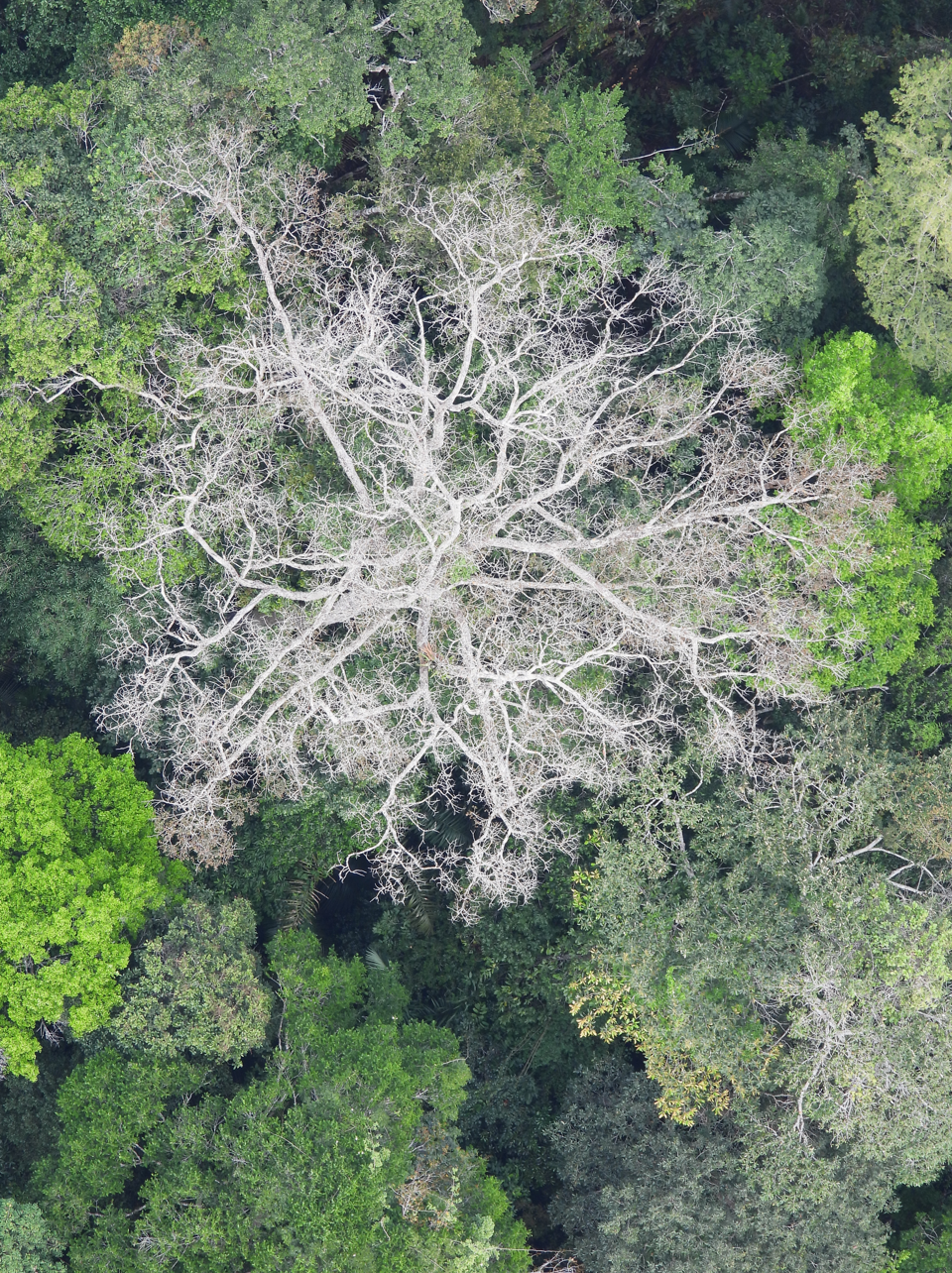
From space, the Amazon rainforest looks like an unbroken expanse of green. But a new study conducted by researchers from the School of Biological Sciences at The University of Hong Kong (HKU), together with international collaborators, reveals seasonal leaf changes hidden within this seemingly constant canopy. Largely undetected by conventional satellite observations, these changes have significant implications for estimating the rainforest’s carbon uptake.
Accounting for leaf loss, renewal and ageing produces a 9.4% difference in modelled annual photosynthetic carbon uptake — approximately 1.42 billion tonnes of carbon per year — compared with conventional models.
Led by Professor Jin WU, with Dr Guangqin SONG as first author, both from HKU School of Biological Sciences, the study, now published in Nature, provides a detailed, basin-wide picture of these hidden seasonal dynamics.
A rainforest less constant than it appears
Unlike the familiar autumn scene of leaves turning yellow or brown before falling, trees in the Amazon can shed older leaves while still maintaining a green canopy. As old leaves are replaced by new ones at different times, the rainforest remains green throughout the year, even though the age of its leaves and their capacity for photosynthesis are constantly changing. However, traditional satellite measures tend to capture the forest as a single green surface, making these changes difficult to track.
To overcome this limitation, the HKU-led team combined machine learning with 10-metre-resolution Sentinel-2 satellite observations from 2019 to 2021 to map monthly changes in leafless canopy across the rainforest. The results show that 75.4% of mapped Amazon forests exhibit substantial seasonal changes in leaflessness — the proportion of the canopy without leaves — even in areas previously thought to remain evergreen throughout the year. Across 70% of the Amazon, seasonal leaf loss occurs at least three months before the canopy becomes greener, showing that trees in different regions shed and replace their leaves at different times, and that changes in leaf cover are not always reflected in how green the forest appears.
“For a long time, the Amazon appeared uniformly green from space, which made it difficult to see how dynamic it really is,” said Dr Song. “By mapping both leaflessness and greenness, we can now distinguish different seasonal strategies across the basin and better understand what they mean for forest function.”
What drives these seasonal differences?
While earlier studies often emphasised sunlight as a major influence on seasonal leaf production, the researchers found that water-related conditions are the strongest predictors of the timing differences between leaflessness and canopy greenness, followed by soil properties and sunlight. Greater seasonal water stress is associated with a wider separation between leaf-loss and greening cycles, offering new insights into how different parts of the Amazon respond to their environment.
As one of the world’s largest tropical rainforests, the Amazon plays a vital role in the global carbon cycle, making accurate estimates of its carbon uptake essential for understanding and predicting climate change. As trees shed old leaves and grow new ones, their canopies contain different proportions of young, mature and ageing leaves. Because leaves of different ages do not photosynthesise equally, two forests that look similarly green may absorb different amounts of carbon dioxide.
Building on Professor Wu’s 2016 Science paper, which linked leaf age to seasonal photosynthesis at Amazon research sites, the new Nature study extends this understanding across the basin. When the researchers accounted for leaf renewal and ageing in their models, they were able to better predict seasonal changes in photosynthesis across 79.9% of Amazon forests, based on comparisons with independent satellite observations. Ground-based eddy covariance measurements taken within the rainforest also supported these findings.
The revised models also generate a 9.4% difference in estimated annual gross photosynthetic carbon uptake. This is a difference between model estimates, not a directly measured change in the rainforest’s carbon storage, but it shows why overlooked leaf dynamics matter for carbon-cycle calculations.
“A forest can remain green while changing profoundly in how it works,” said Professor Wu. “What matters is not only how many leaves are there, but also how old those leaves are and when they are being replaced. Those biological details can scale up to affect carbon uptake across the largest rainforest on Earth.”
Understanding the future of tropical forests
As climate change reshapes rainfall patterns and increases drought stress in parts of the Amazon, understanding when trees lose and replace leaves will be increasingly important for predicting forest productivity and carbon uptake.
“If we want to predict the future of the Amazon’s carbon sink, we need models that reflect the real biological rhythms of the forest,” said Professor Wu.
By linking high-resolution satellite observations with plant physiology, the research offers a new framework for studying how tropical forests function — and how they may change in a warming world.
For details of the research, please refer to the journal paper: https://www.nature.com/articles/s41586-026-11284-y
Media Enquiries:
Faculty of Science, The University of Hong Kong
Tel: +852 3917 4948 / +852 3917 5286
Email: caseyto@hku.hk / cindycst@hku.hk
Image download and captions: https://www.scifac.hku.hk/press
Related Topics
Related News