
HKU Today
Major Conference Brings Stable Isotope Researchers from Nearly 30 Countries to HKU
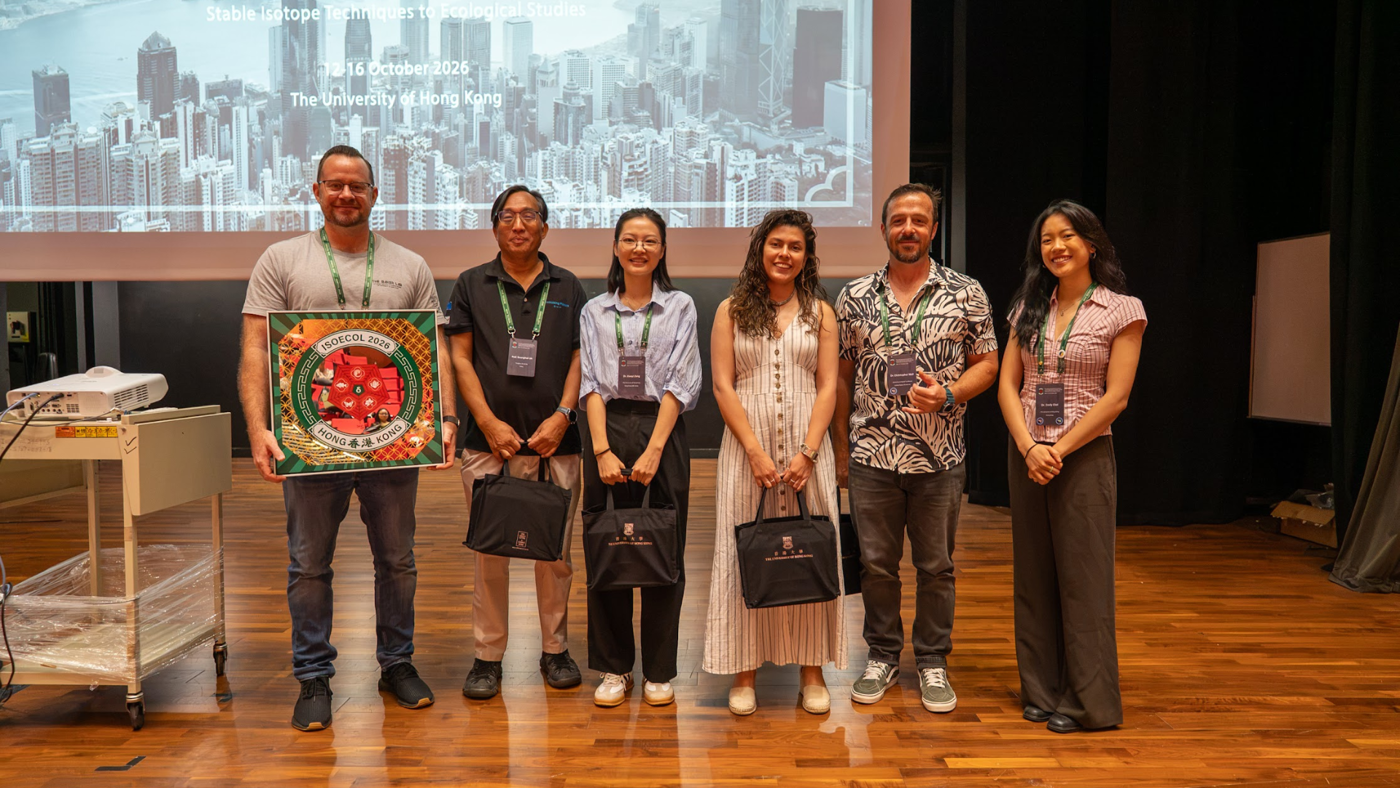
The University of Hong Kong welcomed over 150 researchers from nearly 30 countries for the 14th International Conference on the Applications of Stable Isotope Techniques to Ecological Studies (IsoEcol) last week. The biennial conference, chaired by Professor David Baker, Interim Director of the Swire Institute of Marine Science (SWIMS), was organised by SWIMS and was the first IsoEcol to be held in Hong Kong.
The weeklong programme featured four days of keynote addresses, oral presentations, lightning talks, and poster sessions, with a mid-week break for participants to explore the city. Professor Qiang Zhou, Dean of Science and Chair Professor in the School of Biological Sciences at HKU, opened the conference.
The keynote speakers reflected the global and disciplinary breadth of stable isotope research. Professor Guanghui Lin of Tsinghua University addressed applications of stable isotopes to blue carbon provenance studies, Dr Julia Tejada of the California Institute of Technology presented new methods using amino acid nitrogen isotopes to reveal hidden structures in dietary ecology, and Dr Christopher Wall spoke on energy channels and nutrient plasticity in reef-building corals.
The fourth keynote was delivered by Dr Xiaoyi Zeng, a postdoctoral researcher at HKU who received her PhD in Ecology and Biodiversity from the University in 2025. She spoke on the role of soil invertebrates in plant nutrient assimilation across tropical and temperate forests.
Professor Roman Zubarev of the Karolinska Institute gave the conference’s final talk.
The conference also showcased HKU’s wider strength in the field. Dr Inga Conti-Jerpe, a SWIMS alumna now serving as assistant professor at Lingnan University, was among the speakers, while Dr Emily Chei, who conducted stable isotope analysis at HKU’s Stable Isotope Ratio Mass Spectrometry (SIRMS) laboratory for her PhD, spent two years heading up the organising committee.
“HKU hosts a number of leading scientists in this field and is the home to SIRMS — the only open-access analytical lab for stable isotopes in China,” said Professor Baker. “We are delighted to bring this meeting to Hong Kong and to HKU.”
Photos: Alex Reshikov


Related Topics
Related News