
Research & Discovery
An HKU Robot Faced an Olympic Champion. The Next Challenge Is the Real World.
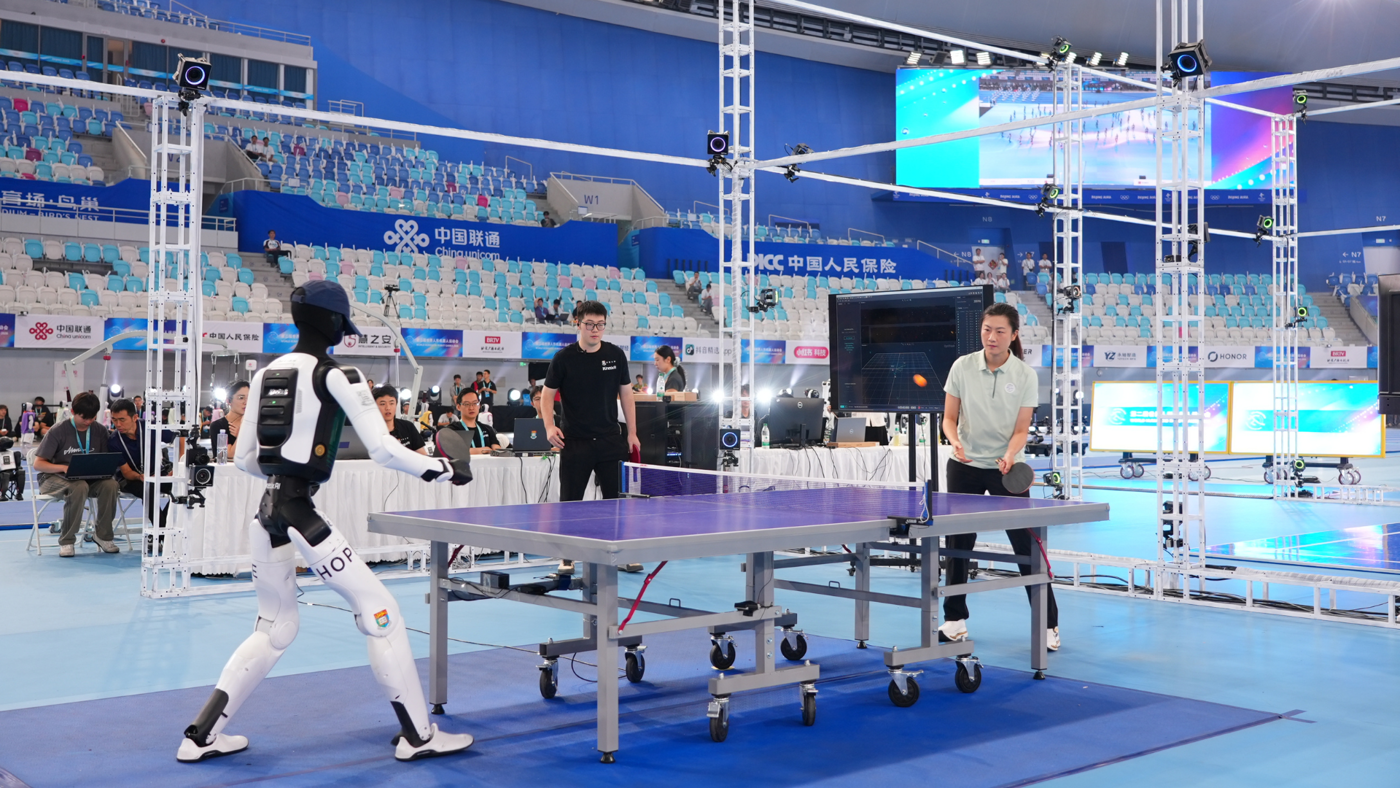
A “smash” in table tennis arrives at speed, its spin can alter its path, and a player has only a split second to decide how to return it.
For a humanoid robot, that moment compresses several hard problems into one: detecting and tracking the ball, reacting quickly, striking accurately and coordinating its whole body while remaining balanced. That is why the HKU-KAI SMASH Team has chosen table tennis as a testing ground for a high-dynamic humanoid robotics system.
The team won silver in the table-tennis competition at the second World Humanoid Robot Games in Beijing. Team leader Professor Ping Luo, Professor Peng Lu of HKU’s Department of Mechanical Engineering, team captain Li Yinghui and team manager Vanessa Tong later appeared on RTHK’s “Vibrant Hong Kong” programme to discuss the project, the team’s preparation for the Games and Hong Kong’s place in AI development.
Professor Luo said the system aims to transfer professional players’ movements to a humanoid robot, allowing flexible body coordination, complex actions and human-like ball returns. SMASH refers to the powerful, short, and attacking stroke associated with elite play.
Professor Lu, an adviser to the team, explained why the task is so exacting. “The motion of the ping pong balls is very dynamic. So the robot has a very limited time to react, to hit the ball back. Another thing is that the balls can spin in very different ways that are even difficult for human players to hit back.” It must then detect and track the ball, return it like a human and maintain balance, he said.
The team split its work into computer vision, motion planning and whole-body-control groups. Tong said the arrangement accelerated development but brought collaboration challenges. “What we achieve depends on how well the whole team performed,” she said.
One of the team’s most memorable moments came at the opening ceremony. Invited a week beforehand, its members tested and debugged intensively before the robot took part in a table-tennis exhibition match with Olympic champion Ding Ning. Professor Luo said the experience was a highlight for the whole team.
Li, the team captain, said table tennis was chosen partly because it is widely popular in China and can draw attention to humanoid robotics. Just as importantly, “the robot must see the ball, react quickly and adjust the movements of its whole body at the same time.” The team hopes the methods can later be applied to other whole-body tasks.
Indeed, SMASH’s ambition extends beyond the table. Professor Luo said the team is working towards commercialising the system while improving the robot’s skills. It also plans to extend and refine it for industrial work, including sorting objects on production lines and conducting product-quality inspections. He sees an opportunity for Hong Kong in linking its fundamental AI research with the manufacturing and supply-chain strengths of other Greater Bay Area cities.
In other words, the question posed by SMASH is therefore larger than whether a robot can return a fast ball: How can the capabilities developed in a demanding sporting task eventually help people in the real world?
Related Topics
Related News