
People
The Virtue of Water
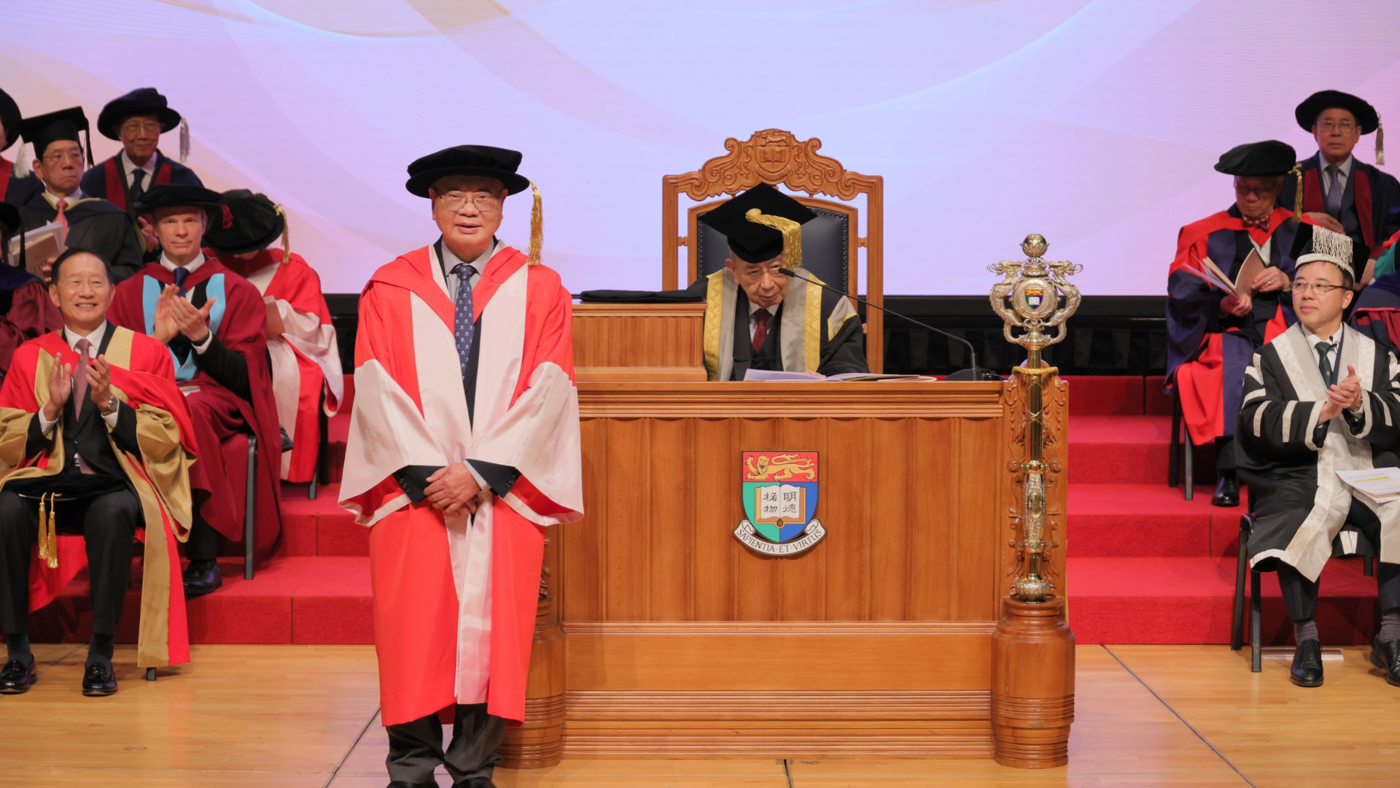
This is the text of a citation delivered by Professor Brian Wong, public orator, HKU, presenting Professor Lee Chack Fan for a Doctor of Science, honoris causa at the 219th Congregation on November 18, 2026.
An element that we take for granted yet is the prerequisite for life.
A force that shapes and defines our societies – from political intrigue to economic productivity, from disease to development. Yet it remains largely colourless.
A subject of fascination for many, including the gentleman whose achievements and accolades we honour, though by no means define the entirety of his legacy.
Water.
In nature, water moves in a circle – it falls upon land through precipitation, percolates into the soil, runs off into water bodies and rivers, before it rejoins the oceans. Throughout this process, evaporation takes it into the atmosphere, where it becomes precipitation.
True to the form of water, life has come full circle for Professor Lee Chack-fan, a pioneering engineer, a leading public servant, and, later in his life, an avuncular academic administrator who devoted his time and energy to this very institution.
Professor Lee’s career is rooted firmly in modern China, where he was born in 1945, in Zhongshan, in a learned family of letters. His father, a Chinese teacher, instilled the virtues and joys of reading in him, from a young age. His mother hailed from a distinguished family.
Enrolled at St. Joseph’s College in the 1960s, he would spend his afterschool hours poring over the radical Chinese writings of Lu Xun and Ba Jin, as well as Western classics such as Wuthering Heights and A Tale of Two Cities.
He found a literary role model in the Schoolmaster Ni Huanzhi (倪煥之), the protagonist of the classic penned by Ye Shengtao, anchored in the May Fourth Movement. Through Ni, Ye channeled his conviction that China needed bold, constructive intellectuals who sought to tackle pressing problems – such as rural poverty, frequent floods, and broader malnutrition.
The young Professor Lee thus pondered: could he do something about the plight of his fellow countrymen? How could he help?
He also took inspiration from the German polymath Albert Schweitzer, who devoted much of his career to medical and public service in Africa, as well as challenging orthodoxy. The City Hall library gave him a glimpse into the intricacies of history of water conservancy in China and reinforced his resolve to make an impact.
As with a river, life moves in non-linear, meandering ways.
Professor Lee set out to read civil engineering at this university, where he received his bachelor’s and master’s degrees. A desire to grapple with frontier, groundbreaking innovation then took him across the Pacific. He spent two further years at the University of Western Ontario prior to receiving a PhD in geotechnical engineering. In Canada, he organised weekend Chinese schools catering to members of the diaspora, as well as visits to elderly homes where the Chinese congregated. Professor Lee saw himself as fundamentally rooted in his Chineseness.
The seeds for his academic career were sown as he joined the University of Western Ontario and the University of Toronto, though he was more drawn to the exciting prospects of putting theory into practice, and eventually commenced two decades of professional service at Ontario Hydro. The abstractions and concepts intrigued him less than the practical impacts he sought to deliver – especially in hydro and nuclear contexts.
China embarked upon the journey of reform and opening up in 1978. In the 1980s, then-Minister of Water Resources and Electric Power, Qian Zhengying, led a delegation including herself and three Vice Ministers to Canada. Qian was eager to learn from Canada’s advanced water conservancy efforts, whilst the Canadian government was keen to engage China given the country’s lead in hydropower plant technology and construction.
As one of the few Chinese employees at the firm, Professor Lee was tasked to accompany Qian throughout her tour, explaining safety standards and engineering mechanics to her as both an interpreter and guide. By the end of the three weeks, impressed by his passion and professionalism, Qian invited Lee to return to his homeland, to spearhead technical feasibility studies and conduct design reviews.
Under the pull of gravity, the river eventually flows back to the ocean – the source.
In the 1980s, the gravitational pull of China was most potent, convincing Professor Lee to undertake regular trips comprising almost a day’s worth of flights, back to the mainland. That was no mean feat, though he would always make flights count by writing papers and working through them. Minister Qian dubbed him “A Descendant of Dayu” (大禹傳人).
When asked about what motivated him, it was neither glamour nor glory that he sought. Professor Lee confided in me, “it was out of a sense of both duty and honour”.
This sense of duty and honour drove him to tackle the thorny challenges surrounding the Three Gorges project – an ambitious, unprecedented undertaking spanning over 300km and encompassing a five-stage ship lock system, straddling Chongqing and Hubei. In particular, he was tasked to address the phenomenon of rock squeeze, which – as Professor Lee recounted to me in vivid detail, decades later – could pose significant threats to the canal’s operations.
He thus led a team to test out solutions at the St. Lawrence Seaway, focusing on preventing the massive vertical rock walls from displacing and deforming under the evolving operational conditions. His first-hand experience would lead him to advise the Canadian International Development Agency and the World Bank on similar projects.
Site visits and working meetings were tough. Electric supply was unstable in the mid-1980s, with temperatures easily reaching 40 Celsius in Wuhan – “free sauna”, as he put it. The central authorities were prompted to not only expedite their hydropower advancements, but also to explore the prospects for nuclear power. Here, Professor Lee again drew upon his experience in Canada, in bringing home the best practices he acquired abroad.
Fixing reservoirs at risk of collapse was also no mean task. With the unbridled proliferation of reservoirs built throughout the 1960s and 1970s, the Chinese state needed experts capable of providing honest, reliable feedback. He vetted several hundreds of reservoirs.
The 1998 China floods prompted the authorities to rethink how to manage water. Minister of Water Resources Wang Shucheng advocated large-scale reforestation on the Loess Plateau to anchor the soil at the sources of key rivers such as the Yangtze and Yellow Rivers. Lee advised closely the state, as a trusted technocrat. He also helped advance the discipline of eco-hydraulics, integrating hydraulics with ecology and land planning.
When the transcontinental commute became untenable, Professor Lee decided to head home – for good. He joined the University of Hong Kong in 1994, to serve as a Professor in Civil Engineering. He was subsequently made Department Head in 1998. He was entrusted by the administration to experiment with soil-nailing as an alternative solution to landslides.
His significant achievements in empirically driven research rendered him a most fitting candidate for Pro-Vice-Chancellor (PVC) of this university, taking charge of research and development in year 2000. Amidst rapid changes to the local higher education sector, and never one to decline challenging portfolios, Professor Lee then took on the External Relations portfolio, helming fundraising efforts in preparation for the Centennial Campus.
Just like water, Professor Lee is amenable to and adapts easily to new environments and challenges. With sanguine optimism, he embraced fully the responsibilities of Directorship of HKU Space between 2008 and 2015, and Directorship of the Jao Tsung-I (饒宗頤)Academy, where he has dutifully served for over two decades. Such persistence is remarkable but also speaks to the devotion that this university inspires amongst its finest graduates. Lee not only built physical structures. He also built institutions.
Professor Lee has had an outstanding academic career. He has published more than 270 international journal papers and 15 academic books. As an Academician of the Chinese Academy of Engineering, he played a part in enriching the policy discussions leading up to numerous iterations of the Five-Year Plan. He is also a Fellow of the Canadian Academy of Engineering and a former President of the Hong Kong Academy of Engineering Science.
But there is more to Lee.
Indeed, out of a life immersed in science and service came a body of prose marked by equanimity and erudite excellence. Professor Lee credits his literary flair to the training provided in the 1960s by 學術組, a Hong Kong-based student association with many a member emerging to be leading journalists, intellectuals, and influencers in the subsequent decades. An impulsive acceptance of an invitation at a fundraising event led him to start a column, which later morphed into over twenty published volumes, including 活在當下 (Carpe Diem) and 心無滯礙 (An Unhindered Mind). Throughout the past decades, without fail or falter, Lee generously enriched the soil of Hong Kong’s cultural sphere with his reflective insights.
Chapter 8 in the Daodejing notes, 「上善若水」. The greatest virtue is like water. Water nourishes myriads without force; it flows to places shunned by others – just like the Dao.
With his versatility, vitality, and vision, Professor Lee embodies the virtue of water.
Related Topics
Related News