
Research & Discovery
A Vast Frozen Carbon Store Is Losing Its Green Shield, An HKU-Led Research Team Finds
Beneath the surface of the Arctic and the high plateaus of Central Asia lies a vast layer of frozen ground known as permafrost. Locked inside it is an enormous store of carbon, while surface vegetation influences ground temperatures and regulates the flow of heat and moisture between earth and sky.
As permafrost warms and thaws, some of its stored carbon may be released. Whether that vegetation is holding steady or losing ground matters enormously — not just for the Arctic, but for the global climate.
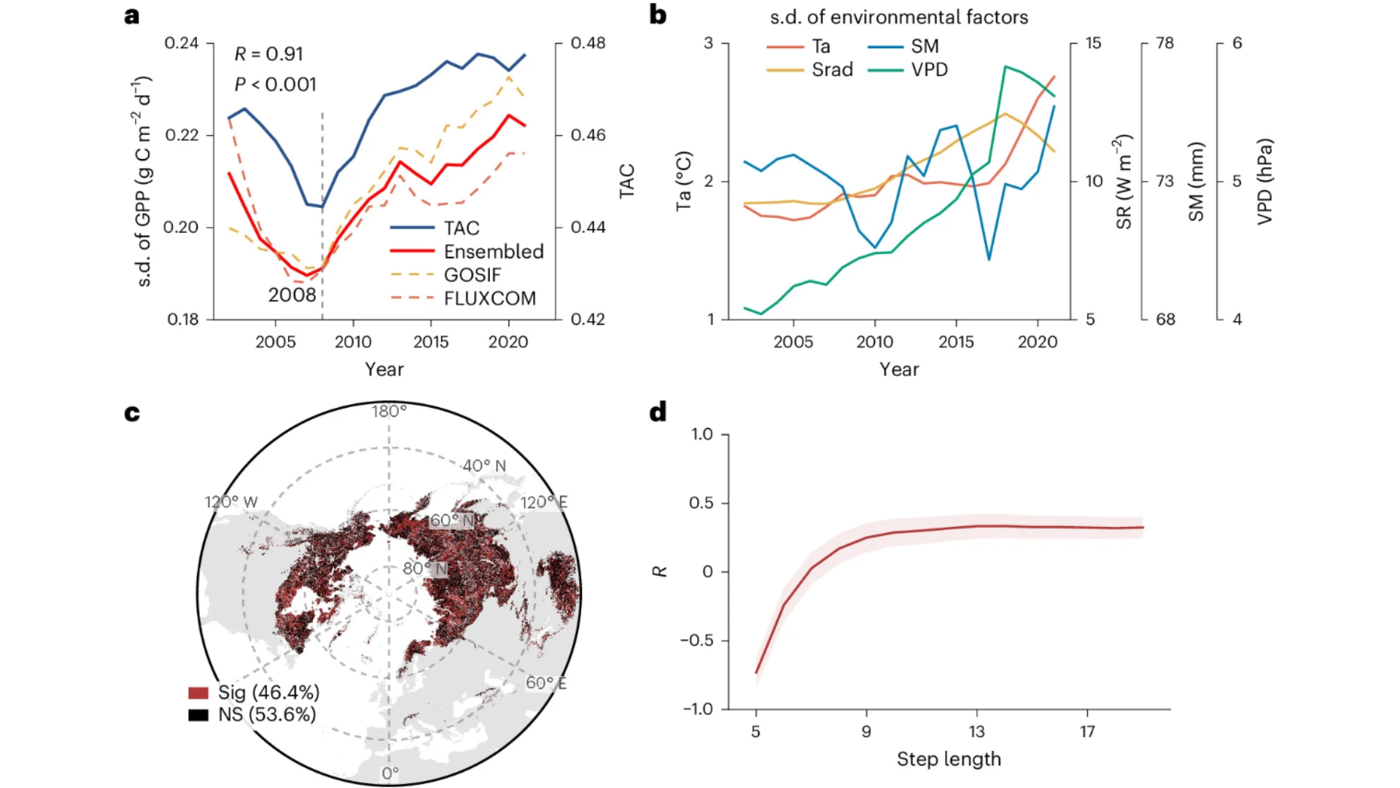
Satellite observations show that vegetation across the region continues to green. But a new international study led by researchers at The University of Hong Kong (HKU) has found that the picture is more troubling than it first appears. Despite satellite data showing continued greening across northern permafrost regions, the vegetation's ability to bounce back from disturbances such as drought and extreme heat has been declining since around 2008.
The study, published in the journal Nature Plants, was led by Professor Yuyu Zhou of HKU’s Department of Geography and Institute for Climate and Carbon Neutrality, with first author Dr Zhengfei Guo of HKU and co-corresponding author Dr Jian Wang of the Chinese Academy of Sciences.
The team analysed 23 years of satellite data from 2000 to 2023. Using a climate-adjusted analytical framework, they found that vegetation resilience strengthened before 2008 but then reversed and declined across diverse vegetation types and permafrost categories, with particularly sharp declines in eastern Siberia and the eastern Tibetan Plateau.
Interpretable machine learning methods identified atmospheric dryness — specifically vapour pressure deficit — as the strongest predictor of the decline. Wildfires compounded the problem, with recurrent burns trapping ecosystems in weakened states.
Perhaps most alarmingly, an evaluation of 15 global vegetation models revealed that most failed to capture the observed reversal, suggesting that current climate projections may significantly underestimate the risks facing northern carbon sinks.
“Our findings challenge the assumption that continued vegetation greening necessarily indicates healthier and more stable ecosystems,” said Professor Zhou. “Even as northern permafrost vegetation becomes greener, indicators of its ability to recover from environmental disturbances are declining.”
Related Topics
Related News