
媒体中心
香港大學研究人員報告香港2017-18年度冬季流感疫苗的高效性
香港目前正處於冬季流感季節。根據我們過往的研究1,香港平均每年由流感引致的呼吸道住院個案及呼吸道死亡個案分別有一萬二千七百宗及四百三十一宗。因流行毒株的變化,流感帶來的實際影響每年均有所不同,而其中以甲型流感(H3N2)引致的衝擊最大。今年冬季香港正經歷由山形病毒株主導的乙型流感疫情。
流感疫苗是世界上最廣泛使用的疫苗。根據衞生防護中心的數據顯示2,去年香港使用約70萬劑流感疫苗。最近加拿大有報告稱在當地流感疫苗抵抗甲型流感(H3N2)的效果不佳,從而引起人們對流感疫苗有效性的關注。由於世界各地流行的流感毒株不同,流感疫苗的有效性亦因地區而異。
研究方法和結果
過去九年,香港大學一直與瑪麗醫院及瑪嘉烈醫院合作監測每年流感疫苗的有效性4。我們一直沿用在全球許多其他國家確立可行的方法來監測疫苗的效用性。由香港大學高本恩教授、裴偉士教授、招瑞生醫生及瑪嘉烈醫院關日華醫生、梁志偉醫生 組成的研究團隊招募因患有急性呼吸道疾病(包括發燒和其他呼吸道症狀)而入住該兩間醫院的兒童,並確認哪些兒童曾接種流感疫苗,哪些兒童感染流感。通過比較兒童感染流感及疫苗接種的情況,我們從而估計流感疫苗對預防住院的有效性。本季加拿大採用了非常類似的方法,估算出流感疫苗對甲型流感(H3N2)的有效性較低(17%),而對乙型流感有中等的有效性(55%)。
最近,研究團隊在香港進行一項基於醫院的研究,估算2017/18年冬季流感疫苗的有效性。研究團隊收集了2017年12月4日至2018年1月31日期間因發熱急性呼吸系統疾病入院的1,078名兒童的數據,並進行流感測試。當中有339名兒童確診感染流感,其中80%感染乙型流感。通過分析這些數據,研究團隊估計流感疫苗有效性為66%。大多數兒童接種的是含山形病毒株的四價疫苗,而非不含山形病毒株的三價疫苗。
香港大學公共衞生學院流行病和生物統計學分部主任及世衞傳染病流行病學及控制合作中心高本恩教授指:「這是對本港今年冬季流感疫苗效果的首次評估,並確認疫苗對抗本地正流行的毒株非常有效。」香港大學兒童及青少年科學系臨床副教授招瑞生醫生補充指:「這些結果顯示流感疫苗的接種效果良好,應該在本港兒童中更加廣泛地使用。展望未來,家長應每年十月和十一月份即流感季節開始之前為兒童接種疫苗。」香港大學公共衞生學院講座教授、譚華正基金教授(醫療科學)裴偉士教授進一步表示:「相對甲型流感(H3N2),研究結果一致確認流感疫苗更有效預防乙型流感和甲型流感(H1N1)。」
關於研究團隊
這項研究由香港大學公共衞生學院流行病和生物統計學分部主任及世衞傳染病流行病學及控制合作中心高本恩教授;香港大學兒童及青少年科學系臨床副教授招瑞生醫生;瑪嘉烈醫院兒童及青少年科關日華醫生、梁志偉醫生 ;香港大學公共衞生學院講座教授、譚華正基金教授(醫療科學)裴偉士教授合作。
香港研究人員在流感病毒研究方面享負盛名。香港大學公共衞生學院的研究人員由香港特區政府食物及衞生局轄下醫療衞生研究基金資助。港大公共衞生學院是港大第一所獲世衞委任為合作中心的學術部門。
傳媒查詢
請聯絡香港大學李嘉誠醫學院(電郵︰medkefa@hku.hk )。
如欲瀏覽新聞圖片,請登入以下網址:https://www.med.hku.hk/tc/news/ 。
參考資料
1. Wu P, Presanis AM, Bond HS, Lau EHY, Fang VJ, Cowling BJ. A joint analysis of influenza-associated hospitalizations and mortality in Hong Kong, 1998-2013. Sci Rep. 2017; 7(1):929.
https://www.nature.com/articles/s41598-017-01021-x
2. Centre for Health Protection press release.
https://www.info.gov.hk/gia/general/201706/22/P2017062200297.htm
3. Skowronski DM, Chambers C, De Serres G, Dickinson JA, Winter AL, Hickman R, Chan T, Jassem AN, Drews SJ, Charest H, Gubbay JB, Bastien N, Li Y, Krajden M. Early season co-circulation of influenza A(H3N2) and B(Yamagata): interim estimates of 2017/18 vaccine effectiveness, Canada, January 2018. Euro Surveill. 2018; 23(5). https://www.eurosurveillance.org/content/10.2807/1560-7917.ES.2018.23.5.18-00035
4. Cowling BJ, Chan KH, Feng S, Chan EL, Lo JY, Peiris JS, Chiu SS. The effectiveness of influenza vaccination in preventing hospitalizations in children in Hong Kong, 2009-2013. Vaccine. 2014;32(41):5278-84. https://linkinghub.elsevier.com/retrieve/pii/S0264-410X(14)01051-2
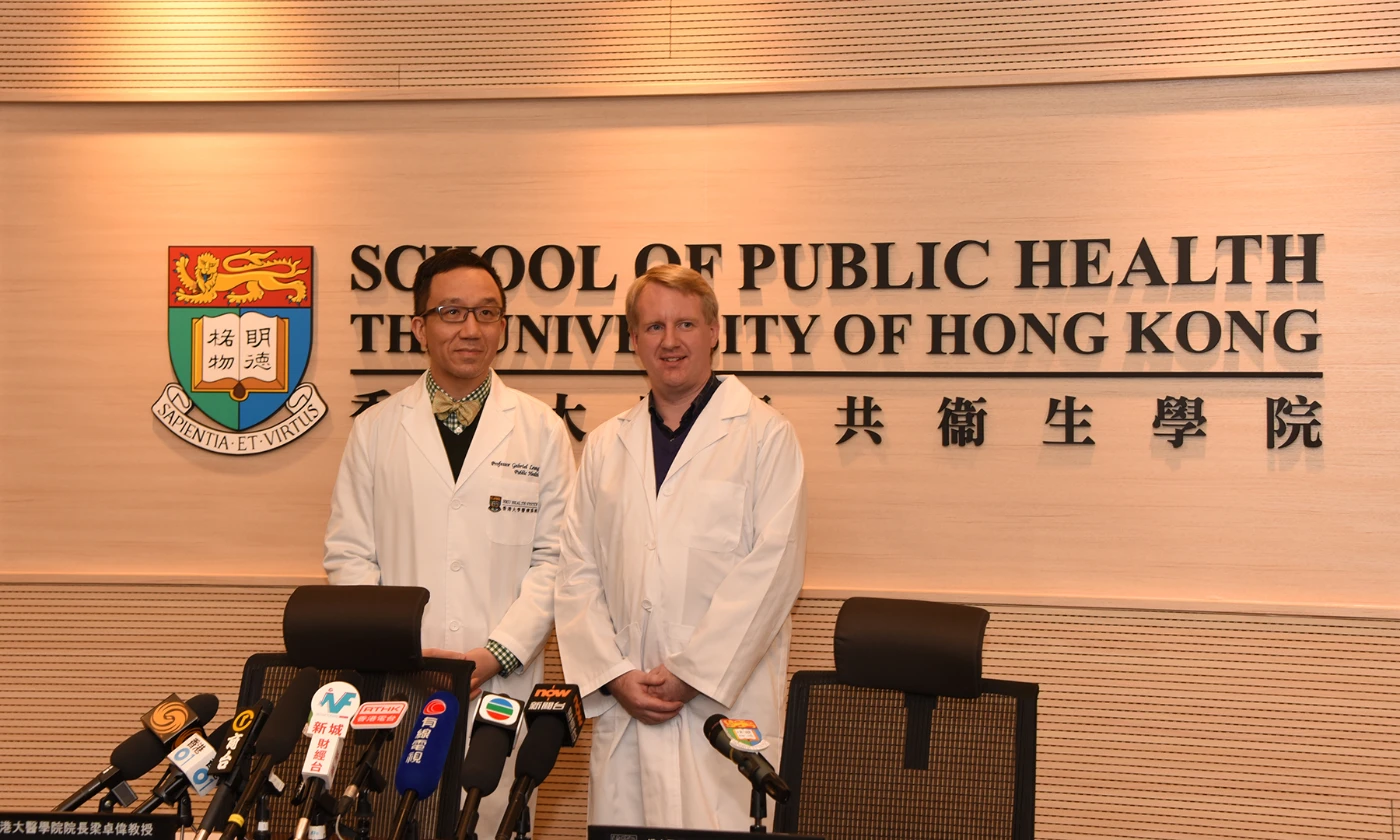
香港大學李嘉誠醫學院院長梁卓偉教授(左)及公共衞生學院流行病和生物統計學分部主任高本恩教授分析近兩個月流感數據,證實注射流感疫苗對預防流感是顯著有效的。
Hong Kong is currently experiencing its winter influenza season. According to our past research1, each year in Hong Kong, an average of 12,700 respiratory hospitalizations and 431 respiratory deaths are attributable to influenza. The exact impact varies from year to year, depending on the circulating strains, with influenza A(H3N2) epidemics tending to have the highest impact. This winter Hong Kong is experiencing an epidemic of influenza B including strains from the B/Yamagata lineage.
Influenza vaccines are the most widely used vaccines in the world, and around 700,000 doses were administered last year in Hong Kong according to the Centre for Health Protection.2 Some concerns have been raised about the effectiveness of influenza vaccines, following a recent report of low effectiveness of the vaccine against influenza A(H3N2) in Canada.3 The effectiveness of influenza vaccination varies by location, because of the different strains that are circulating in different parts of the world.
Research methodology and findings
The University of Hong Kong has been collaborating with Queen Mary Hospital and Princess Margaret Hospital to monitor influenza vaccine effectiveness each year for the past 9 years.4 Using well-established methods that are used in many other countries around the world to continuously monitor vaccine effectiveness, a research team comprising Professor Ben Cowling, Professor Malik Peiris and Dr Susan Chiu from The University of Hong Kong and Dr Mike Kwan and Dr CW Leung from Princess Margaret Hospital has enrolled children who are admitted to these hospitals with an acute respiratory illness including a fever and other respiratory symptoms, and determined which children had previously received influenza vaccination and which children were infected with influenza. By comparing vaccination status in the children with influenza or without influenza, the research team makes an estimate of the effectiveness of influenza vaccination in preventing hospitalization. Very similar methodology was used in Canada this season to estimate low influenza vaccination effectiveness of 17% against influenza A(H3N2) and moderate effectiveness of 55% against influenza B.3
Most recently, the research team conducted a hospital-based study in Hong Kong to estimate influenza VE for the winter of 2017/18. In this analysis, the team included data on 1078 children who were admitted between 4 December 2017 and 31 January 2018 with febrile acute respiratory illness and who were tested for influenza. There were 339 children with laboratory-confirmed influenza, among which 80% had influenza B. Using the data collected on these children, the team estimated that influenza vaccination effectiveness was 66%. Most vaccinated children had received the quadrivalent vaccine which includes a B/Yamagata strain, rather than the trivalent vaccine that does not include a B/Yamagata strain.
Professor Ben Cowling, Head of Division of Epidemiology and Biostatistics at the HKU School of Public Health and researcher at the WHO Collaborating Centre of Infectious Disease Epidemiology and Control, said: “These are the first local estimates of the performance of the influenza vaccine in Hong Kong this winter, and reassure us that the vaccine is very effective against the locally circulating strains.” Dr Susan Chiu, Clinical Associate Professor of HKU Department of Pediatrics and Adolescent Medicine, added: “These results indicate that influenza vaccination is effective and should be more widely used in children in Hong Kong. Looking forward, it is important for parents to get their children vaccinated in October and November each year, before the influenza season starts” Professor Malik Peiris, Chair Professor of Virology and Tam Wah-Ching Professor in Medical Science of HKU School of Public Health, further remarked: “The influenza vaccine tends to be more effective against influenza B and influenza A(H1N1) than against influenza A(H3N2), and that is consistent with these results.”
About the Research Team
The research was conducted by: Professor Benjamin J Cowling, Head of Division of Epidemiology and Biostatistics of WHO Collaborating Centre of Infectious Disease Epidemiology and Control, the School of Public Health, Li Ka Shing Faculty of Medicine, HKU; Dr Susan Chiu, Clinical Associate Professor of the Department of Paediatrics and Adolescent Medicine, Li Ka Shing Faculty of Medicine, HKU; Dr Mike Kwan and Dr CW Leung, Consultants of the Department of Paediatrics and Adolescent Medicine, Princess Margaret Hospital; Professor J. S. Malik Peiris, Tam Wah-Ching Professor in Medical Science and Chair Professor of Virology at the School of Public Health, Li Ka Shing Faculty of Medicine, HKU.
Researchers in Hong Kong have a world-class reputation in research on influenza viruses. Researchers in the School of Public Health HKU are supported by a large commissioned grant from the Health and Medical Research Fund, under the Food and Health Bureau of the HKSAR government. The School of Public Health, HKU, is designated as a WHO Collaborating Centre for Infectious Disease Epidemiology and Control, the first such centre at the University.
Media enquiries
Please contact Li Ka Shing Faculty of Medicine of The University of Hong Kong by email (medkefa@hku.hk).
Please visit the website at https://www.med.hku.hk/news/ for press photos.
References
1. Wu P, Presanis AM, Bond HS, Lau EHY, Fang VJ, Cowling BJ. A joint analysis of influenza-associated hospitalizations and mortality in Hong Kong, 1998-2013. Sci Rep. 2017; 7(1):929.
https://www.nature.com/articles/s41598-017-01021-x
2. Centre for Health Protection press release.
https://www.info.gov.hk/gia/general/201706/22/P2017062200297.htm
3. Skowronski DM, Chambers C, De Serres G, Dickinson JA, Winter AL, Hickman R, Chan T, Jassem AN, Drews SJ, Charest H, Gubbay JB, Bastien N, Li Y, Krajden M. Early season co-circulation of influenza A(H3N2) and B(Yamagata): interim estimates of 2017/18 vaccine effectiveness, Canada, January 2018. Euro Surveill. 2018; 23(5). https://www.eurosurveillance.org/content/10.2807/1560-7917.ES.2018.23.5.18-00035
4. Cowling BJ, Chan KH, Feng S, Chan EL, Lo JY, Peiris JS, Chiu SS. The effectiveness of influenza vaccination in preventing hospitalizations in children in Hong Kong, 2009-2013. Vaccine. 2014;32(41):5278-84. https://linkinghub.elsevier.com/retrieve/pii/S0264-410X(14)01051-2
相关主题
相关文章