
Newsroom
HKU research reveals global urban-rural vegetation resilience gap, highlighting potential of urban green spaces as resilience refugia
A global study led by Professor Jin Wu from the School of Biological Sciences, Faculty of Science, and Professor Yuyu Zhou from the Department of Geography, Faculty of Social Sciences, at The University of Hong Kong (HKU), with Dr Zhengfei Guo as the first author, has revealed a striking divergence in how urban and rural vegetation respond to climate stress. Published in the Proceedings of the National Academy of Sciences (PNAS) under the title “Global divergence in urban-rural vegetation resilience driven by broken ecological trade-offs”, the study found that urban vegetation is surprisingly more resilient than its surrounding rural counterparts, challenging the view that cities are uniformly detrimental to ecosystem stability and highlighting the potential role of sustainably managed urban green spaces under climate change.
Using satellite observations spanning 751 cities across 109 countries from 2001 to 2022, the research team conducted a global multi-decadal assessment of vegetation resilience, defined here as the capacity of vegetation to recover following disturbance.
A surprising and widening urban resilience advantage
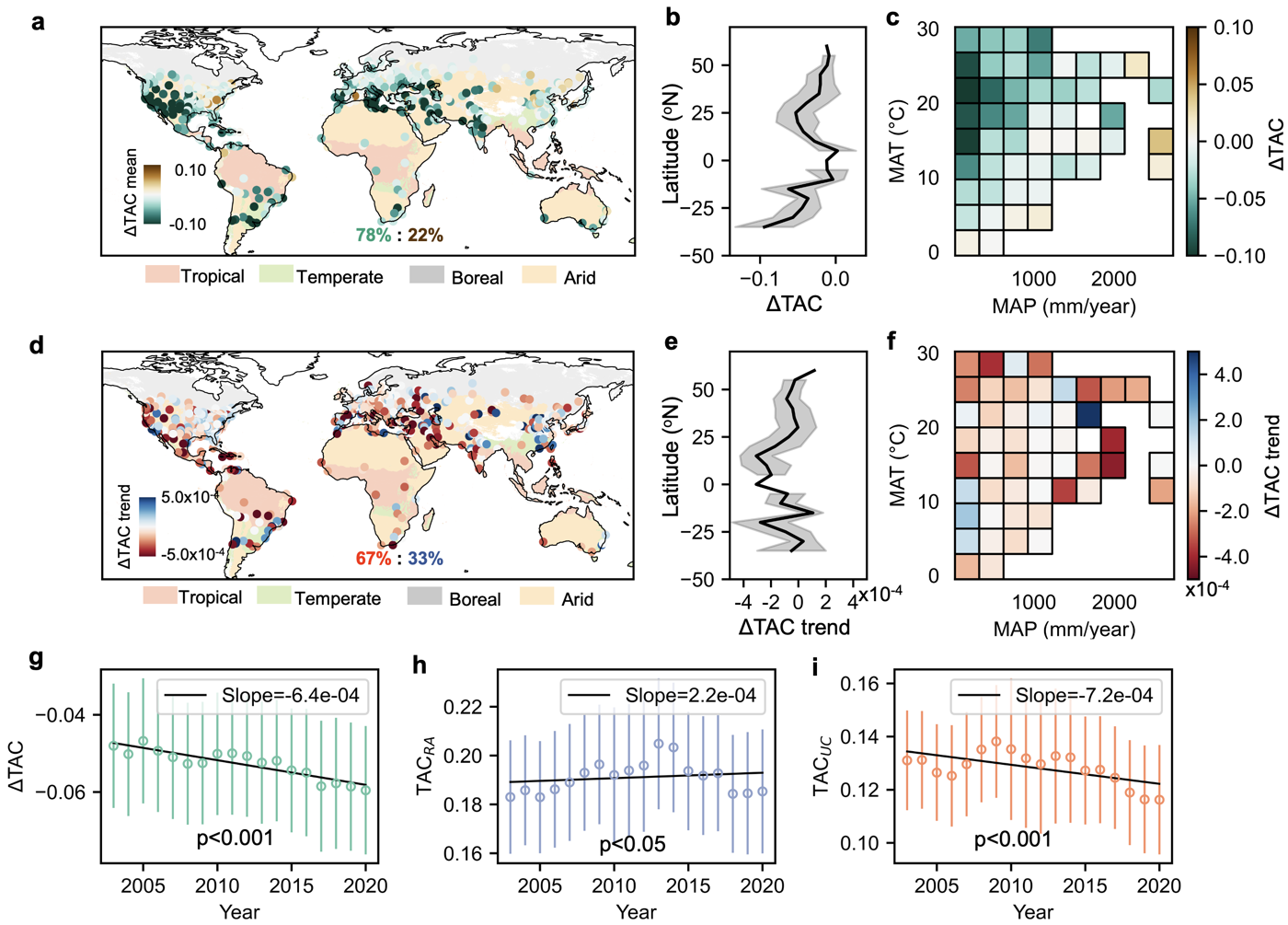
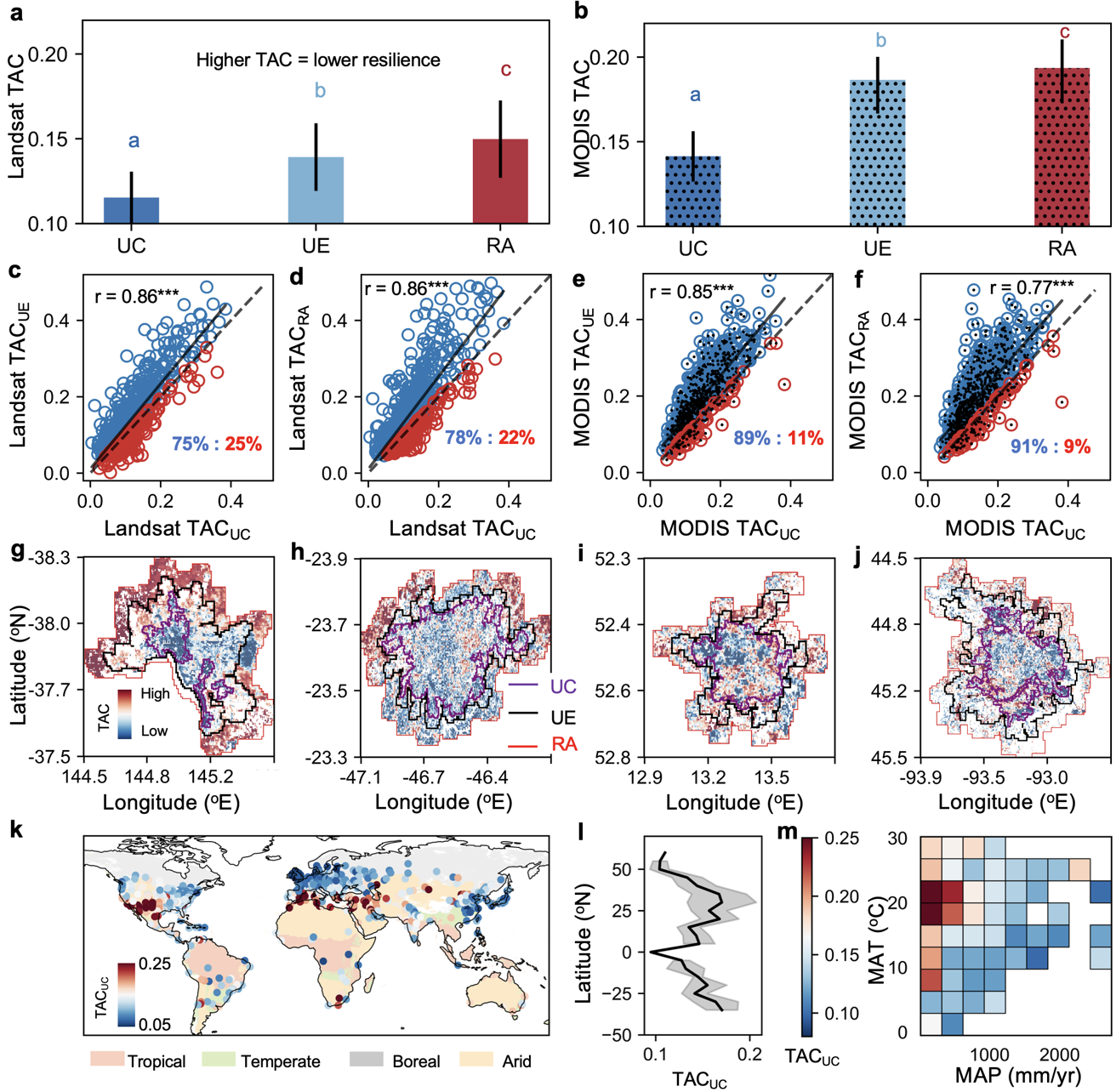
Across 751 cities worldwide, vegetation in urban cores was more resilient than surrounding rural vegetation in 78% of cities. This advantage was particularly pronounced in hot and arid regions, where vegetation is strongly constrained by water availability.
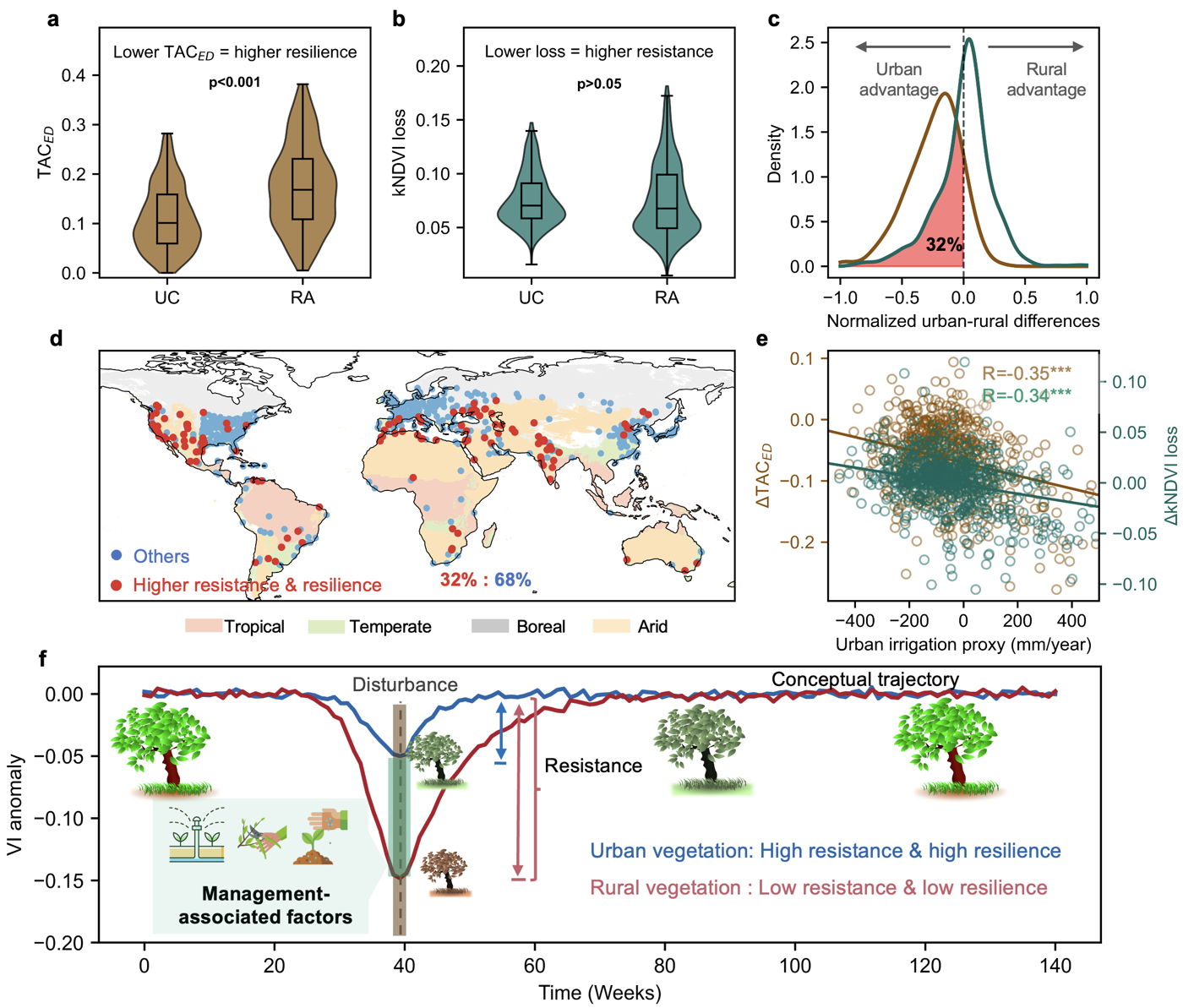
More importantly, the urban–rural resilience gap has widened over the past two decades. This divergence was driven primarily by declining resilience in rural vegetation, while urban vegetation remained comparatively stable or improved slightly over time. Among the factors examined, a management-associated water-subsidy proxy showed the strongest statistical association with the urban resilience advantage, followed by canopy structure. These relationships are consistent with the possibility that urban management can help buffer vegetation against increasing climate stress, although the study does not establish irrigation itself as a direct causal mechanism.
The findings also reveal a deeper shift in how ecological stability can be maintained in cities. In 32% of cities, urban vegetation showed a “dual advantage”: it experienced smaller greenness losses during disturbances and recovered faster afterwards than surrounding rural vegetation. This pattern is consistent with a management-mediated relaxation of the usual resistance–resilience trade-off. Together, the results suggest that, when supported by sustainable and equitable management, urban green spaces may serve as managed refugia for vegetation resilience under climate change.
Professor Jin Wu said: “Vegetation remaining within cities can show unexpectedly strong recovery capacity under environmental stress. Its resilience advantage is closely associated with management-related factors, particularly water subsidy and canopy structure, highlighting the potential of well-designed and sustainably managed urban green infrastructure.”
Dr Zhengfei Guo, the study’s first author, said: “The urban resilience advantage was strongest in hot and arid regions, where vegetation is especially vulnerable to water stress. In nearly one-third of cities, urban vegetation also suffered less damage while recovering faster, suggesting that human management may reshape the balance between resistance and recovery.”
Professor Yuyu Zhou added: “Urban green space can serve as a resilient ecological buffer against climate change. With deliberate, sustainable and equitable management, urban green infrastructure could provide important support for future urban planning and climate adaptation.”
For Hong Kong, the findings provide practical insights for building more climate-resilient urban green spaces. Integrating sustainable water management, appropriate canopy structure and long-term green-infrastructure planning could help maintain vegetation resilience as the city faces increasing climate stress.
The team from Professor Wu and Professor Zhou’s lab collaborated with researchers from the University and international institutions, including Professor Peng Gong, Vice-President and Pro-Vice-Chancellor (Academic Development) and Chair Professor of Global Sustainability, Department of Geography, Faculty of Social Sciences; Professor Giovanni Forzieri from the University of Florence; Professor Manuel Esperon-Rodriguez from Western Sydney University and Bangor University; Professor Jianguo Wu from Arizona State University; Professor Kun Zhang from Sun Yat-sen University; and Professor Nate McDowell from Pacific Northwest National Laboratory and Washington State University.
About the research team
This study was led by Professor Jin Wu and Professor Yuyu Zhou, with the leading author, Dr Zhengfei Guo, jointly supervised by Profs. Wu and Zhou.
Professor Jin Wu: Associate Professor of School of Biological Sciences, Faculty of Science, and Institute for Climate and Carbon Neutrality, HKU.
Professor Yuyu Zhou: AAAS Fellow, Professor of the Department of Geography and the Institute for Climate and Carbon Neutrality, HKU, Director of Sustainable Cities Lab (SCL).
Media enquiries:
For media enquiries, please contact HKU Faculty of Social Sciences Communications Team (tel: 852-3917 1230/3917 1249; email: jessnys@hku.hk / lilychui@hku.hk ).
Related Topics
Related News