
Newsroom
HKU Engineering Team Reveals the Interlayer Elastic Limits of van der Waals Crystals
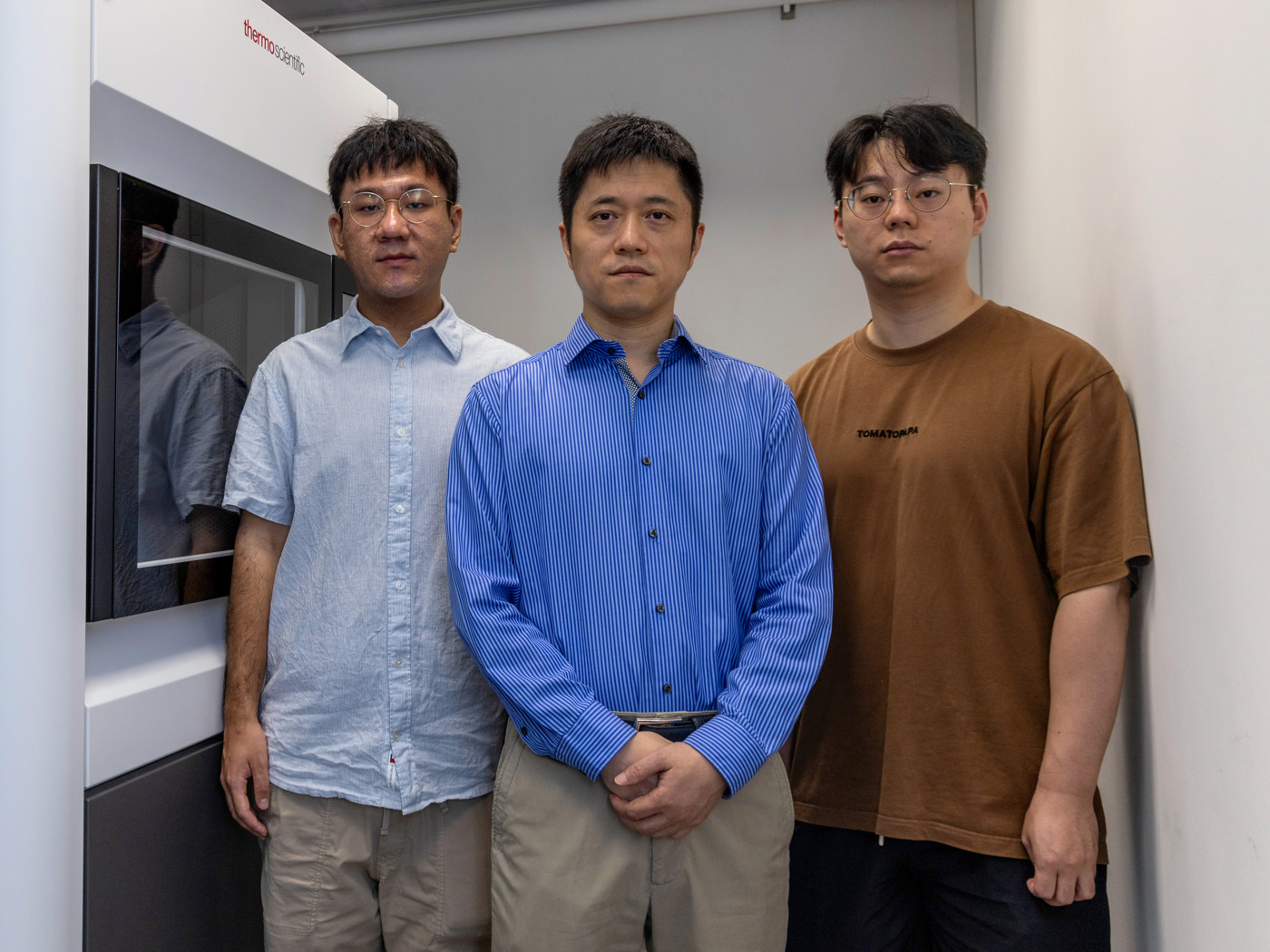
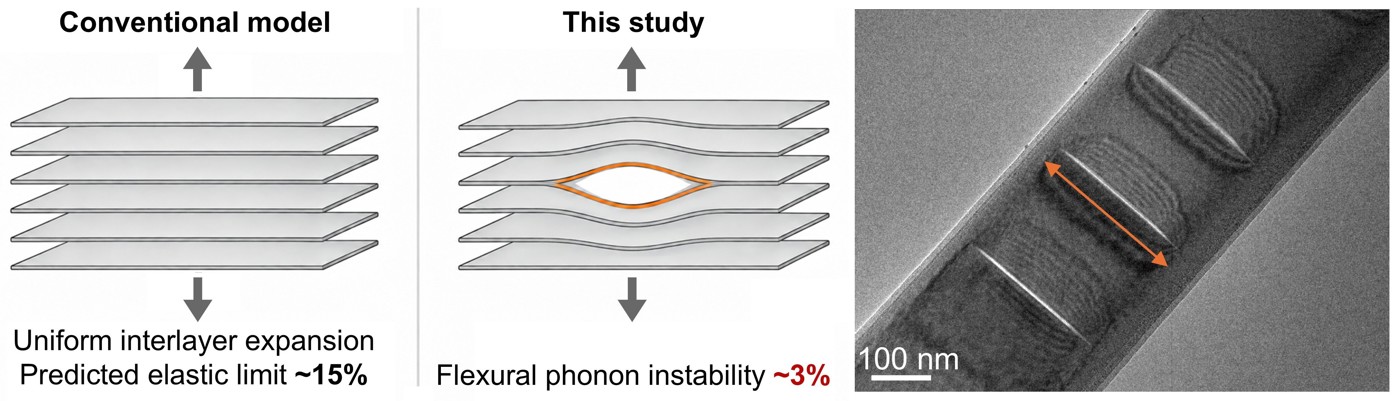
A research team led by Professor Yang Lu from the Department of Mechanical Engineering in the Faculty of Engineering at The University of Hong Kong (HKU), in collaboration with Tsinghua University, has measured the interlayer elastic limits of graphite and hexagonal boron nitride, two representative van der Waals crystals, and revealed the physical mechanism that sets them. By stretching specimens inside electron microscopes and watching their response, the team found that local separation between single-crystalline graphite layers began at an elongation of only about 3%, well below the approximately 15% predicted by uniform stretching models. Theoretical calculations identified unstable bending vibrations of the atomic layers as the trigger. The findings help explain how much interlayer stretching these materials can sustain and how deformation can be used to control their internal structures.
As electronic devices become smaller and smaller, van der Waals crystals and their atomically thin layers are emerging as promising materials for next-generation microelectronics. These materials can be thinned down to a single layer, while layers of different materials can be stacked to create new functionalities. Understanding how the layers deform and when they separate under mechanical loading is therefore essential to assessing their structural stability and exploring how deformation can be used to tune their properties.
How far, then, can these crystals be stretched perpendicular to their atomic layers and still recover their original shape when the load is removed? Determining this elastic limit is a fundamental problem in solid mechanics and an important step towards using deformation to tune material properties. Classical models of ideal strength suggest elastic strain limits on the order of 10%, a scale approached in recent nanomechanical experiments on high-quality silicon and diamond. Whether this understanding extends to van der Waals crystals, whose layers are weakly bonded to one another, has required direct experimental testing.
Graphite and hexagonal boron nitride consist of atomically thin layers with strong covalent bonds within each layer and weaker van der Waals interactions between them. Changing the distance between layers offers a way to tune material properties. Calculations assuming uniform stretching of perfect crystals predict interlayer elastic strain limits of approximately 15% and 16%, respectively. Establishing the materials’ intrinsic limits experimentally requires precise stretching perpendicular to the layers while directly observing the onset of damage.
The team fabricated high-quality single-crystalline microbridges and performed quantitative tensile tests inside electron microscopes, tracking structural changes as they occurred. In situ transmission electron microscopy revealed that, at approximately 2.9% strain, some adjacent layers in graphite had begun to separate, forming nanoscale gaps while the specimen remained connected overall. Hexagonal boron nitride showed similar behaviour at approximately 2% strain. The onset of this local interlayer cleavage marked the intrinsic elastic limit, well below the values predicted for uniform stretching.
To explain this difference, the researchers used first-principles calculations to examine lattice vibrations during stretching. The calculations revealed that, as the layers move further apart, small undulations can become unstable and grow, concentrating deformation locally and ultimately triggering separation. This mechanism is known as flexural phonon instability. Phonons describe collective atomic vibrations, and flexural phonons involve out-of-plane undulations of the atomic layers. The calculated instability strains agree reasonably well with the experimental results, supporting this mechanism.
The resistance of individual layers to bending helps determine whether this instability occurs. In comparative experiments on molybdenum disulphide and gallium selenide, the team observed no similar nanogap formation. Theoretical analysis showed that the greater bending stiffness of their layers can suppress flexural phonon instability before the uniform stretching limit is reached, linking the structure of individual layers to the mechanical response between them.
As stretching continued, the researchers also observed ordered arrays of periodic nanogaps forming in graphite and hexagonal boron nitride. In graphite, a thin amorphous carbon surface layer created during specimen preparation kept the structure connected after local cleavage, allowing further loading and observation. Further analysis showed that each new gap releases elastic strain energy nearby and redistributes local stress, inhibiting the formation of further gaps in its immediate vicinity. This produces an array with a characteristic spacing.
By connecting flexural phonon instability, local interlayer cleavage and periodic nanogap formation, the study shows why the bending stability of atomic layers must be considered when assessing the elastic limits of van der Waals crystals. The findings provide a basis for determining how much interlayer stretching these materials can sustain. They also offer a route to designing interlayer structures through strain and investigating the resulting effects on electronic and thermal transport, offering new insights for the development of future high-performance semiconductor optoelectronic and thermoelectric devices.
The findings were published in Nature Communications on 10 June 2026 under the title “Flexural phonon instability defines intrinsic van der Waals elastic limits in the interlayer direction”. The co-first authors are Dr Heyi Wang of HKU, Mr Miaojie Liu of Tsinghua University and PhD student Jiayi Li of HKU. Professor Yang Lu and Professor Zhiping Xu of Tsinghua University are the corresponding authors.
Paper link: https://doi.org/10.1038/s41467-026-74353-w
About Professor Yang Lu
Professor Yang Lu is Chair Professor of Nanomechanics in the Department of Mechanical Engineering, and Kingboard Professor in Materials Engineering at The University of Hong Kong (HKU). In his current role, Professor Lu serves as Associate Dean (Mainland Affairs) in the Faculty of Engineering. Professor Lu is a leading expert in micro/nanomechanics and its interdisciplinary applications in materials engineering, advanced manufacturing, and semiconductor technologies. He has published more than 300 journal articles in peer-reviewed academic journals including Science, Nature Materials, Nature Nanotechnology, Physical Review Letters etc., 2 book chapters and 7 US patents granted.
For media enquiries, please contact:
Faculty of Engineering, HKU
Ms Christina Chung (Tel: 3910 3324; Email: chungmc@hku.hk)
Ms Natalie Yuen (Tel: 3917 1924; Email: natyuen@hku.hk)
Related Topics
Related News