HKU Around the World
HKU and PKU Sign Strategic Partnership Agreement, Explore Joint Centre in Northern Metropolis
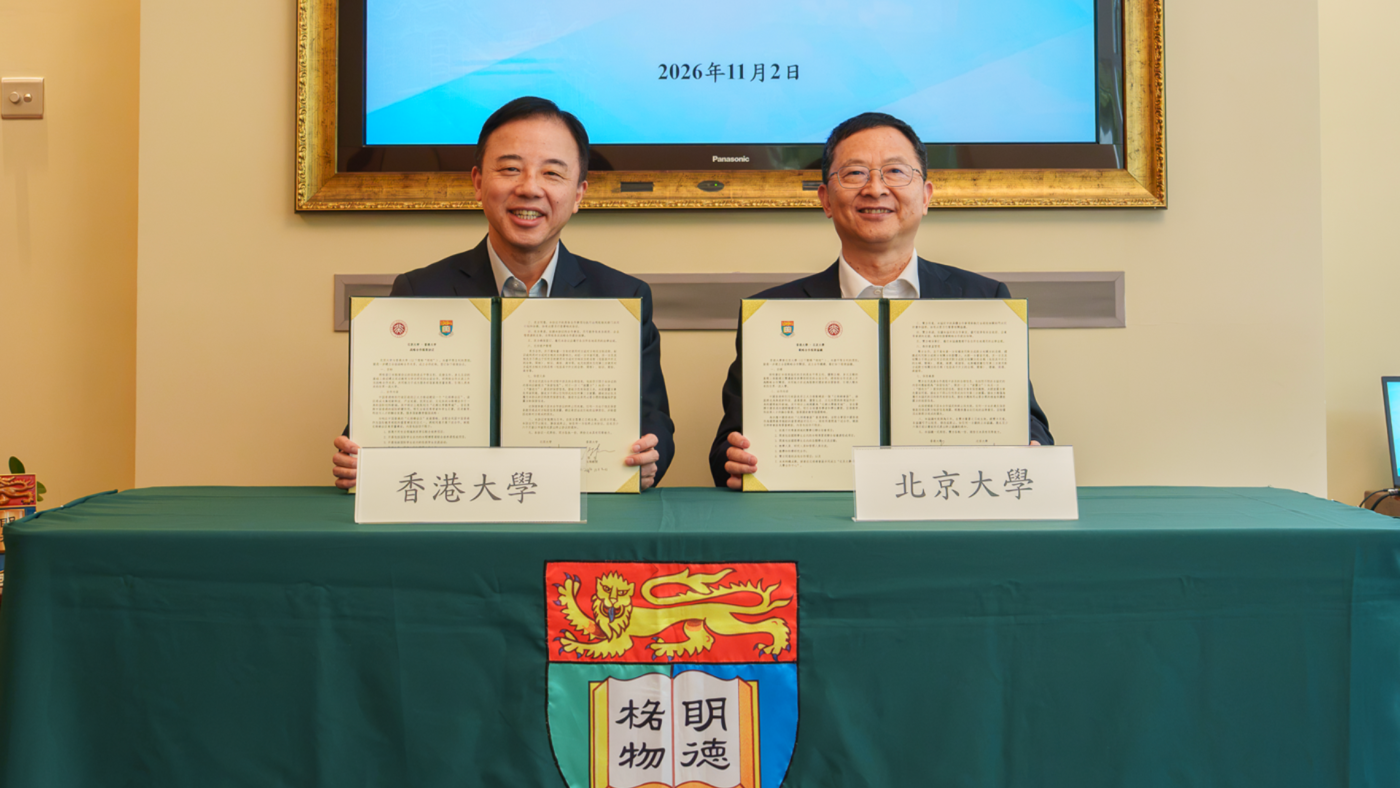
The University of Hong Kong (HKU) and Peking University (PKU) have signed a Strategic Cooperation Framework Agreement establishing a comprehensive blueprint for long-term collaboration across teaching, research, and talent development.
The agreement was signed on November 2, 2026 by Professor Xiang Zhang, President and Vice-Chancellor of HKU, and Professor Gao Song, President of PKU. The partnership leverages the academic and research strengths of both institutions – ranked first and second in Asia, respectively, by QS – to expand opportunities for students and faculty, while supporting Hong Kong's development as an international education hub and contributing to the Northern Metropolis initiative.
The agreement spans seven priority areas, including expanding joint dual-degree programmes across diverse professional disciplines; establishing integrated undergraduate-to-postgraduate pathways for local and international students; facilitating student exchanges and experiential learning; and promoting reciprocal visits and academic exchanges for teaching, research, and administrative staff. Both institutions will also deepen collaboration in cutting-edge scientific research and pursue other innovative projects of mutual interest.
Notably, the two universities will actively explore establishing a "Peking University–University of Hong Kong Joint Centre" within the Northern Metropolis, anchoring the partnership in one of Hong Kong's most significant development initiatives.
Professor Zhang described the agreement as "a powerful alliance between two century-old, world-class institutions." He said: "By seizing the strategic development opportunities of the Northern Metropolis, we will not only expand academic horizons for local and global talent but also pioneer a new paradigm for cross-border research and innovation. This partnership will generate a powerful synergy, contributing significantly to the high-quality development of the nation."
The agreement marks the beginning of what both institutions describe as a transformative partnership, uniting their strengths to cultivate the next generation of global talent and push the boundaries of knowledge.
Related Topics
Related News