Research & Discovery
Finding Their Words: HKU Studies Explore New Paths to Speech Recovery After Stroke
A small HKU trial has reported gains in word-finding after stroke using brain stimulation tailored to each person’s language network, offering an early indication of how rehabilitation could become more personalised.
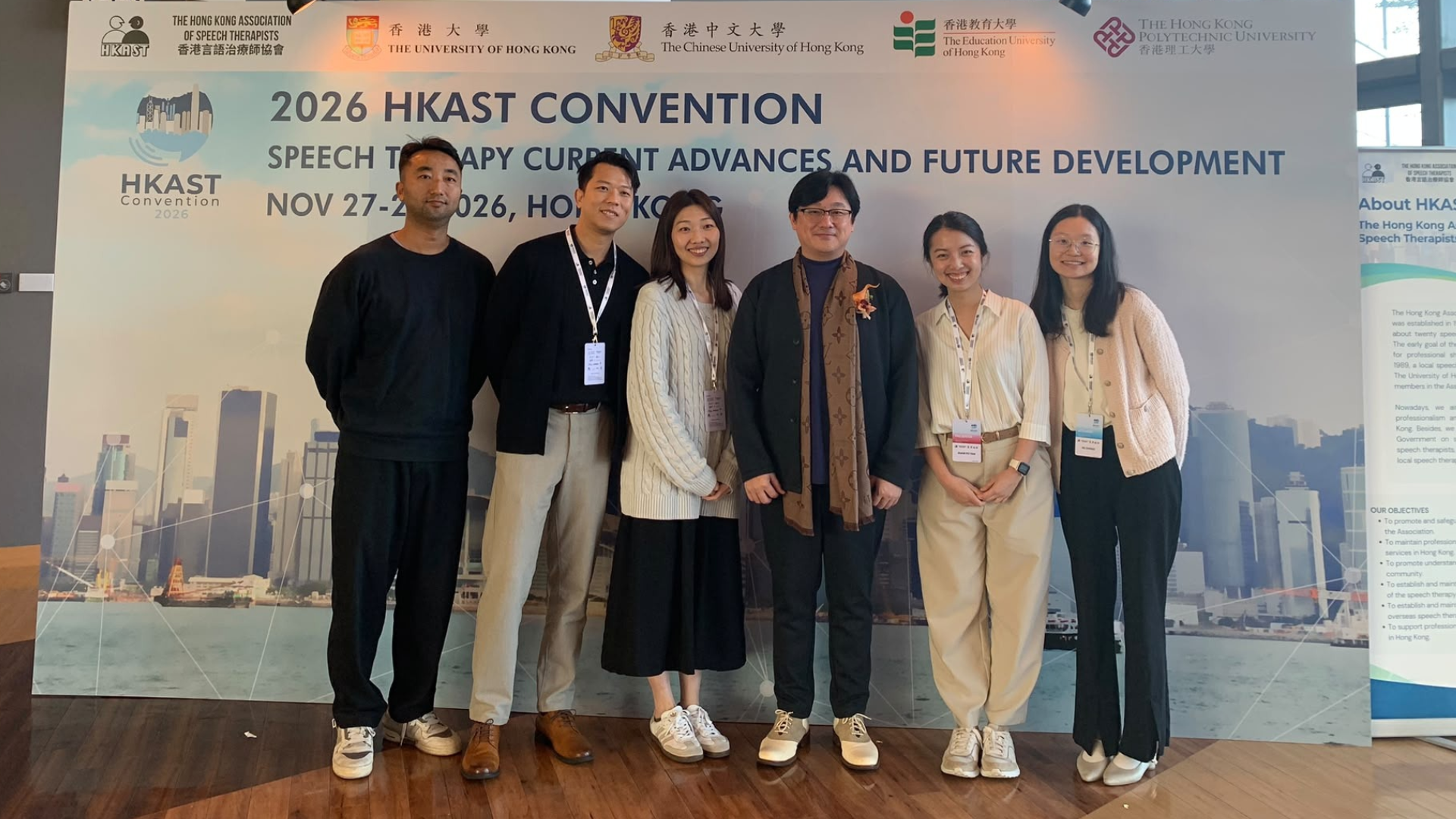
The findings were presented on Friday, 27 November, at the inaugural Hong Kong Association of Speech Therapists (HKAST) Convention at Cyberport 3. Two other HKU studies examined AI-assisted naming practice and intensive online therapy for Cantonese-speaking people with aphasia.
Professor Anthony Pak-Hin Kong said the findings underscored the importance of “customizing interventions to individual needs and utilizing technology to broaden access”.
He described the results as encouraging progress in personalised, accessible aphasia treatment. Evidence-based guidance for Chinese-speaking populations remains limited compared with Western settings, he said. His HKU team has spent several years studying interventions tailored to Cantonese speakers’ linguistic needs.
Kong, head of HKU’s Academic Unit of Human Communication, Learning, and Development in the Faculty of Education, co-chairs the convention. The two-day gathering marks HKAST’s 45th anniversary and is co-organised with Hong Kong’s four speech-therapy training universities.
Aphasia, often caused by stroke, affects the ability to use and understand language, including reading and writing. Difficulty retrieving words, known as anomia, can make everyday conversations demanding. The HKU presentations led by Kong’s research team in the Aphasia Research and Therapy (ART) Laboratory explored how treatment might respond more closely to individual needs and reach people who face difficulties accessing services.
PhD candidate Chester Yee-Nok Cheung presented a randomised, double-blind trial involving 20 people with post-stroke aphasia. His approach uses electroencephalography, which records electrical brain activity, to identify individual stimulation targets. Low-level alternating electrical currents are applied through electrodes on the scalp.
Participants received ten sessions over two weeks, combining word-finding therapy with individually targeted stimulation, stimulation at predetermined sites or a sham condition. According to the study abstract, the individually targeted group recorded the largest improvements in naming and overall language performance. The findings provide preliminary evidence for an approach that requires further evaluation in larger studies.
Speech therapist Po Yan Sham investigated a different route: a computerised application that adjusts the intervals between repeated naming exercises. It combines automatic speech recognition with real-time AI feedback, drawing on the principle that spacing practice can help people retain what they learn.
Five Cantonese-speaking adults with chronic aphasia each completed both the computerised treatment and semantic feature analysis, a therapy that helps people retrieve words through their meanings and characteristics. Both approaches produced naming gains that persisted four weeks after treatment, according to the abstract. The researchers reported comparable gains, suggesting potential for technology-supported practice alongside clinician-led rehabilitation.
Dr. Cherie Wan Yin Wong’s study considered whether an intensive, comprehensive aphasia programme could be delivered online. It involved 26 adults with chronic aphasia who received 39 hours of treatment through either in-person or virtual delivery.
Both groups improved in language skills and quality-of-life measures. Participants’ feedback supported the feasibility of online delivery, while identifying caregiver help, confidence with technology and patient characteristics as important factors. The findings suggest potential for reaching people with limited mobility or access to services.
The morning’s programme included a keynote on AI-based speech assessment by Modality.AI’s chief science officer, Professor Vikram Ramanarayanan. An HKU survey presented by Suxiao Xu identified reliability concerns and training needs among clinicians using digital tools.
The afternoon keynote by CUHK’s Professor Gary Lam focused on centring neurodivergent people’s lived experiences in clinical practice.
The convention continues at HKU on Saturday. Indiana University’s Dr Rita Patel will deliver “Innovating Across Borders: Advancing a Common Framework for Instrumental Voice Assessment” from 9–10 am at Yuet Ming Auditorium in the Chong Yuet Ming Cultural Centre. Her talk will examine how a shared assessment framework could help clinicians compare findings across clinics and countries, linking advances in voice science with everyday care.
Related Topics
Related News