
HKU Around the World
The Trust That Science Must Earn
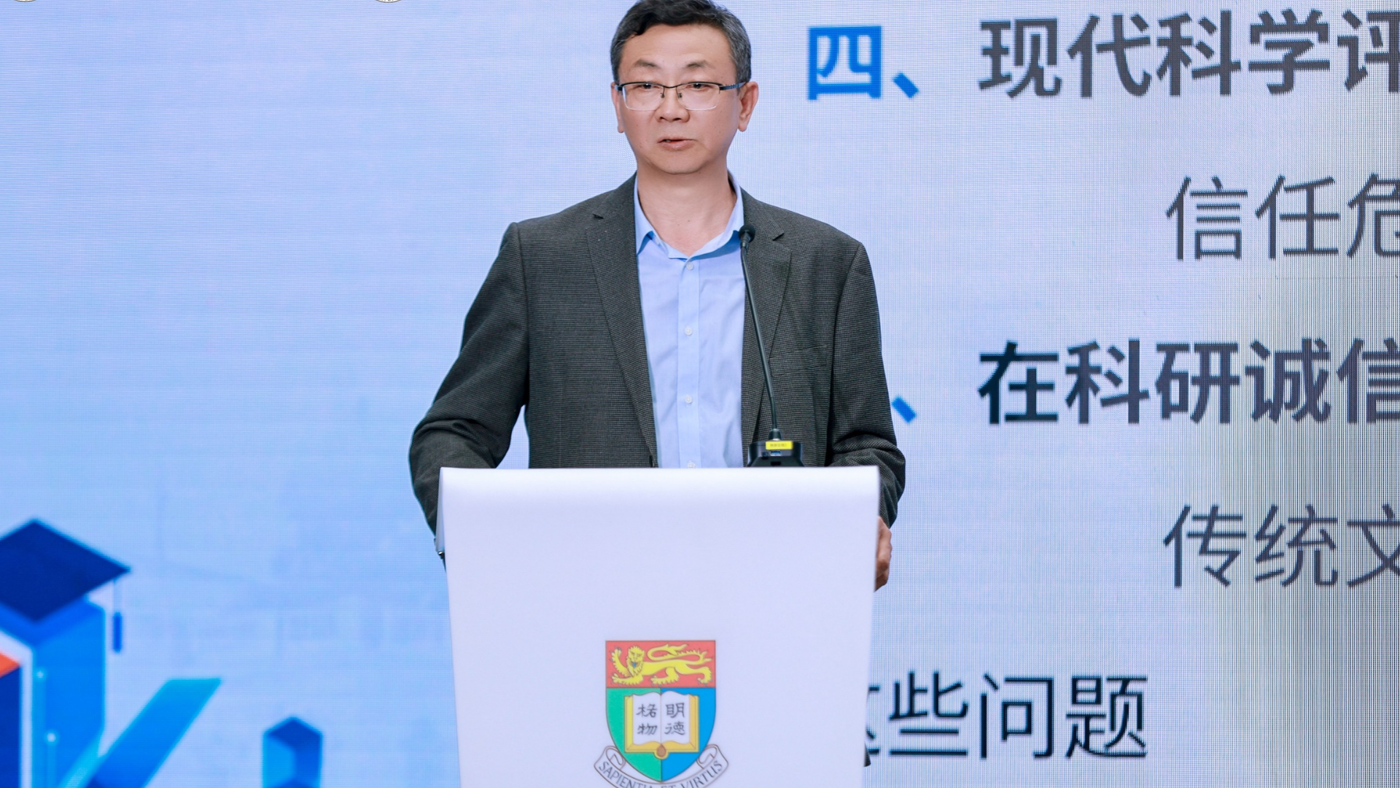
Editor’s note: Professor Zhou Zhonghe is an Academician of the Chinese Academy of Sciences and a researcher at the Institute of Vertebrate Paleontology and Paleoanthropology. He is also the Editor-in-Chief of The Intellectual, a Chinese-language science and public-intellectual media platform. This OpEd was adapted from a keynote address he delivered at the HKU Talent Forum in Beijing on October 31, 2026.
A scientific paper can look deceptively self-contained. It has a title, a list of authors, figures, references and a conclusion. Yet its significance lies outside the document. A paper enters a living system of people and practices: researchers who read it critically, reviewers who test its reasoning, editors who make judgements, funders who set incentives, institutions that reward particular forms of work and, ultimately, a public that decides whether science deserves trust.
Science does not ask to be believed because it speaks with authority. It earns confidence by making claims available for examination. Its strength is not that every published result is final, but that methods, evidence and arguments can be questioned, tested and, where necessary, revised.
In a 2026 Chinese essay on the evolution of modern science, the biochemist Wang Xiaodong made a distinction worth preserving. Peer review, he argued, does not prove a paper correct; it reduces the risk that a research community will accept an error. This is not a small difference. It reminds us that science is a process of organised scepticism, not a factory for instant certainty.
The history of scientific publishing is therefore more than a story about paper and printing. When Philosophical Transactions began in the seventeenth century, it provided a new way to make observations public and to establish a record of who had reported what. Over time, journals and peer review developed as means of organising, assessing and preserving research. Scholarly communication is now often understood as doing four related jobs: registering a claim, disseminating it, helping to evaluate it, and maintaining an archive.
Those functions remain indispensable. But they are under unusual strain. Research is faster, more collaborative and more closely connected to technological, economic and social ambitions. That expansion reflects the widening reach of knowledge. It also makes it tempting to ask papers and journals to perform too many roles at once.
An old Chinese warning captures the problem of distorted incentives. Mozi recounts that King Ling of Chu favoured officials with slender waists; courtiers responded by restricting their meals to conform. The point is not to compare today’s research system with an ancient court. It is to recognise that people learn quickly what an institution rewards.
A publication should communicate a finding and place it on the record. It has increasingly become a shorthand for an individual’s worth, a laboratory’s standing and an institution’s claim on scarce resources. In another 2026 essay, Wang Liming asked how scholarly honour can become a kind of currency, convertible into resources and status. That question is useful because it directs attention away from individual virtue alone and towards the incentives that shape behaviour.
When the question “What does this work show?” is displaced by “Where did it appear?” or “How quickly can it be counted?”, judgement suffers. The San Francisco Declaration on Research Assessment, widely known as DORA, makes the point plainly: a journal-based metric should not stand in for the quality of a particular article or the contribution of a particular scientist. Numbers can be useful descriptors. They become damaging when they offer an illusion of precision that is easier to administer than genuine evaluation.
Peer review faces a similar problem. It is essential, but it is not an infallible machine for truth judgement. Reviewers contribute knowledge, experience and scepticism. They can identify weak reasoning, inadequate evidence and overstatement. Yet review is conducted by human beings with limited time, incomplete information, and sometimes even with competition among peers. It should be valued as a demanding form of scholarly service, not treated as a ritual that transfers all responsibility from author to journal.
The same discipline is needed when we discuss reproducibility and replicability. These terms are often used loosely, as if a single successful or unsuccessful attempt could settle a complex question. Reproducibility commonly means obtaining consistent results from the same data and code; replicability concerns whether new research, using new data or methods, reaches consistent conclusions about the same question. Both are important. Neither removes the need to consider context, uncertainty and the cumulative weight of evidence.
For that reason, a failed replication is not automatically proof that earlier work was worthless. Nor should difficulty in replication be dismissed. It can reveal missing details, hidden variation, fragile methods or questions that deserve closer attention. Science becomes stronger not when it avoids such moments, but when it has the patience and incentives to investigate them honestly.
We should also be willing to experiment with the paradigm of scientific publications and communications. Traditional journals will remain important, but they need not carry every burden alone. Some initiatives make research available first as a preprint, then publish reviews and editorial assessments openly. Others organise community evaluations of preprints. These experiments do not eliminate the need for expertise or careful editing. Their value is that they separate tasks that have too often been compressed into one moment of publication: sharing a result, examining it and deciding how much confidence it deserves.
The same principle applies to research funding and careers. Resources and recognition cannot be distributed without judgement. But a healthy system should not reward only predictable results, rapid output or familiar approaches. It must preserve room for long-term inquiry, work across fields, the replication of important findings and questions whose value may not be immediately visible.
Artificial intelligence makes this task more urgent. AI can assist with literature searches, coding, translation and routine drafting; it may also increase the speed and volume of scientific communication. But it cannot bear scientific responsibility. A tool cannot explain a conflict of interest, accept accountability for an error or decide whether evidence justifies a conclusion. In an era of powerful tools, the human duties of authorship—honesty, disclosure and responsibility—become more rather than less important.
This has consequences for how we educate future researchers. They need technical competence, of course. They also need to learn how to choose meaningful questions, think independently, assess other people’s evidence and explain their work to wider audiences. Scientific reputation is not a personal ornament. It is part of a shared system of trust.
The aim is not to return to an imaginary, simpler age of science. The modern research enterprise is larger, more diverse and more capable than it has ever been. Our task is to ensure that its institutions remain equal to that success. Durable trust does not come from a prestigious logo, a high score or a single gatekeeper. It comes from a culture in which claims can be checked, credit is assigned responsibly, uncertainty is not concealed and curiosity is still allowed to take risks.
Related Topics
Related News