
Research & Discovery
Do Not Surrender the Quest to Understand
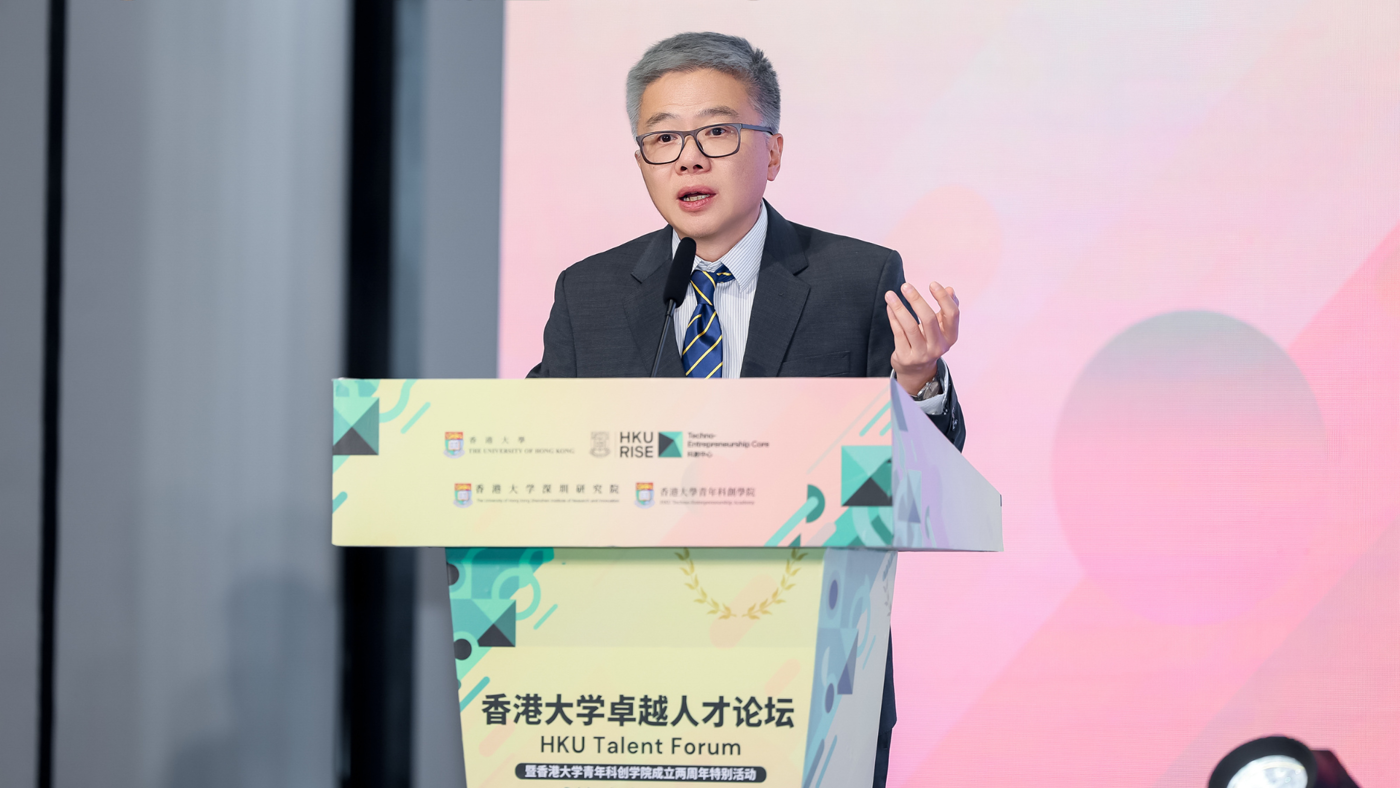
This article is adapted from a speech given by Professor Ngô Bảo Châu, Chair Professor in the Department of Mathematics at The University of Hong Kong, to the HKU Talent Forum and the second anniversary celebration of the HKU Techno-Entrepreneurship Academy (TEA) in Qianhai, Shenzhen, on 5 September. It reflects the author's personal views and experiences.
Artificial intelligence is often framed as a contest: will machines outthink us, take our work, or make expertise obsolete? Those questions are understandable, but they miss a more important one. Will we surrender our own desire to understand the world?
The crucial choice is personal. We can surrender our intellect to AI, wait to be fed all responses from AI, or we can ask AI to help us achieve a broader and deeper understanding of the world. The distinction may sound philosophical. It is not. It will shape how we educate students, organise work, and decide what remains worth doing for ourselves.
We cannot read more, nor remember more, than a computer can. We cannot run as fast as a car, and a chess grandmaster cannot defeat the strongest AI system alone. But these comparisons can mislead. The point is not to race the machine. A person working with AI may understand a situation better than either one working independently. The question is whether the technology enlarges our capacity to make sense of the world, or encourages us to abandon that responsibility.
This is especially important in mathematics, where calculation and understanding have always been different achievements. Ancient civilisations found ways to solve quadratic equations. Renaissance mathematicians found solutions for cubic and quartic equations. Later, Lagrange and Galois explained their structure and limits. Galois did not merely find an answer; he created a language for asking what equations are and what their symmetries reveal.
Imagine an AI system operating before the Renaissance. It might have found formulae for cubic and quartic equations through formidable search and calculation. But finding a formula is not the same as explaining why it works or inventing concepts that let a field see its questions differently. It is hard to imagine such a system arriving, by calculation alone, at the idea of a Galois group.
That distinction should shape how we think about current AI. In mathematics, these systems can explore intricate constructions and test possibilities beyond unaided human calculation. They can bring within view problems once too large, repetitive or technically demanding to investigate seriously, perhaps revealing phenomena hidden because the relevant examples, though modest in dimension, were inaccessible to hand calculation.
Mathematicians often begin with the simplest cases. We study one or two dimensions, identify a pattern and then seek to extend it. Yet some phenomena do not show themselves in the smallest examples. They appear a little further on, where the objects remain conceptually manageable but their details overwhelm the unaided mind. AI may be especially useful there. It can help us explore, compare and construct, perhaps bringing into view something that later becomes the basis of a new theory.
But that is precisely why we should resist treating AI as an oracle. An oracle gives an answer and asks nothing of us. A tool extends our reach while leaving us responsible for the question, interpretation and consequence. The more capable our tools become, the more important it is to preserve our willingness to ask questions for which no ready-made response exists.
That is the work of a university. A university cannot be reduced to providing students with the latest tools, however powerful they may be. Students must learn to test an AI-generated claim, distinguish a plausible pattern from a sound explanation, recognise the limits of evidence and take responsibility for a judgment. But a university must also protect something more fundamental: the thirst to make sense of the world around us, and of the universe.
Therefore, it’s my warmest wish for our students to keep their thirst for making sense of the world around us, of the universe. That wish is larger than employability, though it does not ignore the economic realities students will face. A student who keeps this thirst will not merely operate a tool. They will ask what it reveals, what it conceals, whose interests it serves and what new forms of knowledge or responsibility it may make possible.
This matters because AI will not arrive in a social vacuum. It will change the organisation of work. Junior roles may disappear or be recast. Teachers will have to rethink how they design problems, examinations and doctoral projects. We will need better ways to assess and credit work in which AI has played a part. In some cases, AI may make work more enjoyable and creative. In others, it may create pressure to replace people simply because a system is cheaper.
The deepest risk lies not only in what the technology can do, but in the economic logic through which we choose to deploy it. If efficiency becomes the only measure, we may hand over tasks central to learning, judgment and human dignity. We may also remove the early opportunities through which young people acquire competence. The question is not whether we should stop technological progress. We cannot and should not. The question is what we will value when technology makes substitution possible.
No individual, institution, or company has a finished answer. We will have to work it out together, through policy, education, employment and culture as well as science and engineering. It will require us to recognise human contribution in forms that cannot be reduced to output per hour or cost per task.
The right response is not to stand apart from AI. Let AI be our tool, our companion in that endeavour, because that’s our chance to survive this revolution. The word companion matters. A companion does not absolve us of responsibility or live our intellectual lives for us. It travels with us as we undertake a difficult journey.
The most valuable use of AI may therefore be neither to save us the trouble of thinking nor to offer a convincing imitation of thought. It may be to make the world newly available to inquiry: to reveal patterns we had not seen, test ideas we could not otherwise test and give us more room for the distinctly human work of framing questions, making judgments and creating meaning. That is a task worth preserving. It is also a task worth teaching.
Related Topics
Related News