
Newsroom
HKU Engineering Team Develops Omnidirectional-Sensing Single-Propeller Autonomous Drone Natural Body Rotation for Omnidirectional Sensing, Combining Agile Flight and Collision Resistance
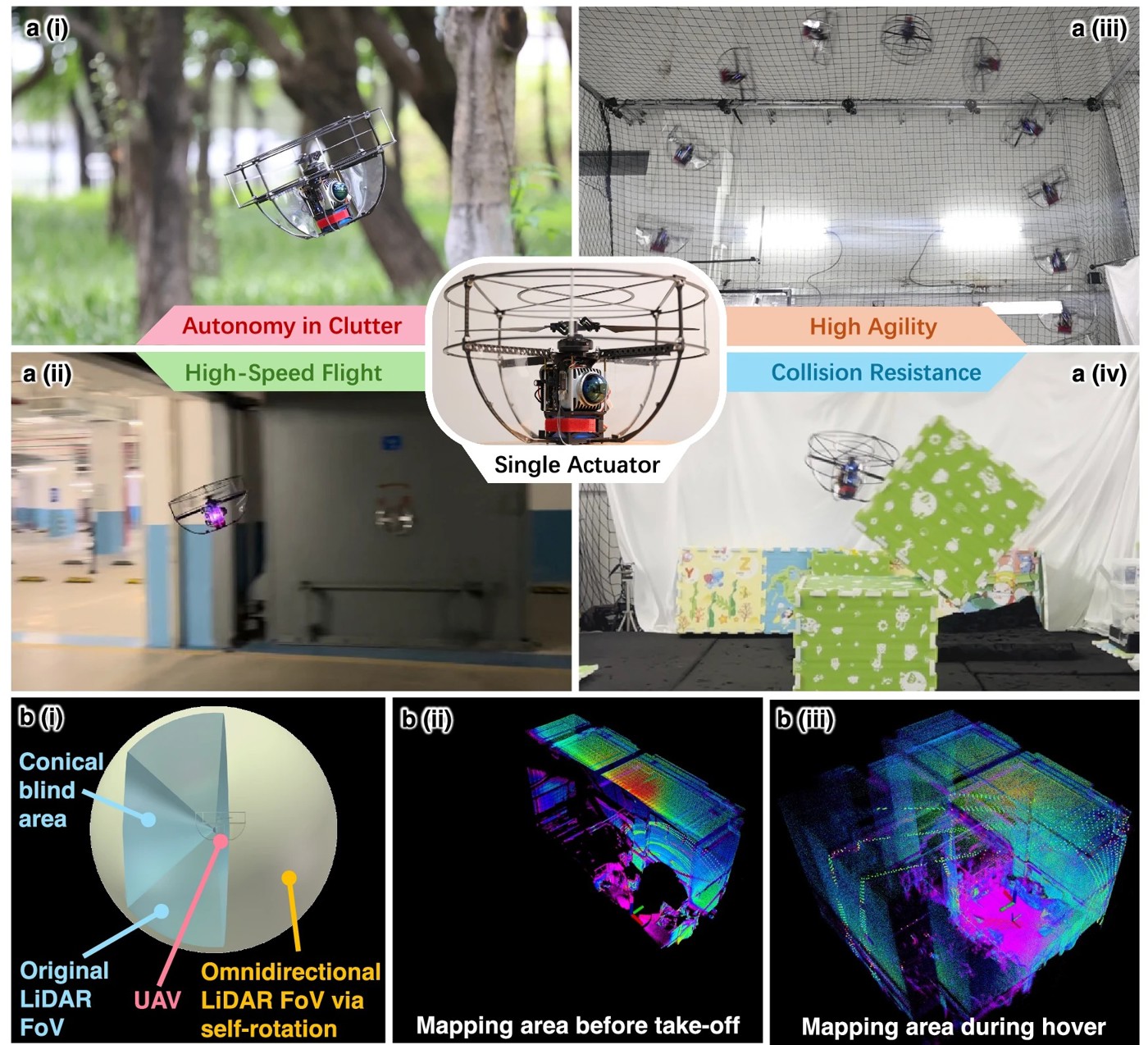
A research team from the Department of Mechanical Engineering of Faculty of Engineering at The University of Hong Kong (HKU) has developed a single-propeller autonomous drone powered by only one motor. It can not only fly at high speed in complex environments such as forests and underground car parking lot, but also observe space in all directions—up, down, left, and right—while in flight, and maintain controlled flight in collision tests. Named PULSAR II, the drone cleverly exploits its continuous body spin to achieve omnidirectional environmental detection with only one LiDAR, without the need to add multiple sets of sensors or a rotating gimbal.
The research team includes Associate Professor Fu Zhang and Research Assistant Professor Nan Chen from HKU’s Department of Mechanical Engineering, among others. Nan Chen is the first author of the paper, and Fu Zhang is the corresponding author. The research findings have been published in the academic journal Nature Communications.
Conventional quadrotor drones use four motors to control flight. To expand the sensing range, they usually need to add more cameras, LiDAR, or independent rotating devices. However, such extra equipment not only increases body weight and power consumption but also makes the entire system more complex. A single-propeller drone requires only a single motor, offering a simple structure and high flight efficiency, but simultaneously achieving precise control, comprehensive sensing, and safe flight in obstacle-dense environments has long been a research challenge.
PULSAR II adopts a specially designed swashplate-less mechanism, with a single motor driving two propeller blades. Researchers only need to precisely adjust the rotational speed during each revolution of the motor to change the attack angle of the two blades, generating the torque required to control flight direction. The drone’s body naturally rotates during flight, thereby gaining the advantages of high-efficiency flight and omnidirectional sensing that conventional aircraft find difficult to achieve simultaneously.
LiDAR measures distances to surrounding objects by emitting and receiving laser signals, helping the drone build 3D maps. However, even with a sensor with a larger field of view, there are still areas it cannot see when its orientation is fixed. The research team mounted a LiDAR vertically on the body. Combined with the drone’s own rotation, it can scan the space including the ceiling above, the ground below, and the surroundings around the body. In experiments, before takeoff, the drone could only build a partial indoor map; after takeoff, as the LiDAR continuously rotated, it could build a more complete 3D point-cloud map without the original blind spots. This allows the drone, even when hovering in place, to know the positions of surrounding obstacles and then plan its next flight path.
Prof. Fu Zhang said: “Generally, to make a drone see more comprehensively, one often has to add sensors or install an additional rotating mechanism. We instead use the body’s own spin to expand the field of view. The key is to coordinate the mechanical structure, environmental sensing, and flight control so that this simple design can also handle complex environments.”
In addition to seeing comprehensively, the drone must also fly accurately. Since the response of a single-motor propulsion system is not completely consistent at different rotational speeds, the research team first established a propulsion model through experiments, then designed a compensation method, and introduced model predictive control on manifolds, enabling the drone to follow a predetermined trajectory more accurately. In tests involving high-speed figure-eight flight and in-air flipping attitude flight, PULSAR II completed them precisely; compared with the conventional control method used in the study, the new system’s trajectory tracking error was also greatly reduced.
To reduce the risks caused by collisions, the team installed a lightweight carbon-fiber protective frame around the drone to protect the propellers and other more fragile components, and developed a control method capable of identifying external disturbances, preventing the body’s inherent spin from affecting the detection of impacts. Researchers respectively dropped a soft ball from above while the drone was hovering, and arranged for the drone to fly forward, collide with, and push away placed obstacles. Test results showed that PULSAR II could still maintain stable flight performance under these collision conditions.
The research team further brought the entire autonomous flight system to real-world environments for testing. The team conducted tests in forests dense with trees, branches, leaves, and weeds, as well as in underground car parks filled with pillars, doorways, and overhead pipes. The drone successfully traversed passages and bypassed obstacles at speeds exceeding 6 meters per second. During flight, mapping, obstacle avoidance, and flight control were all completed autonomously by the onboard system, without relying on GPS navigation, external motion-capture equipment, or a ground computer.
Dr. Nan Chen pointed out: “Making a single-propeller drone fly is only the first step. The greater challenge is to coordinate sensing, path planning, and flight control during flight, especially under conditions of high-speed turning maneuvers or external disturbances. Field tests in dense forests and enclosed underground car parks allowed us to verify the performance of this system in real environments.”
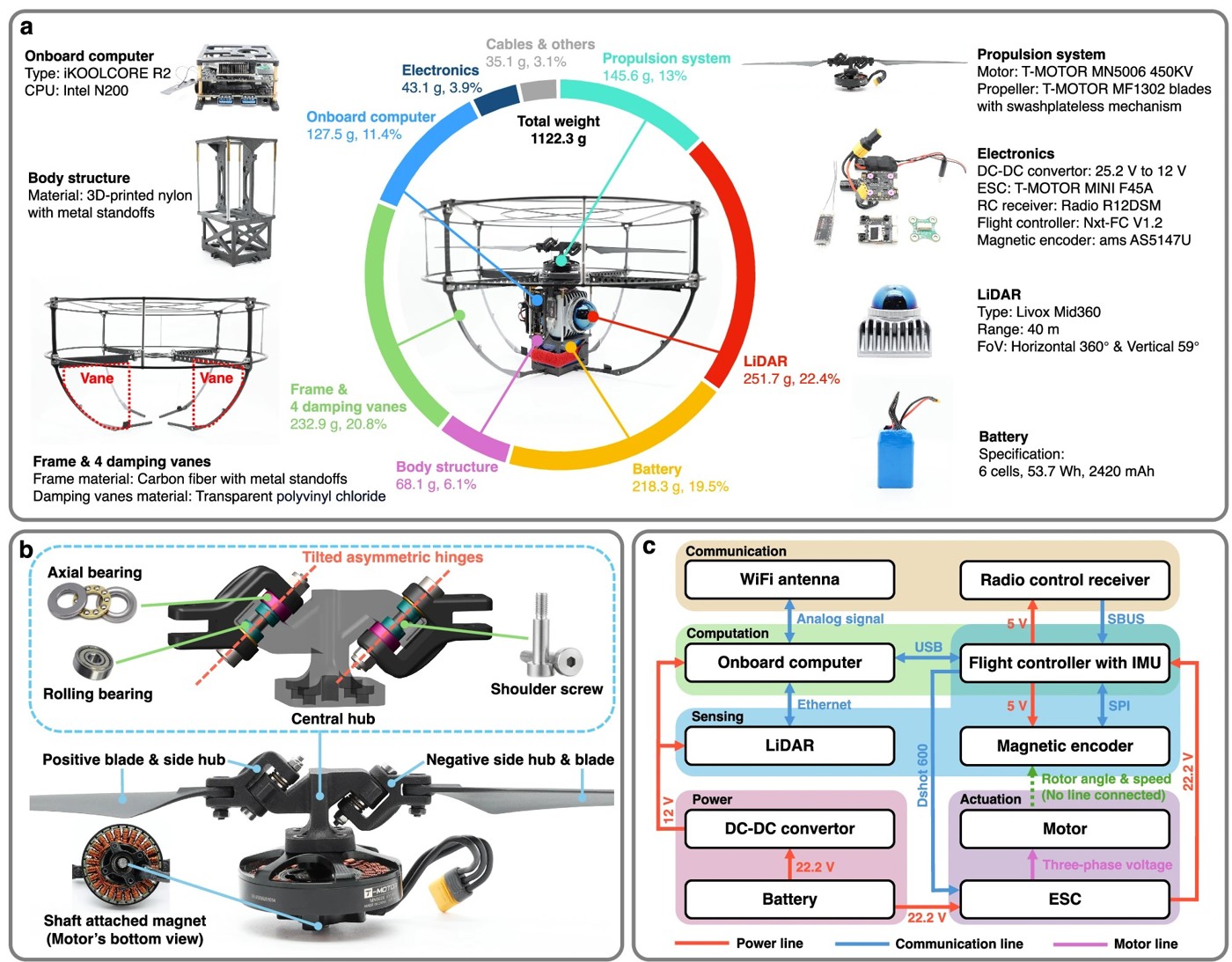
The PULSAR II has a total weight of about 1.12 kg and achieved a measured hover time of 15 minutes and 50 seconds. The research team believes that this technology may in the future be applied to environments where satellite navigation signals are weak or unavailable, including dense forests, caves, tunnels, and underground facilities, and provide new technical options for search and rescue, disaster response, and 3D terrain mapping. The team also plans to further improve the drone’s localization capability in open spaces lacking sufficient laser reflection points.
The paper published in Nature Communications is titled “An autonomous single-actuator UAV with omnidirectional field of view, high agility, and collision resistance.” Paper link: https://www.nature.com/articles/s41467-026-73283-x.
For media enquiries, please contact:
Faculty of Engineering, HKU
Ms Christina Chung (Tel: 3910 3324; Email: chungmc@hku.hk)
Ms Natalie Yuen (Tel: 3917 1924; Email: natyuen@hku.hk)
Related Topics
Related News