
People
The Trouble-maker, the Problem-shooter, and the Boxer
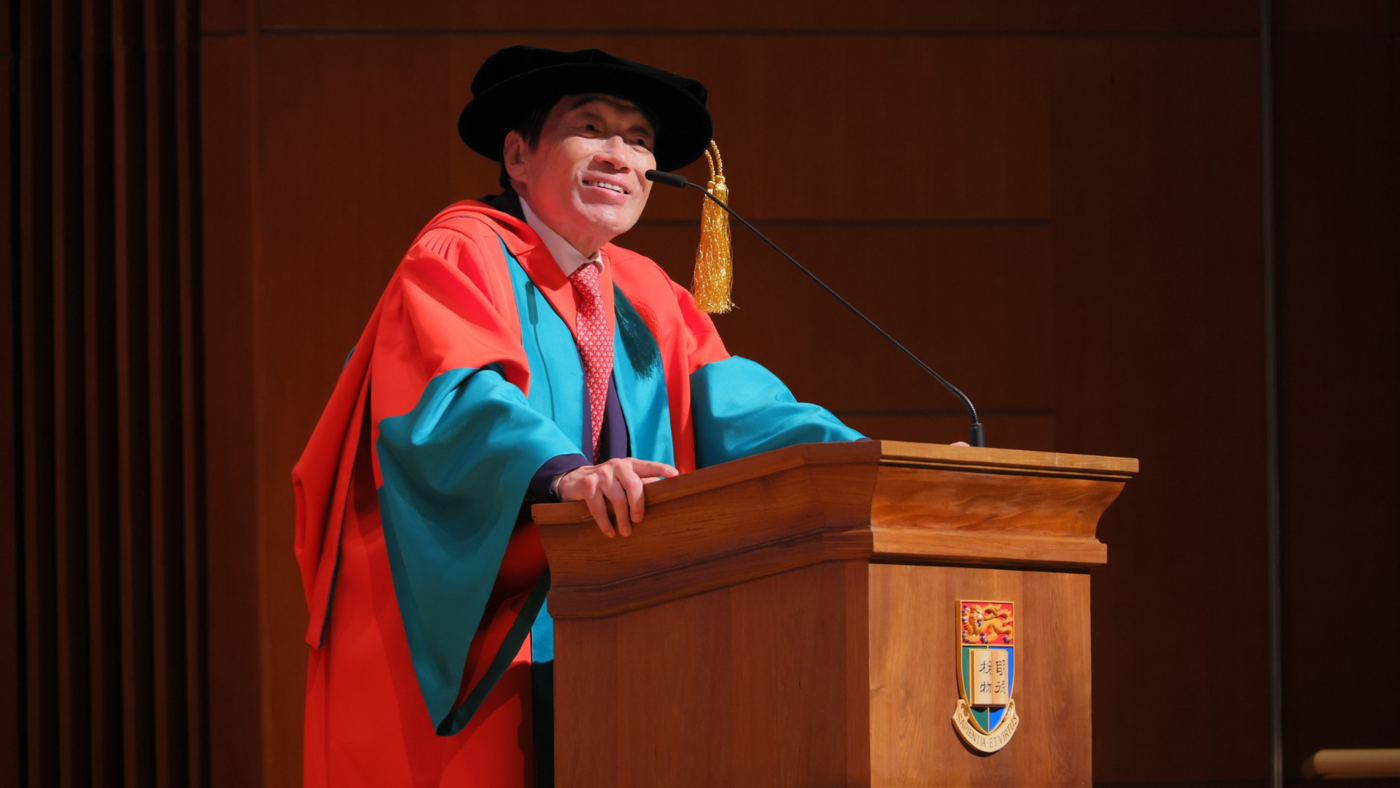
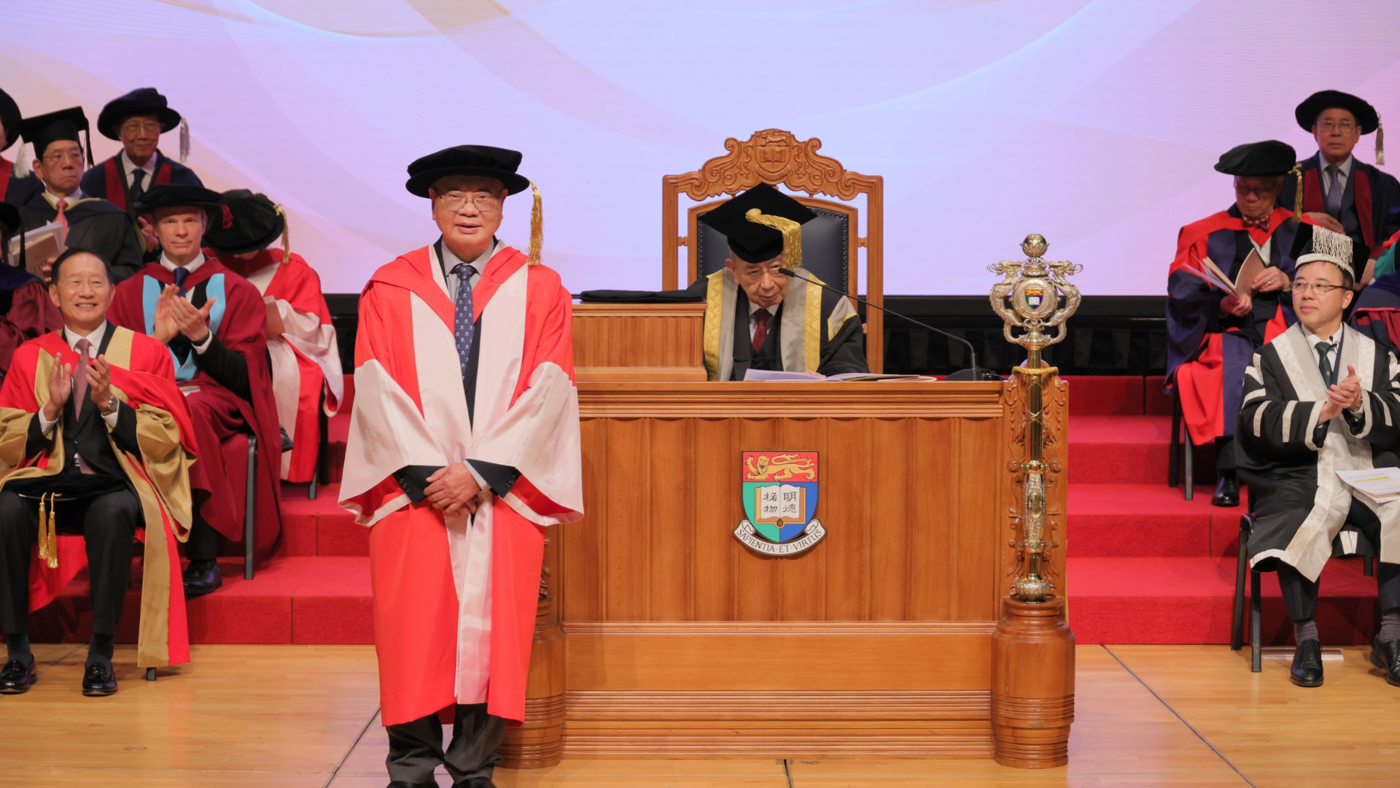
This is the text of a citation delivered by Professor Brian Wong, public orator, HKU, presenting Mr Henry Fan Hung Ling for a Doctor of Science, honoris causa at the 219th Congregation on November 18, 2026.
To defy expectations and convention. To solve a myriad of problems through empathy and efficiency. To pick oneself up where one falls. To persist against all odds.
These are the qualities that fittingly describe the underdog that we know from the books of old.
These are also qualities that came to mind after my conversation with our protagonist today. To do his life – of ups and downs, of trials and triumphs – justice, is no mean task. But I will seek to do so in three chapters, which speak to three important facets of his character:
The Troublemaker, the Problem-shooter, and the Boxer.
Chapter One – the Troublemaker
Mr Henry Fan was born in Shanghai in 1948, the fourth amongst five siblings.
His father moved to Hong Kong in 1950 and was joined by his wife two years later.
She also brought along her four-year-old son. Grandma dubbed him the “naughtiest” and insisted that Mr Fan’s mother brought him to Hong Kong.
This thus became the first stroke of luck in Mr Fan’s life.
He and his parents resided in Kowloon City, where he attended kindergarten and then proceeded through a slew of primary and secondary schools before arriving at St. Francis Xavier’s College. Whilst many of his classmates indulged in basketball and boyish bluster after school, he had a rather unique understanding of leisure –
Observing court cases, through sitting in on the Supreme Court, then located in Central.
He was mesmerised by the ebullient bravado of the barristers, as they fought wars with words. He wanted to become one of them.
Yet despite reading his Sixth Form at the prestigious Diocesan Boys’ School, there was no easy way for him to practise law. There were only two paths – studying law in the UK or paying a hefty sum to a local law firm to serve as an articled clerk. Neither was immediately affordable to him.
A modest childhood had trained him to be resourceful and get creative about the way he navigated his life ahead. He knew he had to find another way. As such, he resolved to read Economics and Business Management at this very university, graduating in 1969. He was equally determined to pursue legal studies once he had the means to do so.
Chapter Two – the Problem-shooter
Upon graduation, Mr Fan joined World Wide Shipping, the prominent shipping company helmed by Sir YK Pao, where he worked his way up the ranks between 1969 and 1976. Starting out in Hong Kong, he later transferred to Tokyo, where he spent six years.
In foreshadowing his later developments, he also kept himself extremely busy in this period. He enrolled himself on a remote legal study course at the Rapid Results College, where he would strive to catch up with the latest cases, complete mock exams and exercises remotely, and send his answers in via correspondence. It took him ten years to receive his qualifications.
Given how rapid the process was, I think he should have asked for a refund.
In 1976, Mr Fan was approached by D.H. Chen to join Nan Fung, which was looking to start its own shipping practice. Never one to turn down challenges, he ended up at the helm of the shipping and property practice at the firm.
But his true passion remained with the law. Thirteen years after his graduation, he was finally called to the bar in 1982, completing his pupillage and formally beginning his practice in 1985. The first six months of the pupillage came with no pay. The next six months yielded limited pay.
Yet his love for the law, rooted in its upholding of justice but also its intellectual enigma, prompted him to take the leap. He remortgaged his house to finance his practice.
Through his legal practice, Mr Fan also earned his moniker, “The King of Loitering”.
He took particular interest in defending defendants in cases of loitering and other victimless crimes, especially those who often found themselves implicitly profiled and targeted.
There was one case where the prosecution alleged that the defendant had not only loitered but also resisted arrest by sprinting away from the officers in charge.
To prove his case, Mr Fan asked his defendant to remove his shoe in the court. As it turned out, the defendant had a foot impairment that precluded him from sprinting.
Another stroke of luck brought him to his next chapter.
He had been making respectable money at Nan Fung. Becoming a barrister meant taking a significant pay cut. Had it not been for this transition, he would unlikely have said “Yes” to the invitation from Larry Yung in 1987, who recruited Mr Fan to helm the business dimension of CITIC Hong Kong, a prominent subsidiary of the state-owned investment conglomerate.
Mr Fan joined CITIC Pacific as a Director in 1990 and became its Managing Director in 1992. He would remain in that role for seventeen years. He oversaw unprecedented expansion in CITIC’s portfolio, undertaking several critical acquisitions and investment decisions. His successes opened the door to key public service appointments.
In 2005, he joined the Executive Council as a Non-official Member. In 2007, he was appointed Chairman of the Mandatory Provident Fund Schemes Authority. He also became the Treasurer of this very university. A then-fellow Council member of his confided in me that he had never seen such a hands-on, attentive, and articulate statutory officer, who toiled tirelessly, who went above and beyond to keep this university’s financial machine running.
Yet his story was about to take a rather dark turn.
Chapter Three – the Boxer
During my lunch with Mr Fan, he insisted that I talked about what happened in 2008. Accordingly, I did my own research.
In October that year, CITIC revealed losses of 14.7 billion HKD, arising from leveraged foreign-exchange contracts tied to the Australian dollar. He was accused of engaging in market misconduct by disclosing false or misleading information. Six months later, he resigned as the Managing Director of CITIC Pacific. He dropped his public duties.
The ensuing investigation lasted six years. In 2014, the SFC officially initiated enforcement proceedings against him, amongst four other former colleagues and the company. The next three years were grueling. In these darkest times, he found light and solace in his belief that he had done nothing wrong. That he would rise again from where he fell.
In 2017, the Market Misconduct Tribunal cleared Mr Fan and his colleagues of all charges. It ruled that the SFC failed to prove culpability. It also ruled that the SFC must cover the costs of the litigation process for all the involved.
Yet the damage was done. Mr Fan’s reputation had been tarnished, in a city where forgiveness is often not easily granted.
But the then-Chief Executive saw value in Mr. Fan’s expertise. She appointed him to the Boards of the Hospital Authority and the West Kowloon Cultural District in late 2018. Without trepidation or hesitation, he took on the heavy mantle to chair the Hospital Authority in September 2019, with his term renewed successively in 2021, 2023, and 2025.
Though not a physician by training, he entered office with a determination to understand the institution from the inside out. Within the first three months on the job, he visited every public hospital under the Authority’s watch and made a point of meeting leaders and managers across the system face to face.
Then came COVID-19.
693 meetings. That’s the number of meetings Mr Fan attended during the pandemic, including the daily meetings of the Central Command Committee. With meticulous attention to detail, he steered the HA through strike pressures, service disruptions, and, of course, the harrowing fifth wave.
The Boxer must fight on.
“Sustainability” and “reform” cropped up in the words of many of his colleagues reflecting upon his legacy. Mr. Fan advocated systemic reform rather than piecemeal adjustment, focusing on modernising hospital governance. He emphasised patient-centered care: improving safety, shortening waiting times, streamlining the patient journey, and attending even to often-overlooked aspects of hospital experience such as meal services and practical dignity in care.
At the same time, he exhibited immense concern for his staff, addressing attrition through improved support packages, low-interest loans, training opportunities, and greater recognition for the healthcare professionals on whom the entire system, indeed, our very city, depends.
Public service, at its best, is deeply unglamorous. Yet Mr Fan gave it his very best – out of a love for his city. Our city.
Mr Pro-Chancellor, most successful figures have their lives marked by smooth ascent.
Mr Fan’s was not.
His is a life punctuated by detours and difficulties, marked by setbacks but also renewal, shaped by strokes of luck, leaps of faith, and defined by the act of persisting.
His story is one of an underdog: not a man without talent, far from it, but a man who took the road less travelled by; who had to improvise, recover, and start again; who persisted.
And perhaps that is why his story resonates with many of us. For it reminds us that amidst the storms of life, the ever-fixed mark is our human touch. The innately human capability to be flawed, to make mistakes, to trip up. Only to get back up again.
「邊度跌低,就喺邊度企返起身」
Distinction is often forged in difficulty, as with the countless business memos, legal submissions, and policy directives Mr. Fan drafted and pushed – in the crucible of persistence.
Here, I quote Simon and Garfunkel:
“In the clearing stands a boxer/And a fighter by his trade
And he carries the reminders/Of every glove that laid him down
Or cut him till he cried out/In his anger and his shame,
‘I am leaving, I am leaving’/But the fighter still remains.”
The fighter still remains.
Related Topics
Related News