
People
From Fireworks to Invisibility Cloaks: Sir John Pendry’s Life of Starting Again
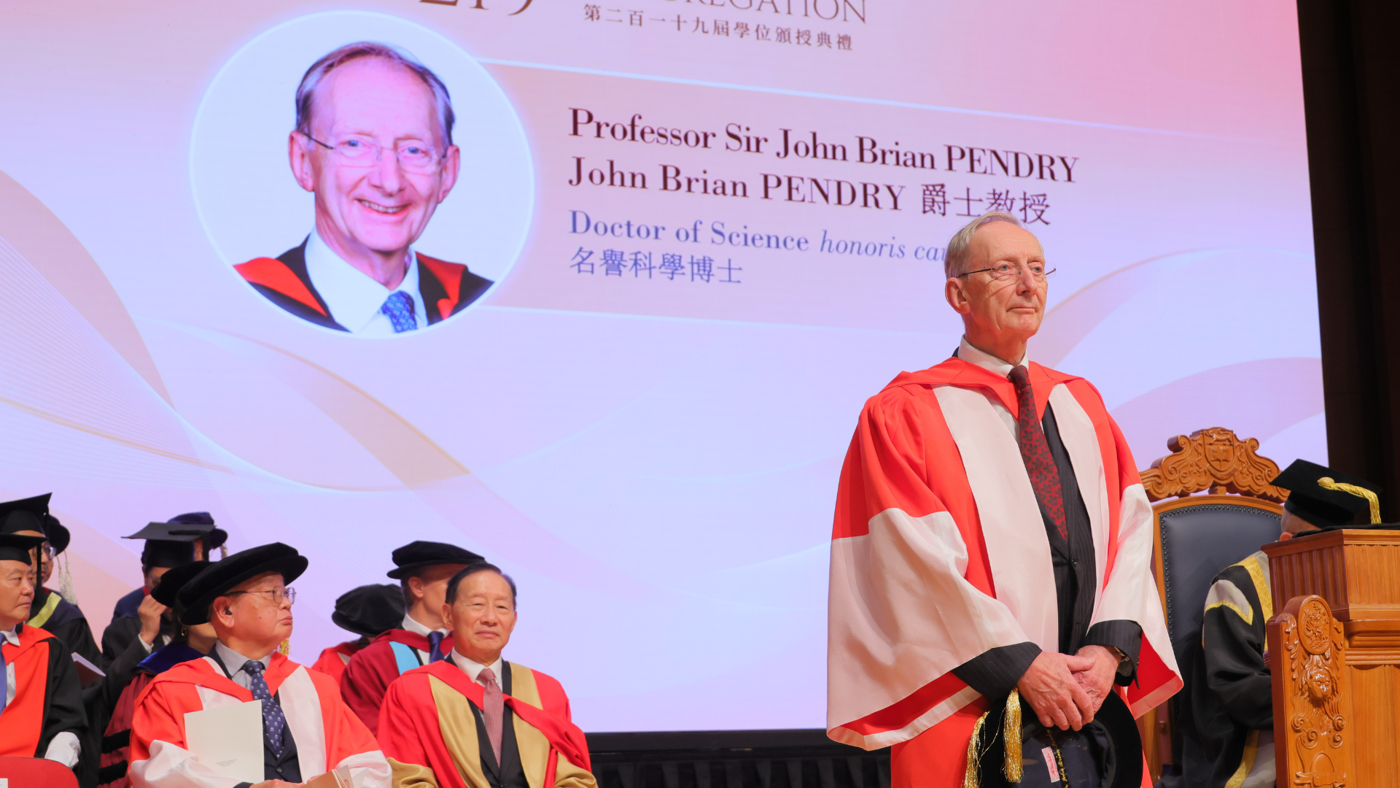
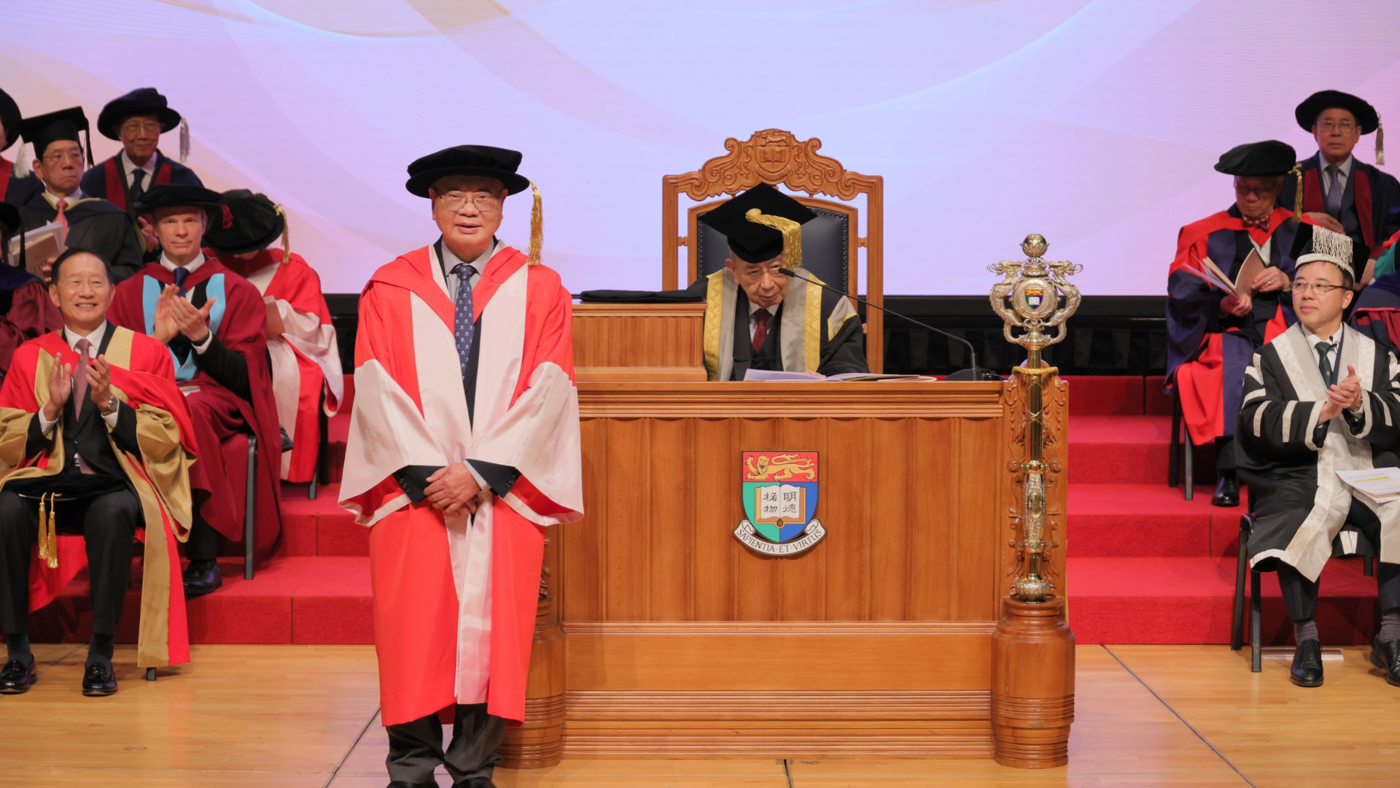
Editor’s note: Sir John Pendry was one of four recipients of honorary doctorates at HKU’s 219th Congregation on November 18 2026. This profile draws on an interview he conducted with HKU Public Orator Professor Daniel Bell and his informal remarks to HKU community leaders during the visit.
Ask Sir John Pendry what the word light brings to mind, and he does not begin with an equation. He remembers being a small boy in Ashton-under-Lyne, a market town in north-western England, waking to morning sunshine reflected from the red-brick houses opposite. His bedroom filled with an orange glow.
“You knew through the light that it was going to be a great day,” he recalls.
The Imperial College London physicist helped develop the ideas behind metamaterials, engineered structures that can steer electromagnetic waves in ways ordinary materials cannot. His proposals for superlenses and invisibility cloaks have made him internationally renowned. Yet in our conversations, the scientist’s story begins with something less imposing: a child who wanted to know how things worked, and a world full of things to investigate.
The boy from Penny Meadow
Born in 1943, Pendry grew up in a Lancashire cotton town. Wartime housing difficulties brought his parents into his grandmother’s home. She ran a shop selling sweets, ice cream and chocolate. In his published autobiography, he calls it “heaven for a small boy”. The cellar contained abandoned mechanical and electrical equipment: another kind of treasure.
The shop stood on Penny Meadow, a name that amused him because any grass had long since disappeared. Shopkeepers lived nearby with their families, and there were plenty of children to play with. Before Guy Fawkes Night, they collected wood for the bonfire with a zeal that made unattended wooden possessions vulnerable.
The adults were hardly models of restraint. A neighbouring tobacconist bought generous supplies of fireworks and, seeking somewhere dry, stored them on the mantelpiece above his fire. Eventually, they went off in the living room. Pendry was not there when it happened, but saw the aftermath.
His own early science was equally exuberant. There were toys taken apart and not always reassembled, radios to build, and experiments involving flashes and bangs. At secondary school, a farmer’s son became his “partner in crime”; the farm provided room for their experiments. Asked whether he had worried about possible misuse, Pendry replies: “I should have been.”
The distinction between an interested child and a prodigy matters to him.
“I didn’t know I had a talent for it,” he says. “I knew I had a consuming interest in it.”
He remembers being diffident rather than fiercely competitive. School revealed his strengths in science and mathematics. Languages were another matter: “I hated languages. I had no talent whatsoever.”
Around the age of ten, his interests deepened with the arrival of transistors. An uncle who worked as a radio engineer supplied electronics magazines. These were not university textbooks. They explained unfamiliar semiconductor technology to engineers trained in older equipment, offering a young reader a way into ideas beyond building another radio.
The child did not yet recognise disciplinary borders. “You just see the science there in front of you and enjoy it,” he says.
That appetite remains recognisable. “My mind is restless,” he says. It dislikes having nothing to do. Creativity also depends on what the mind has been given to work with: knowledge acquired, problems encountered, ideas left to turn over.
A mentor, and a life beyond work
At Cambridge, however, curiosity did not guarantee a seamless passage. An unhappy third undergraduate year ended with an upper-second-class degree rather than the first he had wanted, narrowing his choice of research projects. Nevill Mott helped connect him with Volker Heine, who became his doctoral supervisor.
Pendry remembers Heine making time for an idea even in the early evening, when dinner should have been calling. The lesson was not simply to choose a brilliant mentor. A supervisor needed standing in the field, but also time and interest for a student. Prestige without attention was not enough.
He completed his doctorate in 1969, worked at Bell Laboratories, and led a theory group at Daresbury Laboratory before joining Imperial in 1981. His career brought management responsibilities as well as science. He did not regard looking after people as an unfortunate interruption.
“If you’re responsible for people, that’s always your first responsibility,” he says.
The move from Daresbury to London nevertheless required a calculation beyond research. He took a pay cut, while London meant expensive housing and the irritations of commuting. He and his wife, Pat, discussed the decision together.
They had met at Cambridge, where she was a postdoctoral researcher in mathematics, and married in 1977. By the time of the London move, her civil service career mattered too. Fortunately, her employers welcomed a transfer to the capital and offered a financial incentive. The move could work for both of them.
Asked for accounts of personal sacrifice, Pendry gently frustrates the expected narrative.
“I think it’s been plain sailing on the personal front,” he says. “I’m sorry.”
Two ways to succeed
He is equally candid about professional ambition. Discovery sustains him, but praise helps. A good idea, published and appreciated, gives pleasure. He does not insist that scientists are above such feelings.
“We all have that vanity inside us, I think. Sure, I have it, too.”
What matters is deciding how to use one’s abilities. For younger scientists, he describes two routes to success: building a strong research record and then taking greater institutional responsibility, or sustaining a career centred on original research.
Neither is inherently superior. He has been a department head and held senior responsibilities at Imperial. He considers administration important, and briefly contemplated moving further in that direction.
“Ultimately, I decided that my best talents were for research,” he says.
The route through academic leadership is more common, he suggests. His own research-centred path is “not unusual, but it is a minority route”. Those seeking leadership need to think about timing: moving before they have demonstrated their abilities can be premature; waiting too long can leave them without the experience a senior role requires.
The courage to begin again
For those who want to keep discovering, he recommends the habit he has returned to throughout our conversations: “I could strongly recommend the recipe that I’ve given out time and time again, which is this ten-year cycle.”
Theory makes that easier: “Being a theorist, you travel light.” Unlike someone committed to expensive experimental apparatus, he can more readily move when a question has run its course—though his responsibilities to students remain.
Across his career, he has moved from surface science to waves in disordered materials, then to metamaterials. Now he is exploring systems whose properties change in time.
Reinvention has a cost. In surface science, he had become established and respected. Leaving meant explaining himself to old colleagues, then proving himself to people for whom his previous reputation carried little weight. It is difficult to relinquish a field in which one is already known.
But his ten-year cycle is not simply a craving for novelty. The real question is whether he still has something valuable to contribute. Preparing another direction preserves the ability to choose, rather than waiting to be steered into whatever role remains available.
Nor does starting again mean dispensing with expertise. His advice begins with acquiring a serious skill, learning what predecessors have achieved and seeking good guidance. Only then does branching out become useful: “You have something to bring to the party.”
He compares that apprenticeship to learning the piano. Years of disciplined practice precede fluency. Breadth needs something solid underneath it.
Unknowns, and other pleasures
Uncertainty, meanwhile, is part of the attraction. “When you go into a new area, you go in because of the unknowns,” he says. “You don’t know what you’re going to find.”
His own research helped open possibilities that others brought into laboratories. Among them were Xiang Zhang, now HKU’s President and Vice-Chancellor, and Nicholas Fang, now an HKU professor, whose Berkeley team demonstrated a silver superlens in 2005. But discoveries cannot reliably be scheduled to deliver a product before the next election. He argues for research funding broad enough to leave room for the unexpected.
He wants the same openness between scientists. “We should try to make science universal,” he says. He recognises that successful technologies can acquire military uses and attract security restrictions. Still, limits on whom researchers can visit and what they can discuss trouble him. Governments may set the rules; that does not make every lost conversation harmless.
Even artificial intelligence does not provoke a defensive claim to uniquely human territory. He uses it to help write computational code. “It would be very rash to say what AI cannot do,” he says.
Speaking to HKU community leaders during his visit, he describes the pleasure of being among friends: “It’s a very stimulating experience for me to come here and have discussions with all my friends. It’s a great refreshment.”
Away from work, there is music, gardening and photography. He has written that his efforts to improve at the piano have enjoyed less success than his science. These pursuits do not have to earn their place by improving his physics. Asked whether his other interests help his research, he offers a different justification: “It helps me because it’s a way of not doing theoretical physics.”
In his eighties, with some former students already retired, he continues to look for another question. Yet a lifetime studying light has not displaced that earlier pleasure: a bedroom brightening with reflected sunshine, and the expectation of going out to discover what the day might hold.
Related Topics
Related News