
Research & Discovery
Professor Xiao-Jing Wang Receives Top Computational Neuroscience Award
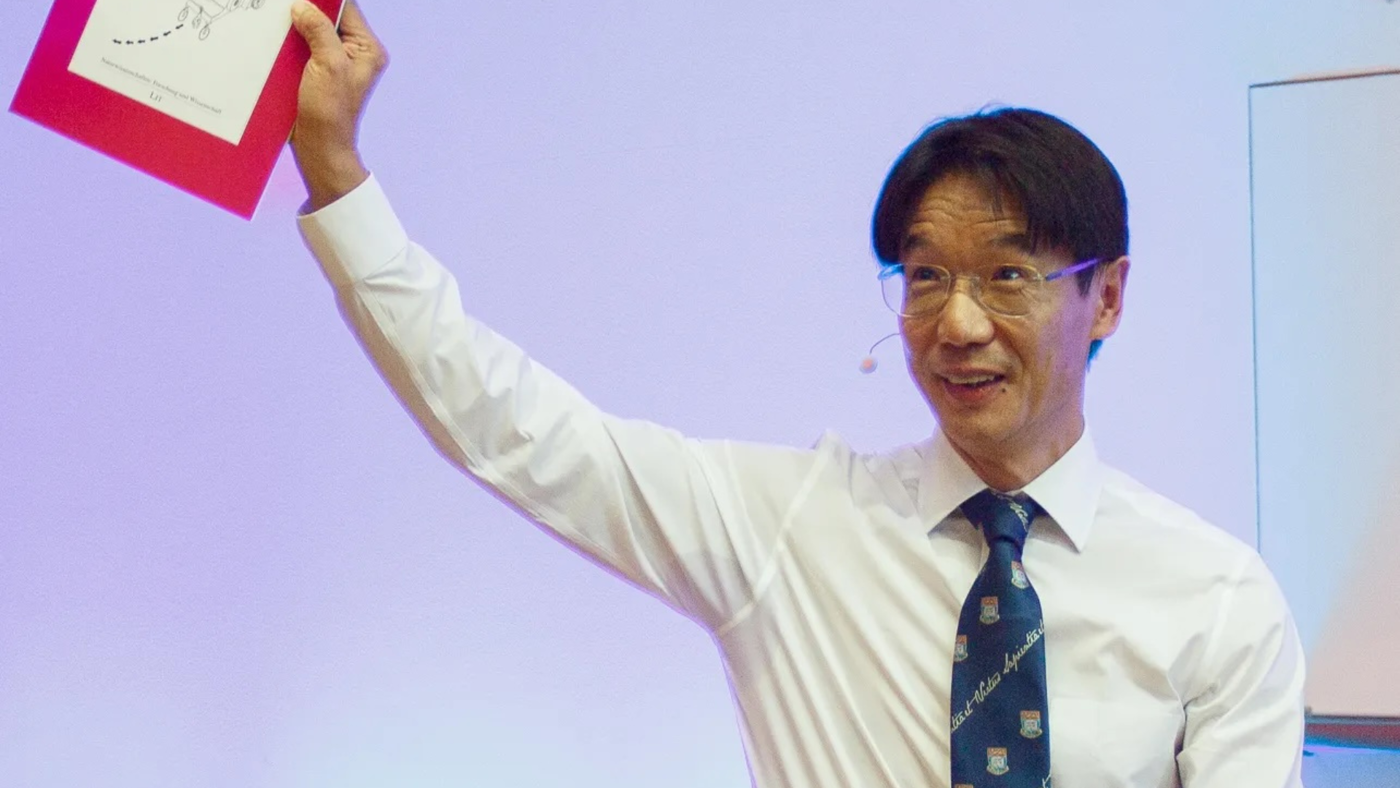
HKU Professor Xiao-Jing Wang, a theoretical physicist turned neuroscientist, has received the 2026 Valentin Braitenberg Award for Computational Neuroscience – one of the field’s top honours.
The award, presented by Germany’s Bernstein Network at its annual conference in Frankfurt on September 29, honours established scientists for outstanding contributions to the field. The selection committee cited Wang’s “enormous contributions across many subfields, from biophysics to computational psychiatry,” calling him "one of the most influential computational neuroscientists of his generation.”
Wang has spent decades building biologically grounded models of the prefrontal cortex that explain how neural circuits give rise to working memory and decision-making. Those models — rooted in the biophysics of individual neurons but scaled to capture the dynamics of large networks — have become standard frameworks in the field, informing work on both artificial intelligence and brain disorders.
His research helped establish computational psychiatry, an approach that uses mathematical models to connect disruptions in neural circuit function to symptoms of mental illness. He has published more than 100 papers, amassing over 56,000 citations, and in 2025 published Theoretical Neuroscience: Understanding Cognition, a textbook that synthesises the field's progress.
Wang earned his PhD in physics with highest distinction from the Université libre de Bruxelles in 1987 and has since mentored generations of researchers. He co-founded the Gordon Research Conference on the Neurobiology of Cognition and the Computational and Cognitive Neuroscience Summer School at Cold Spring Harbour Asia. He joined the University of Hong Kong as a Chair Professor with a joint appointment between the School of Computing and Data Science (CDS) and the School of Biomedical Sciences at the LKS Faculty of Medicine (HKUMed).
“I am honoured to receive the Valentin Braitenberg Award,” Wang said. “It is a recognition of all my former students, postdoctoral fellows, and collaborators — and a testament to the idea that basic and open science knows no borders.”
Related Topics
Related News