
HKU Today
Cho Tak Wong’s Journey from Factory Floor to University Founder
Why would the founder of a global automotive glass business establish a university?
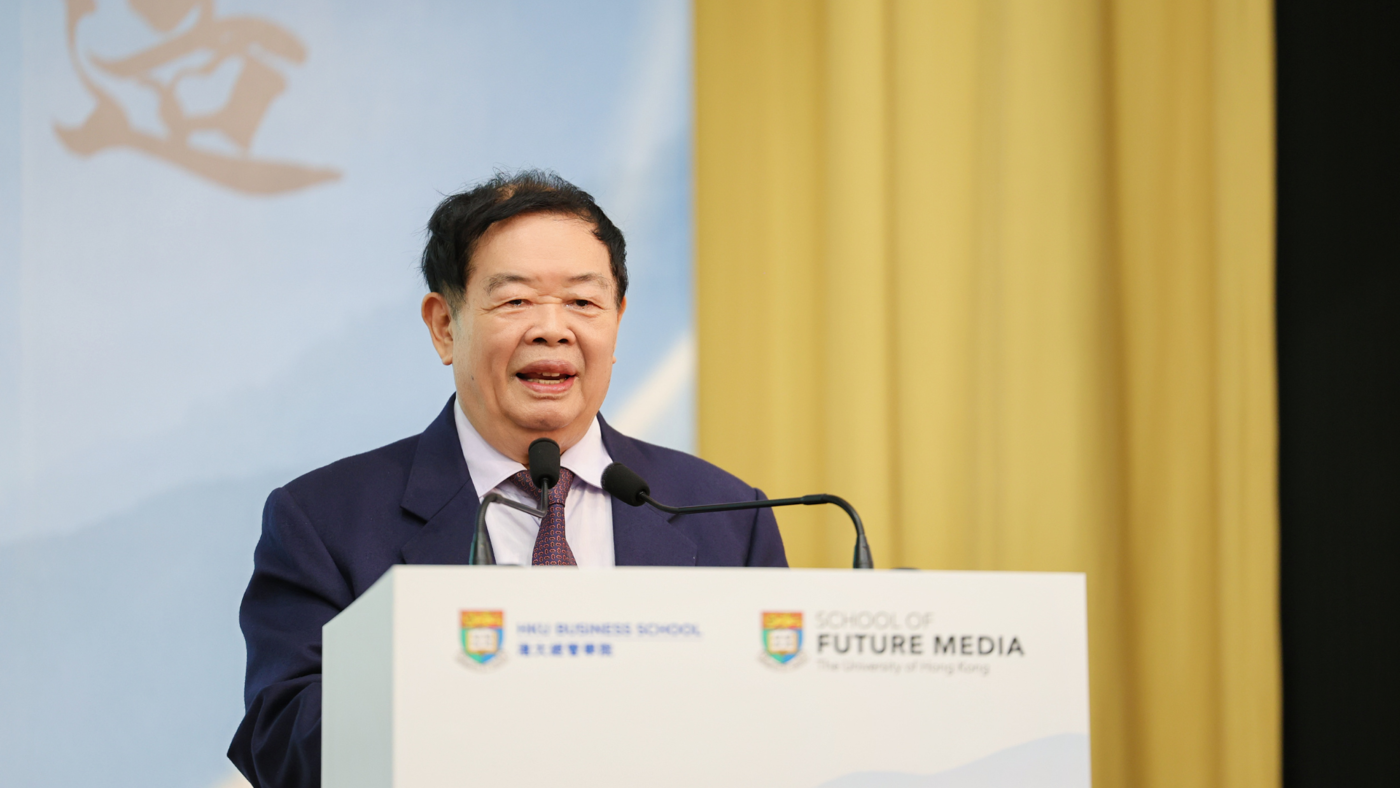
Mr Cho Tak Wong, founder of the Fuyao Group, believes China needs more highly skilled industrial talent.
Cho, also known as Cao Dewang, shared his thinking at the University of Hong Kong (HKU) on October 12 during “Chinese Manufacturing: Moving Forward Beyond Boundaries,” jointly organised by HKU Business School and the School of Future Media.
A university for the public good
The founder and Lifetime Honorary Chairman of Fuyao Group opened his keynote by recalling that he had not completed junior secondary school and had relied heavily on self-study. Yet decades spent developing an international manufacturing company had given him an interest in how universities in other countries nurture talent and innovation.
Cho cited leading American private universities, including Harvard and Stanford, which are heavily supported by philanthropists and businesspeople. He argued that Chinese entrepreneurs should likewise devote their private wealth to building educational institutions that serve society, rather than seeking profit.
This thinking underpins Fuyao University of Science and Technology, which Cho described as a nonprofit, public-interest institution.
Setting it up wasn’t easy. In his keynote, he discussed frankly the regulatory hurdles to establishing it.
Mr Cho has so far pledged RMB10 billion to the project but stressed that money alone was not the point.
His goal, he said, was neither fame nor simply another university. His larger aim is to explore a model of privately supported higher education that can contribute to institutional reform and meet evolving national needs.
That ambition has practical dimensions. Cho spoke about learning from Cambridge, where academics establish companies alongside students to develop research into products. Universities, he suggested, can give students experience of turning scientific ideas into useful technologies while also creating opportunities for research-led entrepreneurship.
Bringing the factory into education
In addition to translating research into innovation, Cho wants universities to have a more practical relationship with production. He explained that newly hired university graduates at Fuyao Group often spend around two years gaining workplace experience before assuming important responsibilities. Earlier industrial exposure during undergraduate studies, he believes, could reduce that transition.
“Let students understand factories, get to know them, and come to love them,” he said, describing the task he has set educators at Fuyao University.
The goal is to cultivate outstanding engineers who can address the production and technical challenges facing Chinese industry. Students should encounter real equipment and materials, observe manufacturing processes and understand how management decisions affect what happens on the factory floor.
Cho also challenged the image of factories as outdated or unattractive workplaces. Modern plants, he noted, can be highly automated and technologically advanced. Without firsthand experience, students may overlook engineering careers and opportunities for innovation.
During the audience question-and-answer session, participants raised the impact of artificial intelligence on universities and the mismatch between academic qualifications and employers’ needs. Cho did not outline a specific AI teaching model. Instead, he returned to his central proposal: bring undergraduates into factories before graduation so that learning and working are not separated by years of adjustment.
Profit with principle
Cho linked this educational mission to his approach to business. Asked why he had stayed with automotive glass while other industries offered bigger or more rapid returns, he invoked a traditional Chinese saying: “A gentleman may love wealth but must acquire it through proper means.”
Profitability is necessary, he explained, because a company must earn enough to survive, invest and improve its products. But profit should never come at the expense of legal obligations or sound judgement. He warned against financing long-term investments with short-term bank loans and stressed the importance of careful management.
Professor Zhenhua Mao, professor at HKU Business School noted Fuyao’s measured approach to expansion. Globally, Cho emphasised adapting to local laws and cultures, an approach also reflected in discussions of the documentary American Factory.
Now 80, Cho recently stepped down from his role as Chairman in Fuyao in favour of his son – making him one of many first-generation entrepreneurs in China navigating a generational transition.
When asked what entrepreneurs should pass on to their descendants, Cho placed wisdom and knowledge above money alone.
“I believe that what should be passed down is wisdom,” he said. “There is an old Chinese saying: ‘Do not seek to amass great wealth in gold and jade; rather, aspire for one's descendants to be virtuous and wise.’ Such virtue is far greater than mere material wealth. Therefore, what ought to be transmitted includes wisdom, knowledge, strength of character, and the values and traditions of the family.”
Related Topics
Related News