
HKU Around the World
‘We Can Discover New Species Every Day’: Dr Fabrice Not on the Microscopic, Mega-Impactful World of Plankton
Dr. Fabrice Not is a biological oceanographer and marine scientist based in France and the research Director for the French National Centre for Scientific Research (CNRS) and the Managing Director at the Roscoff Marine Station operated by CNRS and Sorbonne University.
There, he works on plankton – microscopic organisms that live in the water column of the ocean – and has contributed to foundational research in this field.
He is also a regular visitor to Hong Kong and HKU, teaching plankton biodiversity as guest lecturer at Integrative Marine Ecology and Conservation (IMEC) MSc, hosted by the Swire Institute of Marine Science (SWIMS).
HKU Lead asked Dr Not why studying microscopic organisms in the sea is important, and why he enjoys coming to HKU to teach.
Lead: What is plankton?
Dr Fabrice Not: It is a functional term and includes all the organisms that drift in the water but do not have the ability to swim against the main currents. Within plankton there are plant-like and animal-like organisms called phytoplankton and zooplankton. The vast majority of plankton are microscopic.
What is the importance of plankton?
Plankton is extremely important because it sustains the entire ecosystem. You can say that it is the foundation of marine ecosystem functioning.
How so?
Phytoplankton are plants. They produce oxygen and capture carbon dioxide via photosynthesis. Plankton contribute to oxygen production on our planet as much as plants on land do. Phytoplankton is also the base of the food chain. It is eaten by small animals – zooplankton, and then this food chain goes to fishes and everything else that we, humans, eat. Put simply – if there is no plankton, there can be no other life in the ocean.
What made you decide to study plankton, and not sharks or whales?
I have always been fascinated by things you cannot see, but have an impact. Unless you have the right tools to study them, you cannot see plankton, but without it, we cannot live! Also, large animals do not tell you much about how the ecosystem functions, what its foundation is, and this is what I am curious about.
One of my motivations is also to discover new things. In the microscopic world of plankton, we can discover new species every day. Sometimes, looking at plankton, you are the first human being to see these organisms. So much is still unknown, and this is fascinating.
How many planktonic species have you described?
We discovered a new lineage in the tree of life, which is a lot more than a new species.
We called this lineage Picozoa, publishing a paper in Science in 2007. Since then, people have been studying this lineage, describing different species, and showing their importance.
Where do you work?
Roscoff Marine Laboratory in France. It is one of the first marine labs in the world, founded 150 years ago. We do research in our back yard: the English Channel that separates France and the UK. But we also work all over the world, going on research vessels to the Pacific and the Atlantic to collect plankton samples. We ask questions such as: what is the biodiversity of plankton? How is this biodiversity distributed across the different oceans and across time?
What is the latest direction in plankton research?
We’re realising that most planktonic organisms can be both zooplankton and phytoplankton, depending on their environmental conditions, for example via algal symbiosis in zooplankton. This interdependence and interconnectedness of organisms is part of a new idea in ecology – of holobiont, meaning that no species on our planet is isolated, but depends on a consortium of several other species. This consortium is the unit that explains the health or success of a species.
The other thing is environmental genomics. It allows us to study hidden biodiversity such as the very small things which you cannot tell apart using their appearance, or organisms that are inside each other, such as symbionts or parasites. Environmental genomics allows us to “see” this hidden biodiversity through its genes. We extract DNA from the environment, and in this DNA all the species – small and large – are mixed together, giving you access to the hidden biodiversity. This tool is very powerful and is changing the way we are looking at our environment. It is particularly suited to the microscopic world of plankton.
What brings you to Hong Kong and HKU?
Last year I was invited to contribute to Integrative Marine Science and Conservation (IMEC) M.Sc. at the Swire Institute of Marine Science (SWIMS) at HKU. I really enjoy being here, teaching for 2 weeks. SWIMS has great facilities, and the location at Cape D’Aguilar is beautiful. It is a bit remote, but that is what makes being here amazing.
What do you teach?
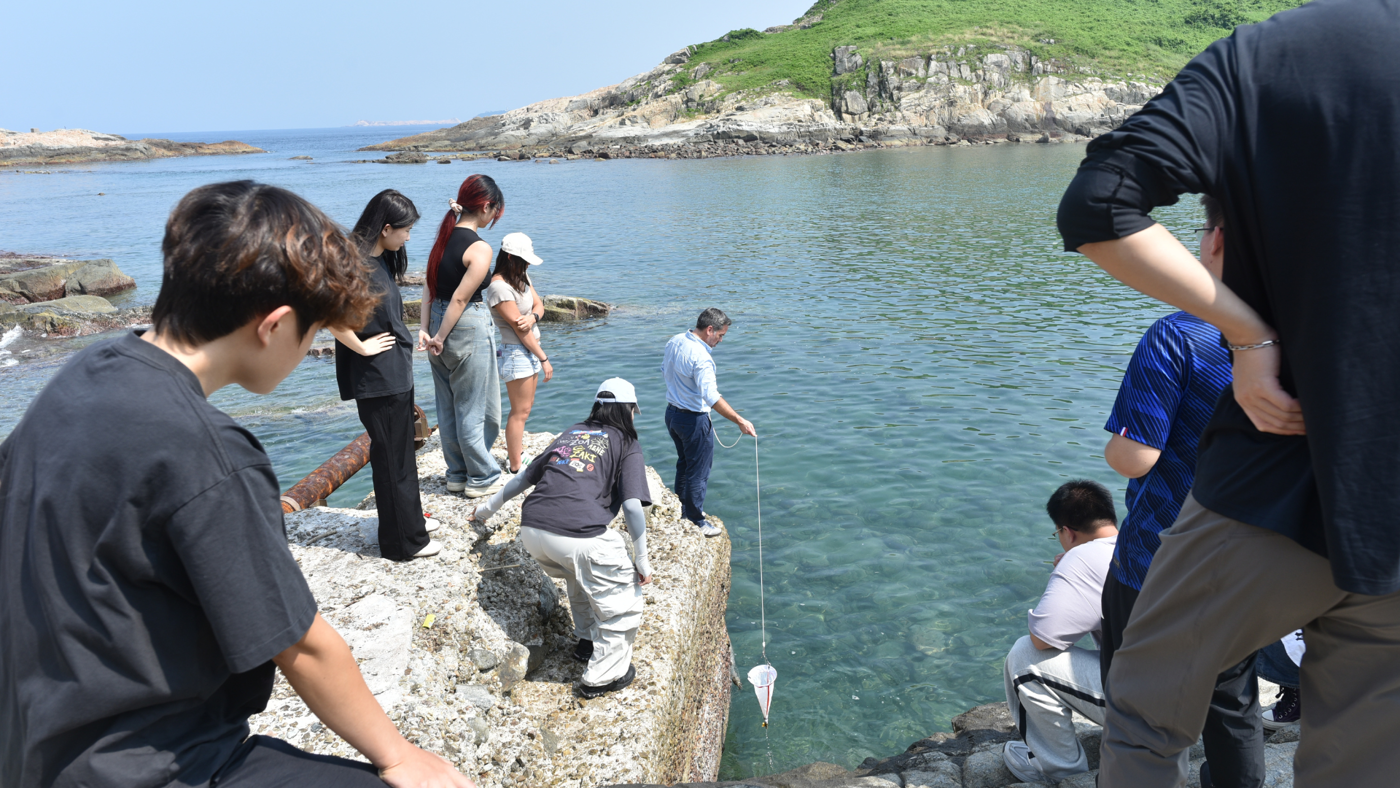
The importance of the small world, of plankton, to marine ecosystems. I teach the students the tools they need: microscopy, DNA methods, and how to collect and analyze plankton samples. I also teach a little about the legal framework around biodiversity, for example Biodiversity Beyond National Jurisdiction (BBNJ), a UN treaty signed this year.
Most of the curricula at university don’t teach the importance of the microscopic, microbial world in the ocean. But I think it is very important that people who in the future will manage protected areas, or work in aquaculture, are aware of it.
Finally, I am from Europe. Now, Asia – and China – are becoming very strong – a driving force in science. I am very happy to come to teach here and be part of it.
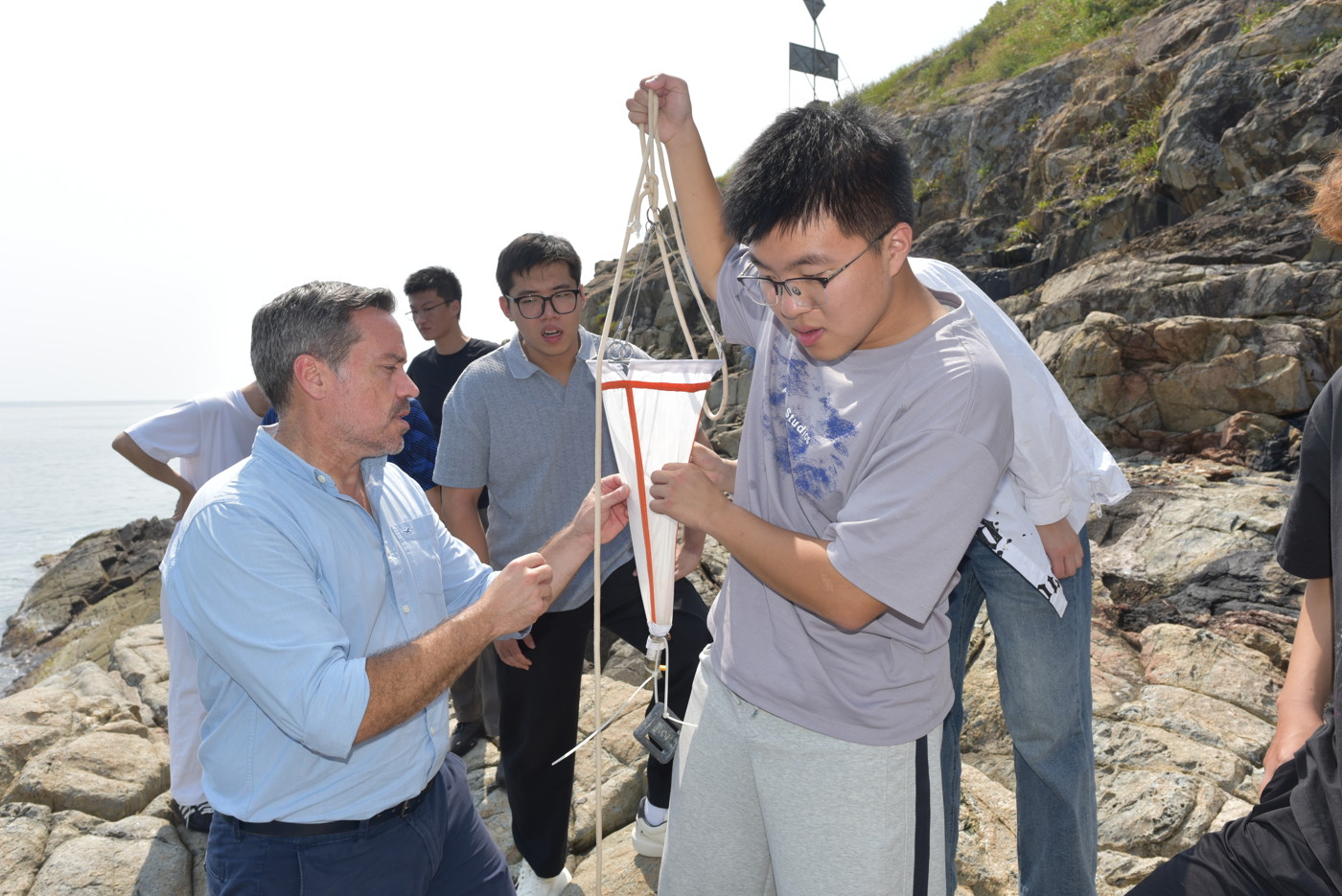
Dr. Not teaching IMEC students how to take samples using a plankton net. Image: The Swire Institute of Marine Science
Related Topics
Related News