
Newsroom
HKUMed reveals emerging Omicron variants better adapted to the human gut, with potential to spread beyond the respiratory tract
A research team from the School of Public Health at the LKS Faculty of Medicine, the University of Hong Kong (HKUMed), has discovered that emerging Omicron sublineages of SARS-CoV-2 use distinct biological strategies to spread and cause disease. Specifically, the XBB.1.5 and EG.5.1 variants are better adapted for respiratory spread and may pose a heightened risk of severe respiratory disease, while BA.2.86 and JN.1 tend to replicate more effectively in the intestines, potentially opening alternative transmission routes. This research highlights the importance of ongoing monitoring and functional characterisation of emerging strains to support public health planning and preparedness for future outbreaks. The findings were published in Nature Communications [link to the publication].
Since the emergence of Omicron variants, SARS-CoV-2 has continued to evolve into numerous sublineages. Scientists have found it increasingly difficult to determine whether differences in transmission and disease severity are caused by the virus itself or by existing immunity built up through vaccination or previous infections. To address this, the researchers conducted controlled laboratory experiments using models that closely mimic human tissues including human bronchial and lung tissues, airway organoids (miniature lab-grown models that resemble the human airway), and intestinal models, including proximal intestinal enteroids (miniature models of the small intestine) and colon cells. The researchers directly compared the intrinsic biological properties of Omicron variants ranging from BA.1 to JN.1 under the same experimental conditions to better understand their differences in infection, replication and transmission potential.
Four sublineages infecting respiratory tissues may increase risk of severe lung disease
The study found that several Omicron sublineages, including BA.5, BA.5.2.1, XBB.1.5 and EG.5.1, replicated efficiently in human respiratory tissues. This suggests that these variants are particularly effective at infecting and multiplying in the airways and lungs, which may facilitate person-to-person transmission and potentially increase the risk of severe lung disease. Among the variants studied, EG.5.1 showed particularly notable features.
Professor Michael Chan Chi-wai, from the School of Public Health, HKUMed, said, ‘EG.5.1 can enter human cells through two different pathways, making it easier to infect tissues. It also showed enhanced growth in alveolar epithelial cells, which are located deep in the lungs, suggesting a stronger ability to infect the lower respiratory system and potentially causing more serious illnesses.’ The researchers observed a similar pattern in XBB.1.5, which also replicated efficiently in respiratory tissues, indicating a high level of transmissibility.
JN.1 intestinal adaptation points to potential faecal transmission pathway
The study found that BA.2.86 and JN.1, in contrast, replicate less efficiently than EG.5.1 in respiratory tissues but demonstrated higher replication levels in proximal intestinal enteroids, suggesting that they are better adapted to infect and grow in certain parts of the intestine. Interestingly, this increased replication was not observed in colon cells, indicating that the virus may prefer specific regions within the intestines.
Another important finding is that JN.1 exhibits a stronger ability to infect and grow in gut tissues while triggering relatively low levels of inflammation. This combination suggests that the virus may persist in the gut without causing obvious symptoms, potentially increasing the possibility of transmission through faecal contamination. Professor Michael Chan commented, ‘The study highlights that while some variants are optimised for respiratory spread, others may be evolving to survive and multiply better in the gastrointestinal tract, which could influence how the virus spreads. The research also provides practical insights for laboratory studies, demonstrating that airway organoids are more reliable for studying how SARS-CoV-2 enters and infects human cells. The findings also suggest that the proximal intestine may be more relevant than the colon when investigating potential faecal transmission.’
The study emphasises that SARS-CoV-2 continues to evolve along different biological pathways, which could enable alternative transmission routes. Professor Michael Chan explained, ‘Since new variants can develop from existing lineages, like BA.2.86 and JN.1 evolving from BA.2, it is very important to continue to monitor and study these emerging strains. As immunity from vaccinations and previous infections can decline over time, understanding how these viruses evolve and behave will help inform public health planning and strengthen preparedness for future outbreaks.’
About the research team
The study was led by Professor Michael Chan Chi-wai, School of Public Health, HKUMed, with Professor Kenrie Hui Pui-yan, Assistant Professor, contributing as the first author. The research team members from the same School included Professor Malik Peiris, Emeritus Professor and Honorary Clinical Professor; Professor Leo Poon Lit-man, Daniel C K Yu Professor in Virology, Chair Professor of Public Health Virology; and Professor John Nicholls, Clinical Professor, Department of Pathology, School of Clinical Medicine, HKUMed.
Media enquiries
Please contact LKS Faculty of Medicine of the University of Hong Kong by email (medmedia@hku.hk).
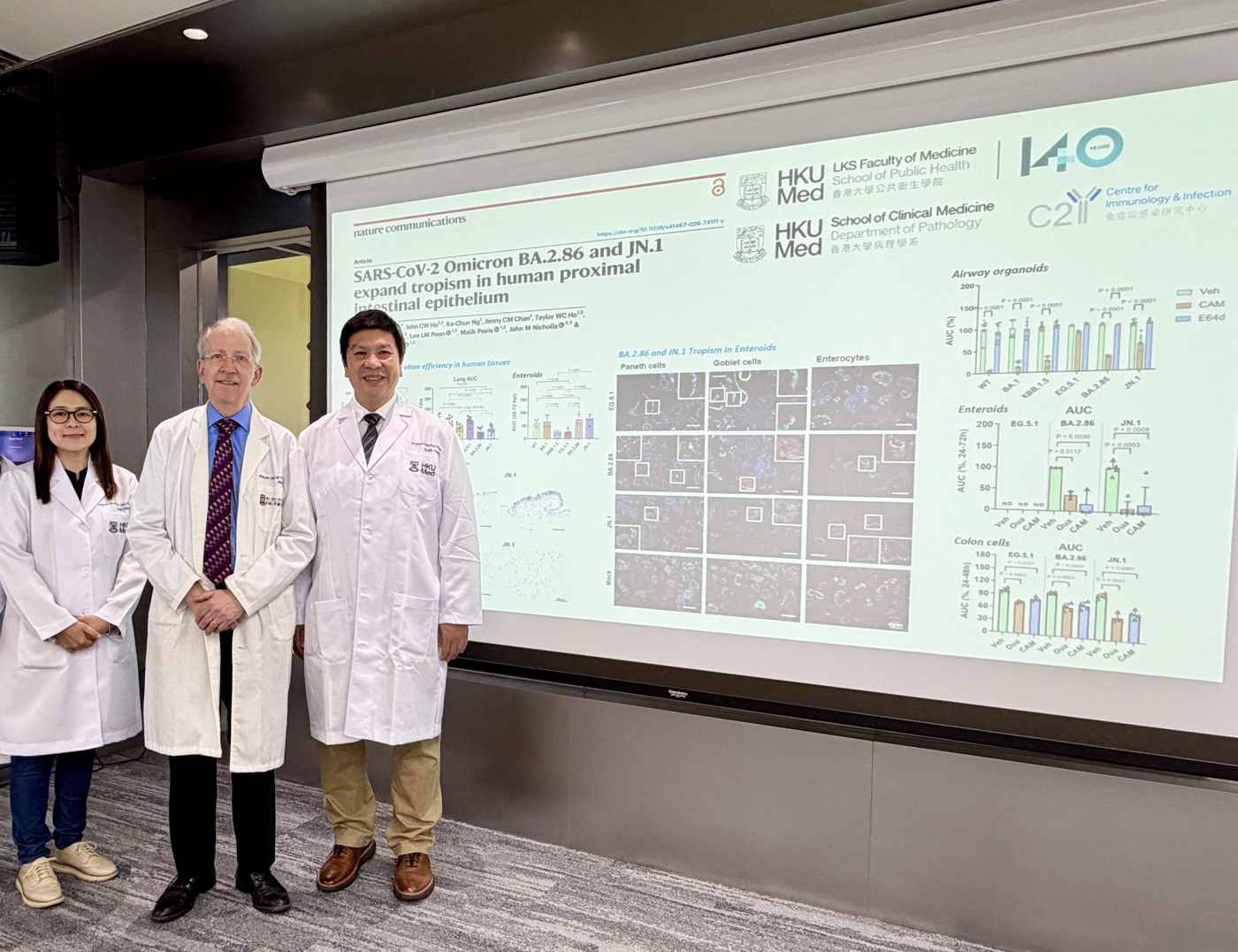
HKUMed researchers discover that some emerging Omicron variants are better adapted to the human gut, suggesting potential alternative transmission routes. The research team includes (from right): Professor Michael Chan Chi-wai, Professor John Nicholls and Professor Kenrie Hui Pui-yan.
Related Topics
Related News